
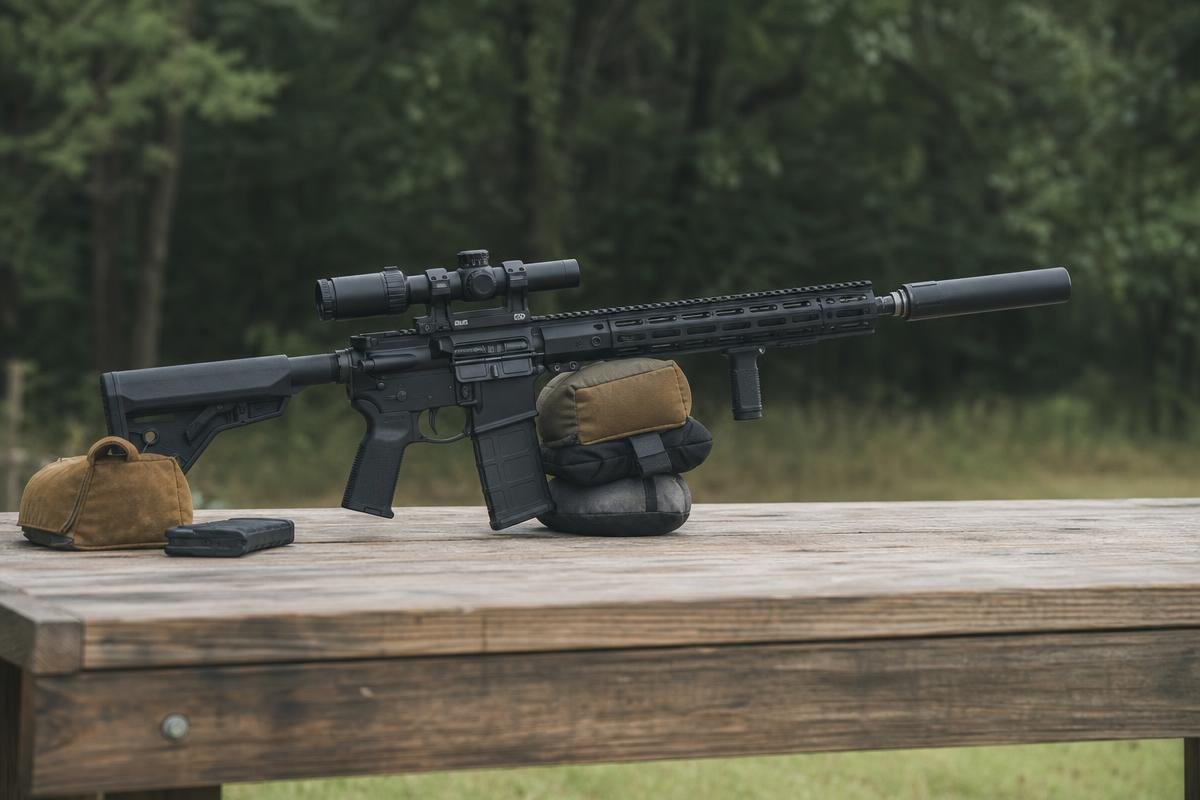
Choosing 300 blackout optics for a suppressed build starts with your ammunition, shooting distance, and compatible upper parts. Subsonic loads at close range demand different glass than supersonic rounds pushed to 200 yards across open ground. We are an online retailer shipping complete uppers, barrels, and parts for 300 Blackout builds from our Denison, TX facility. Our team can answer questions about upper parts and optic compatibility by phone or through our contact form.
Questions about upper parts for a suppressed 300 Blackout build? We can help you compare parts and check optic compatibility by phone or through our contact form.
Key Takeaways
- The best optic choice depends on whether your 300 Blackout runs subsonic, supersonic, or both.
- An LPVO paired with an offset red dot gives you true 1x close-quarters speed plus magnification for longer shots.
- Red dots excel on dedicated subsonic suppressed builds where shots stay inside 100 yards.
- Barrel length, gas-system setup, and optic mounting geometry should be evaluated separately when configuring a 300 Blackout rifle.
- Mounting height, tube diameter, and reticle type all change how a suppressed rifle handles in the field.
300 Blackout Optics for Suppressed Builds: Red Dot or LPVO?
For dedicated subsonic builds shooting inside 100 yards, a red dot is the better choice. For dual-use supersonic and subsonic builds, an LPVO or an LPVO-plus-offset-red-dot combo is more versatile. The optic you mount should match the ammunition you run and the distances you actually engage, and those two variables settle most of the decision before price ever enters the conversation.
Where Red Dots Win
Subsonic 300 Blackout loads, typically 208-grain projectiles running around 1,000 fps, have substantial drop at longer distances. Inside 100 yards, a red dot is the right tool. Target acquisition is faster, eye relief is unlimited, and that matters when a suppressor shifts the rifle's balance point forward. The Aimpoint Micro T-2 and the Trijicon MRO are both established choices for this role at different price points. Neither adds more than 3 to 4 ounces to your setup.
For close-range shooting with subsonic loads, a red dot offers a light, fast sight picture inside 100 yards.
Where LPVOs Win
Switch to supersonic loads, 125-grain at roughly 2,200 fps, and the rifle reaches out to 300 to 400 yards effectively. At that range, you need magnification to place shots on steel or game. A 1-6x or 1-8x LPVO covers that gap. The Vortex Strike Eagle 1-6x24 is an accessible starting point. The Vortex Viper PST Gen II 1-6x steps up in glass quality. The Vortex Razor HD Gen II-E 1-6x is the premium end of that range. For longer-range shooting, those extra yards matter.
The weight penalty is real. Most LPVOs run 16 to 22 ounces before you add a mount. That is four to six times the weight of a comparable red dot.
The Core Trade-Off
| Factor | Red Dot | LPVO | Combo |
|---|---|---|---|
| Weight | 3 to 4 oz | 16 to 22 oz | 20 to 26 oz |
| Max Effective Range | 100 yards (subsonic use) | 300 to 400 yards | 300 to 400 yards |
| Target Acquisition Speed | Fastest | Fast at true 1x | Fastest (offset dot) |
| Market Position | Midrange to premium | Budget to premium | Premium dual-optic setup |
A true 1x LPVO is fast, but it is not identical to a parallax-free red dot at close range. If your build lives in the woods and runs subsonic loads, a red dot wins. If you run both load types on the same property, the LPVO or a combo setup earns its weight. Pair your optic choice with the right 300 Blackout upper and the decision gets easier from there.
Best Red Dots for a Suppressed 300 Blackout AR-15
A suppressed host with a short barrel and a subsonic load is a close-to-mid-range tool. Red dots match that role well. They stay light, they stay fast, and they do not add the mount height or eye-box constraints that an LPVO does. The three optics below cover the main price tiers and use cases for suppressed builds. If you are still deciding between a red dot and a magnified optic, the comparison above covers that trade-off. For specific red dot options, start here.
Aimpoint Micro T-2
The T-2 is the benchmark because it survives conditions most builds never see. The 2 MOA dot runs on a CR2032 battery for up to 50,000 hours on setting 7, and it offers 12 brightness settings including four night-vision-compatible positions. Those settings can be useful for low-light range use where permitted.
At 3.7 ounces without a mount, it does not meaningfully change the balance of your 300 Blackout upper. Pricing varies by retailer. It is the right answer if the rifle is a working tool, not a range toy.
Holosun 510C and 507C
The 510C gives you a 2 MOA dot, a 65 MOA circle, or both, with solar failsafe backup and a CR2032 battery rated at 50,000 hours. The 507C is the compact version at 1.6 ounces, no circle reticle, same battery life. Both are generally positioned below the T-2 in price. For a budget-conscious suppressed build used primarily at the range, either Holosun is a practical choice. The T-2 is more durable by spec, but the Holosun keeps the build cost reasonable without giving up meaningful field performance.
EOTech EXPS3
The EXPS3 runs a holographic reticle: a 68 MOA ring with a 1 MOA center dot. That reticle does not bloom under a 3x magnifier the way a standard red dot can, which matters if you plan to run a magnifier behind it for the occasional longer shot on open ground. The EXPS3-0 variant is night-vision compatible. Parallax-free at 100 yards, 0.5 MOA per click. Pricing varies by retailer. It is heavier than the Aimpoint Micro, but the holographic reticle gives it a real functional edge if a magnifier is already in your plans.
Best LPVOs for a Suppressed 300 Blackout AR-15
A dual-purpose 300 Blackout rifle running both supersonic and subsonic loads needs an optic that handles close-range transitions without giving up holdover accuracy at distance. These four options cover the range from best budget LPVO for AR-15 builds up through premium glass, with specs that match real-world use cases. Match your LPVO choice to the intended use of your AR-15 complete uppers before you buy.
Vortex Strike Eagle 1-6x24
The Strike Eagle runs a second focal plane BDC reticle, weighs 20.1 oz, and delivers 3.5 inches of eye relief at 6x. Pricing varies by retailer. The glass is adequate for supersonic work out to 300 yards, which covers most open shots on North Texas pasture. Past that, the SFP reticle loses accuracy at intermediate magnification settings, and the glass shows its limits. This is an entry point for variable magnification without moving into premium pricing.
Vortex Viper PST Gen II 1-6x
The Viper PST Gen II uses a second focal plane VMR-2 reticle in either MRAD or MOA, weighs 22.7 oz, and pricing varies by retailer. Its reticle subtensions are calibrated at maximum magnification, so holdovers are not valid at every setting. For a shooter running supersonic loads at distance, that distinction is not abstract. It is the difference between a confident 200-yard holdover and a guess.
This is the best LPVO for 300 Blackout suppressed builds where the shooter wants real precision without premium pricing.
Vortex Razor HD Gen II-E 1-6x
The Razor HD Gen II-E weighs 21.5 oz, uses an APO optical system, and is offered with JM-1 BDC or VMR-2 reticles. Pricing varies by retailer. The glass quality is a genuine step above the Viper, and the true 1x makes close-range transitions faster. If you will not compromise on glass and want a suppressed host that performs at both ends of the magnification range, the price premium is justified. Pair it with a Geissele Super Precision mount for zero retention under suppressor recoil. Mount selection and zero considerations appear below.
1-8x Options and When to Step Up
Quality 1-8x models generally cost more than entry-level 1-6x options and typically weigh 24 to 28 oz. That extra weight and the tighter cheek weld requirement make sense when the build is primarily a subsonic suppressed host that occasionally needs more reach than 6x allows. If your range sessions stay under 300 yards, a 1-6x is the better choice. If you are shooting longer supersonic strings on open ground, the added magnification earns its weight.
The LPVO Plus Offset Red Dot Combo: When You Need Both
Why Suppressed 300 Blackout Shooters Run This Setup
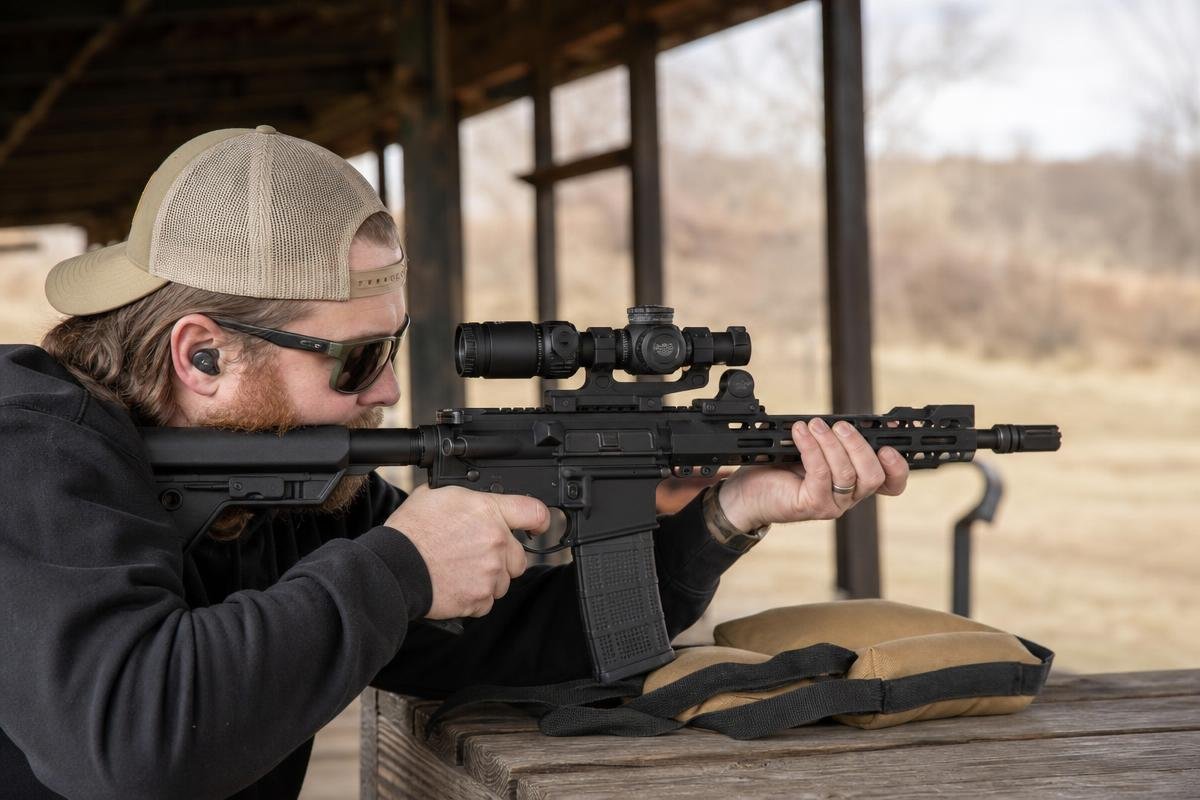
The suppressed 300 Blackout platform pulls double duty in a way most calibers do not. Subsonic loads at under 50 yards in tight timber, then a supersonic follow-up shot across an open field at 200 yards or more. That range gap is exactly why the LPVO plus offset red dot combo exists as a serious configuration, not a range toy. Keep the LPVO dialed to 4x or 6x for distance work. Roll the rifle 45 degrees and the offset dot is on target in under a second for close shots. The combo is a practical answer when shooting distances vary.
If you are still weighing whether an LPVO or a standalone red dot fits your build better, the red dot versus LPVO comparison above covers that trade-off without repeating it here.
Choosing the Right Offset Mount Angle: 45-Degree vs. Top-Mounted
A 45-degree offset mount, such as the Arisaka Defense offset or the Unity Tactical FAST mount, positions the dot at a cant so you rotate the rifle to access it. A top-mounted or piggyback setup, like a Trijicon RMR sitting on a Larue or Geissele top rail, keeps the dot co-witnessed directly above the LPVO without any cant required. The mechanical difference matters on a suppressed build. Top-mounted setups add height and forward weight.
The 45-degree offset keeps total system weight lower and does not interfere with suppressor-driven bolt timing, which affects how the rifle tracks under the optic. Understanding how your AR-15 BCG selection affects suppressor-driven bolt timing is worth reviewing before you finalize your mount choice. For suppressed 300 Blackout, the 45-degree offset is the more common and practical choice.
Recommended Offset Red Dot Pairings
Three pairings cover most budgets and use cases. The Aimpoint Micro T-2 on an Arisaka 45-degree mount is the gold standard. It is built for rugged use, designed to minimize parallax, and rated for extended battery life. The Holosun 507C on a Unity Tactical FAST mount typically costs less and is a strong choice for a budget-conscious build without sacrificing meaningful performance. Shooters already running Trijicon glass on the LPVO side often pair a Trijicon RMR Type 2 at 3.25 MOA on a 45-degree mount to keep the system consistent. All three work with a complete 300 Blackout upper ready to drop onto your lower. Pick the pairing that matches your budget and the glass already on the rifle.
Not sure which offset red dot fits your suppressed rifle? Our team can help you compare mount angle, height, and reticle choices. Call us at (888) 706-0633 and we will point you in the right direction.
Mount Selection and Zero Considerations for Suppressed Builds
Why Suppressor Recoil Impulse Demands a Quality Mount
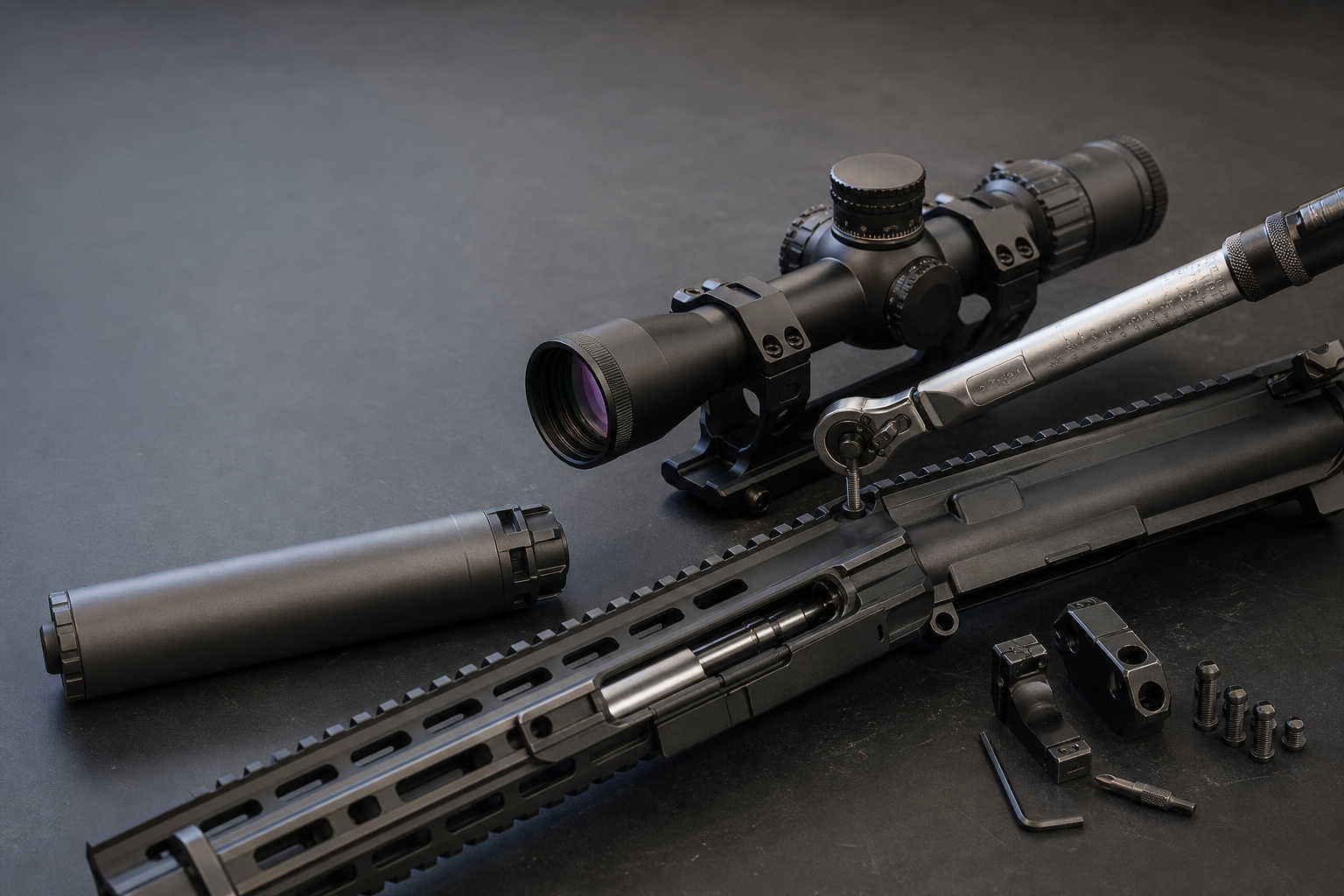
A suppressor adds 12 to 24 ounces to the muzzle end and changes the recoil character from a sharp snap to a longer, rolling push. That sustained impulse cycles back through the upper receiver and directly into your optic mount. Cheap QD mounts can shift zero under that repeated pressure, and you may not notice until your groups open up at the range.
Geissele Super Precision and LaRue Tactical LT104 mounts use torque-to-spec locking mechanisms that hold zero across thousands of suppressed rounds. Torque the mount and ring hardware only to the manufacturer's specified values. Under-torquing can cause problems on suppressed builds.
Gas system length also affects how much back-pressure cycles through the bolt carrier, which directly loads the mount; if you want to understand that relationship, the guide on how to choose the right gas system length for your AR-15 covers it in detail.
Recommended Mount Heights for Suppressed 300 Blackout
For red dots on a flat-top AR-15, a 1.54-inch lower one-third co-witness height is standard. For LPVOs, a 1.54-inch centerline is common, while a 1.93-inch mount provides a taller, heads-up position. On suppressed builds with longer handguard configurations, some shooters find the suppressor body creeps into the sight picture at lower mount heights. A taller mount may improve sight-picture clearance, but any mount change requires a fresh zero check.
Zeroing Your LPVO or Red Dot on a Suppressed Host
Zero suppressed if you plan to shoot suppressed. Point-of-impact shift between suppressed and unsuppressed fire runs 1 to 3 MOA depending on suppressor design and load. That is a 1- to 3-inch error at 100 yards, which matters for accuracy at that distance. Confirm your point of impact after any change in suppressor or load.
A practical dual-zero approach for this caliber: run a 50-yard zero for subsonic 208-grain loads and a 100-yard zero for supersonic 125-grain. If your 300 Blackout upper will see both load types, keep a written dope card and know which zero is dialed before you pull the trigger.
Building Your Suppressed 300 Blackout Upper Around Your Optic Choice
Your optic and your upper are a system decision. Barrel length, gas system, and handguard all affect which optic makes sense, and locking in those specs together saves you from rebuilding later.
Barrel Length and Gas System Considerations
Yes, barrel length changes which optic makes the most sense. A 9-inch or 10.5-inch host running subsonic loads through a pistol-length gas system is a CQB tool. That configuration pairs with a red dot or an LPVO-plus-offset setup, not a magnified optic you plan to dial past 4x. A 16-inch barrel with a carbine-length gas system handles supersonic loads well and gives you a real reason to run a 1-6x or 1-8x LPVO across the full magnification range. Browse our 300 Blackout barrel options to match barrel length to your intended use before you commit to an optic.
Handguard Length and Rail Space for Your Optic Setup
A 15-inch free-float M-LOK handguard gives you room to mount an offset red dot, a pressure switch, and a light without crowding anything. On a short-barreled host, a 10-inch handguard limits your options fast. M-LOK keeps weight down and lets you place accessories exactly where you need them without running full-length Picatinny rail. Our 300 Blackout uppers are assembled, headspaced, and function-checked in-house, ready to drop onto your lower with the handguard length already matched to your barrel.
Ready to buy a complete 300 Blackout upper matched to the optic you just chose? Ours ship assembled, headspaced, and function-checked from our Denison, TX facility.
Optic Compatibility Help for Suppressed Builds
We are an online retailer shipping nationwide from our Denison, TX facility at 4000 Texoma Pkwy, Denison, TX 75020. For upper parts and optic compatibility advice, call us at (888) 706-0633 or use our contact form.
Suppressed 300 Blackout setups can serve different shooting distances. Shooters using subsonic loads at close range may prefer a red dot or low-power variable at 1x. Supersonic loads at longer distances can benefit from 4x or 6x magnification. A quality LPVO handles both without swapping glass.
Frequently Asked Questions
What is the best red dot for a suppressed 300 Blackout build?
The Aimpoint Micro T-2 is the benchmark. It is rated for extended battery life and built for rugged use. The Holosun 507C runs NV-compatible brightness settings and holds up well at roughly one-third the price. Either way, prioritize a mount rated for suppressor recoil impulse, not a standard rifle mount.
Can you run an LPVO on a suppressed 300 Blackout?
Yes, and it is common for shooters running supersonic loads past 150 yards. Only first focal plane (FFP) scopes maintain reticle holdover subtensions at every magnification. The featured Vortex Strike Eagle and Viper PST Gen II are second focal plane (SFP), with reticle holdovers calibrated at maximum magnification.
Does a suppressor shift point of impact with an LPVO or red dot?
Expect 1 to 3 MOA of shift depending on suppressor design and load. Zero with the suppressor attached if you plan to shoot suppressed consistently. Running a dual-zero is an option, but it adds complexity in the field.
What is a good budget LPVO for an AR-15?
The Vortex Strike Eagle 1-6x24 is a solid budget-oriented starting point, with pricing that varies by retailer. Its SFP BDC reticle works well for supersonic loads inside 300 yards. It is not FFP, so holdovers are only accurate at 6x, but for a budget build that is a reasonable trade-off.
Do I need a special mount for a suppressed AR-15 build?
A quality mount matters more on a suppressed rifle than a standard one. Suppressor recoil is a longer, rolling push that walks zeros on cheap QD mounts over time. A Geissele Super Precision or LaRue LT104 is worth the investment.
What magnification is best for 300 Blackout at 200 yards?
Four to 6x is enough for supersonic loads at 200 yards. A 1-6x dialed to 6x gives a clear sight picture for a 6-inch target at that distance under field conditions. You do not need a 1-8x or higher for a 200-yard target with supersonic loads.
Ready to spec your suppressed upper around the optic you just chose? We have 300 Blackout uppers assembled, headspaced, and function-checked in-house, plus barrels for your build. Orders ship from our Denison, TX facility. Call us at (888) 706-0633 with questions about optic compatibility, barrel length, or handguard configuration.
Ready to Get Started with AR15Parts.com?
Call (888) 706-0633 to speak with our team about upper parts and optic compatibility, or use our contact form. We can help you compare available parts for a suppressed 300 Blackout build and answer compatibility questions before you order.