
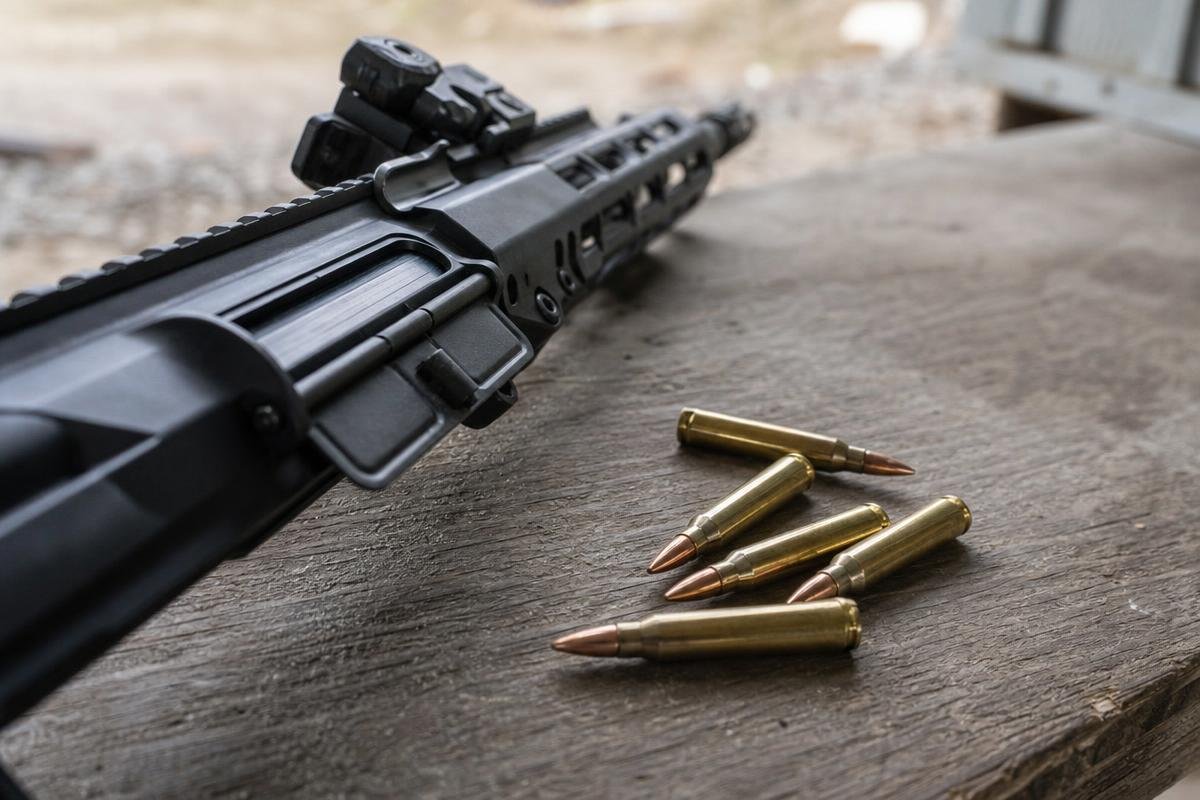
5.56 NATO ballistics are more than a single velocity number. Muzzle energy, bullet drop, terminal performance, and wind drift all shift depending on barrel length, grain weight, and load selection. The sections below cover pressure, velocity, trajectory examples, and grain-weight selection, so you can make informed choices about your build.
We ship complete 5.56 uppers and barreled components nationwide from our Denison, TX facility, so the ballistic figures below are not just table data to us. They address common questions about matching uppers, barrels, and ammunition to specific uses. Need help matching a 5.56 upper to your range requirements? We can point you in the right direction.
Key Takeaways
- 5.56 NATO velocity varies by barrel length, load, chamber, and test conditions, so use load-specific data rather than a universal per-inch rule.
- SAAMI lists .223 Remington at a 55,000 psi maximum average pressure. 5.56 NATO data uses a different test protocol and should not be compared directly with SAAMI figures.
- Grain weight selection affects terminal performance: 55 gr M193 and 62 gr M855 behave differently at distance and in different twist-rate barrels.
- Bullet drop and wind drift become meaningful factors past 300 yards, especially on the open ranges around the Red River where consistent crosswinds are the norm.
How Barrel Length Changes 5.56 NATO Muzzle Velocity
The Velocity Reference Table
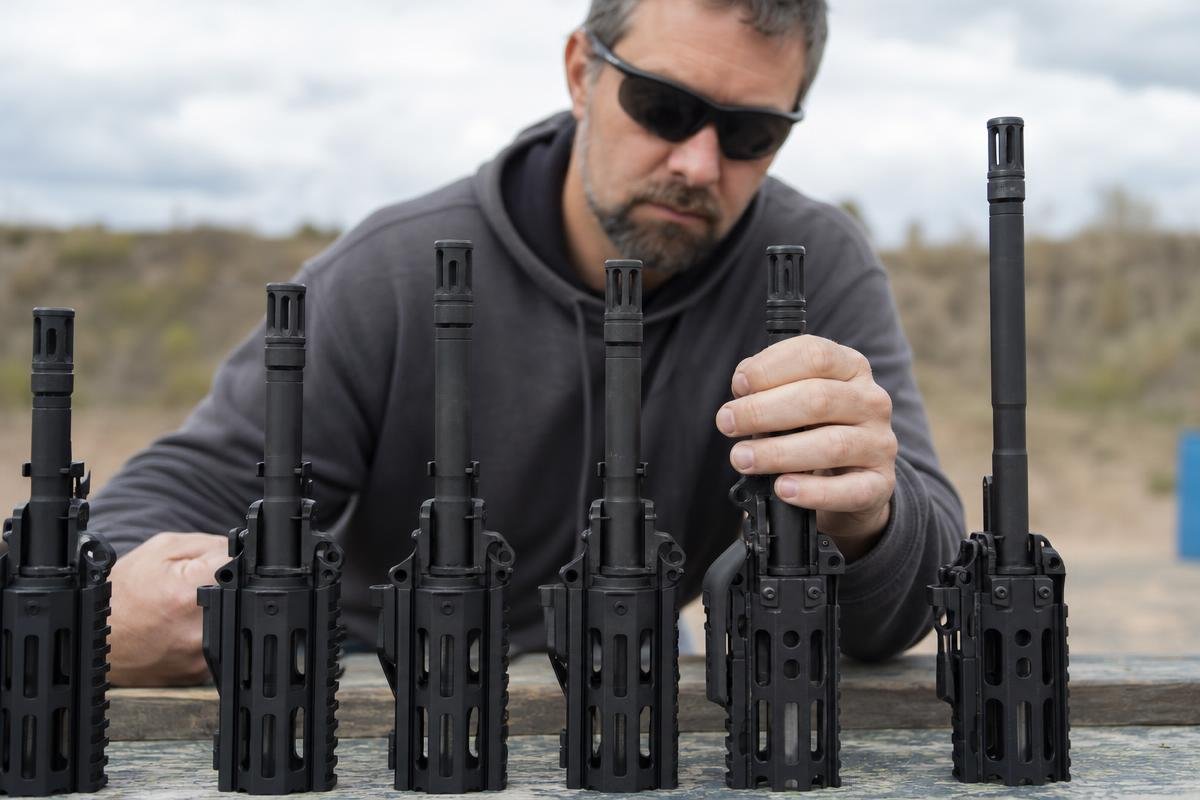
The figures below use 55 gr M193 as the baseline. All numbers are approximate and vary by ammo lot, chamber, and atmospheric conditions.
| Barrel Length | Gas System | Approx. Muzzle Velocity |
|---|---|---|
| 10.5 in | Pistol | ~2,700 fps |
| 14.5 in | Carbine / Mid | ~2,900 fps |
| 16 in | Mid / Rifle | ~3,050 fps |
| 20 in | Rifle | ~3,250 fps |
Going from a 20-inch barrel to a 16-inch costs roughly 200 fps. Dropping to a 10.5-inch costs another 350 fps on top of that. Those are not rounding errors. They change what the bullet does at the target.
Why Velocity Loss Matters Past 200 Yards
Fragmentation and expansion thresholds vary by projectile design, impact velocity, and test conditions. Use the ammunition manufacturer's terminal-performance data for the exact load and barrel length rather than applying one threshold to every 5.56 projectile.
On the open ranges around Grayson County, where 10 to 20 mph crosswinds are common, velocity also determines how much wind drift compounds. Slower bullets drift more. That matters at 200 yards and beyond.
Choosing Barrel Length for Your Build
Match the barrel to the role. A 10.5-inch makes sense for close-quarters work where compact size outweighs velocity loss. A 14.5-inch barrel balances compact dimensions and velocity for some configurations, subject to current legal requirements. A 16-inch is the civilian sweet spot: no SBR registration for a standard rifle configuration, reliable gas system function, and enough velocity to hold onto that same 2,700 fps fragmentation window out past 150 yards. A 20-inch maximizes velocity and precision at distance.
For a general-purpose build in this part of the country, the 16-inch is hard to argue against. We stock complete 5.56 NATO uppers and ship them nationwide, or you can check our selection of AR-15 barrels in multiple lengths if you are building from scratch.
5.56 NATO vs. .223 Remington: Chamber Pressure and Why It Matters
Pressure Standards and Test Methods
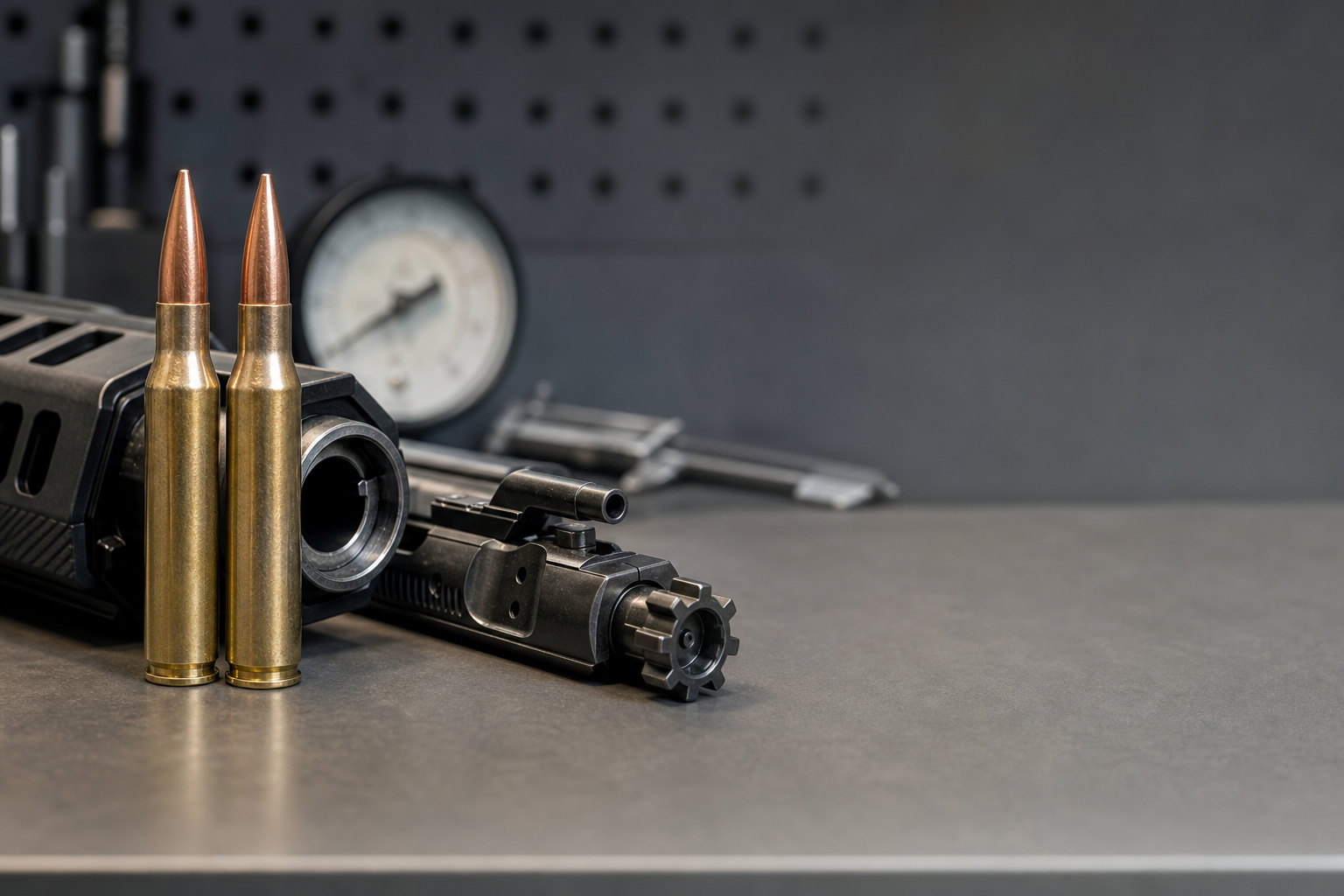
These cartridges look similar, but ammunition compatibility depends on the chamber marking and manufacturer specifications. SAAMI lists .223 Remington at a 55,000 psi maximum average pressure. 5.56 NATO data comes from NATO test methods that use a different protocol and should not be compared directly with SAAMI figures.
Chamber Spec: 5.56 NATO vs. .223 Remington vs. .223 Wylde
Pressure numbers alone do not tell the full story. The more critical difference is the leade, which is the distance between the case mouth and where the rifling begins. 5.56 NATO chambers have a longer leade, or throat, than .223 Remington SAAMI chambers. When you fire 5.56 NATO ammo in a .223 Rem chamber, the bullet contacts the rifling sooner than it was designed to. That compresses pressure faster and spikes it higher than the chamber was built to handle. That is a real safety concern, not a theoretical one.
Three chamber options exist for AR-15 builders. The .223 Remington chamber is the tightest. It delivers good accuracy with match .223 loads but should not run 5.56 NATO ammo. The 5.56 NATO chamber accepts both cartridges safely, though the longer leade can reduce precision with match-grade .223 ammunition. The .223 Wylde is a hybrid. It uses the freebore angle of a .223 Remington chamber for accuracy, paired with the leade length of a 5.56 NATO chamber for safe pressure handling.
If you buy ammo in bulk and end up with mixed 5.56 and .223 stock, which is common for high-volume shooters, the .223 Wylde is the practical answer. Our .223 Wylde complete uppers are built to handle both without compromise.
What This Means for Your Upper Receiver
Check the barrel marking before you change ammo types. A barrel or upper stamped "5.56 NATO" accepts both cartridges. One stamped ".223 Rem" runs .223 Remington only. One stamped ".223 Wylde" gives you the best of both. If the marking is worn or missing, treat it as a .223 Rem chamber until you confirm otherwise. When in doubt, contact us before running hot 5.56 loads through an unknown chamber.
M193 vs. M855: Which 5.56 Load Do You Actually Need?
M193 is a 55 grain full metal jacket load optimized for velocity-driven fragmentation above roughly 2,700 fps. M855 uses a 62 gr projectile with a steel penetrator tip, offers modest improvement over M193 on light barriers, and is best stabilized by 1:7 to 1:9 twists; it is not armor piercing. They are not equivalent in terminal behavior, and the load you run should match your barrel twist rate and intended use. Understanding M193 vs M855 ballistics keeps you from buying the wrong ammo for your build.
M193: 55 Grain FMJ at 3,250 fps
M193 is a 55 grain full-metal-jacket boat-tail loaded to approximately 3,250 fps from a 20-inch barrel. From a 16-inch barrel, expect closer to 3,050 fps. Terminal performance depends on velocity-driven fragmentation. Above roughly 2,700 fps, the bullet fragments aggressively on impact. Below that threshold, it behaves like a standard FMJ and punches through without reliable expansion.
This makes M193 a strong choice for varmint work and high-volume training. It is widely available as bulk ammunition. For home defense, choose a purpose-built defensive load with terminal performance tested from your barrel length rather than relying on bullet style alone.
M855: 62 Grain Steel-Penetrator at 3,025 fps
M855 uses a 62-grain projectile containing a steel penetrator component and a lead core. Muzzle velocity from a 20-inch barrel is approximately 3,025 fps. Its construction was designed for specific military performance requirements, but barrier results depend on the exact material and test protocol. It does not improve terminal fragmentation. At equivalent velocities, M855 fragments less reliably than M193. It is not a defensive load. For light-barrier performance or military-spec compatibility, M855 may fit the role. For general-purpose or defensive use, it is not the better option.
Twist Rate and Load Compatibility
A 1:9 twist barrel handles 55 to 69 grain bullets reliably. A 1:8 twist is the most versatile, stabilizing everything from 55 to 77 grains. A 1:7 twist, the original M16A2 spec, is optimized for 62 grain and heavier projectiles including M855 and tracer rounds. Running 55 grain M193 through a 1:7 barrel is not a problem. Overstabilization is rarely a practical concern for lighter bullets at these velocities. A 1:9 barrel, however, may not reliably stabilize 77 grain match bullets.
Not sure which twist rate matches your grain weight? Browse our 5.56 NATO uppers and AR-15 barrels to compare available twist rates and we'll help you match the build to the loads you actually shoot.
If you are unsure which twist rate your current or planned barrel runs, browse our AR-15 barrels to compare available twist rates to match your build to the loads you actually shoot.
5.56 NATO Energy and Drop: What the Numbers Look Like Downrange
Muzzle Energy and Retained Energy at Distance
A 55 gr M193 load leaving a 20-inch barrel at 3,250 fps carries roughly 1,290 ft-lbs of muzzle energy. By 100 yards that number drops to around 1,000 ft-lbs. At 300 yards you're looking at approximately 600 ft-lbs, and by 500 yards you're down near 400 ft-lbs. The 62 gr M855 starts close to 1,260 ft-lbs at the muzzle but holds energy slightly better at distance because of its higher ballistic coefficient.
Swap to a 16-inch barrel and the 55 gr load opens at closer to 1,130 ft-lbs, with that gap widening at every distance marker beyond 200 yards. Barrel length matters. If you want to see how barrel length affects muzzle velocity before you buy, browse our AR-15 barrels in a range of lengths and twist rates.
Bullet Drop at 100, 200, 300, and 500 Yards
Trajectory depends on the exact load, measured muzzle velocity, ballistic coefficient, sight height, atmospheric conditions, and zero. Run the named load through a current ballistic calculator before publishing or relying on specific holdovers. A 50-yard zero may create a second intersection near 200 yards, but the exact trajectory varies with the load, muzzle velocity, sight height, and atmospheric conditions.
Past 300 yards, bullet weight and ballistic coefficient start driving the outcome more than raw muzzle velocity. Our 5.56 NATO complete uppers are available in barrel lengths from 10.5 to 20 inches if you're building for a specific distance envelope.
Wind Drift and Its Effect on Practical Accuracy
The 55 gr M193 carries a G1 BC of approximately 0.243. Wind drift depends on the exact load, muzzle velocity, ballistic coefficient, atmosphere, and wind angle. Compare named loads in the same ballistic solver before relying on a percentage difference. On the open ranges out here near the Red River, 10 to 20 mph crosswinds are routine.
Wind drift at 400 yards is a practical variable to account for. If you are shooting past 300 yards consistently, heavier bullets earn their place. For a direct comparison, evaluate 5.56 NATO against longer-range options such as 338 ARC using comparable load data and shooting distances. 338 ARC requires a dedicated bolt and magazine, not just a barrel swap on a standard 5.56 AR-15.
Have questions about which barrel length or upper fits your range distances? Call us at (888) 706-0633 and we'll point you in the right direction.
Grain Weight Selection: Matching Your 5.56 Load to Your Use Case
5.56 grain weight selection is one of the most practical decisions you make as an AR-15 owner. The right bullet weight depends on what you are doing with the rifle, how far you are shooting, and what barrel twist rate you are running. Get this wrong and you leave performance on the table, or worse, run an unstable projectile.
55 Grain for Training and Varmint Hunting
The 55 gr FMJ is the most affordable and widely available 5.56 load on the market. It is the right choice for high-volume training. It stabilizes well in 1:9 and 1:12 twist barrels, though 1:8 and 1:7 handle it fine too.
For varmint hunting across the ranch country north of Denison and into southern Oklahoma, a 55 gr soft-point or ballistic-tip load is a practical choice. Prairie dogs and coyotes in open terrain are well within the effective range of a 55 gr ballistic-tip from a 16- or 20-inch barrel. That load fragments reliably at the velocities those barrel lengths produce. It is not a strong home defense choice. Terminal performance becomes inconsistent when velocity drops in shorter barrels.
62 Grain for Barrier Penetration and General Use
The 62 gr M855 and its commercial equivalents are a reasonable all-purpose option. Its steel penetrator tip offers modest improvement over M193 on light barriers, but it is not armor piercing. It is best stabilized by 1:7 to 1:9 twist barrels. Terminal performance on soft tissue is less predictable than purpose-built defensive loads, so treat it as a range and general-use round rather than a primary defensive load.
75 to 77 Grain for Precision and Home Defense
The 75 gr Hornady BTHP and 77 gr Sierra MatchKing or Nosler OTM are the precision and defensive sweet spot. Higher ballistic coefficients mean better wind resistance, which matters on the wind-exposed ranges common across this stretch of the Red River valley. OTM and BTHP construction alone does not guarantee expansion, so use load-specific terminal-test data. These loads require a 1:8 or faster twist to stabilize reliably. Do not run them in a 1:12 barrel.
If you are building for this weight class, complete 5.56 NATO uppers with 1:8 twist barrels are ready to drop onto your lower and optimized for both 62 gr and 77 gr loads. Reserve 75 to 77 gr for defensive use or precision work. They are not a cost-effective training round.
5.56 NATO Ballistics in Context: Comparisons That Actually Help
Cartridge comparisons only matter if they answer a specific build question. Here is how 5.56 NATO ballistics stack up against three common alternatives, based on what the specs actually show.
5.56 NATO vs. .300 Blackout
.300 Blackout was designed for suppressed, short-barrel use. From a 9-inch barrel, it delivers comparable energy to 5.56 NATO and cycles reliably on subsonic loads. That is a real advantage if your build is a suppressor host. From a 16-inch barrel, 5.56 NATO pulls ahead on velocity, effective range, and cost per round. Since Jan 1, 2026, the NFA tax on suppressors and short-barreled rifles is $0, but ATF Form 4 (or Form 1, as applicable) registration and approval are still required. .300 Blackout is a legitimate choice for builders running short barrels with a can. For general-purpose work, 5.56 wins. Compare 300 Blackout ballistics across supersonic and subsonic loads before making that switch.
5.56 NATO vs. 6.5 Grendel
6.5 Grendel was purpose-built to extend the AR-15's effective range. Past 400 yards, it retains energy and resists wind drift significantly better than 5.56 NATO. Inside 300 yards, 5.56 NATO's higher velocity and lower ammo cost make it the practical choice for most shooters. If you are doing precision work past 400 yards on a standard AR lower, the trade-off in magazine capacity and ammo cost is worth it. We stock 6.5 Grendel complete uppers ready to drop onto any mil-spec lower.
5.56 NATO vs. 7.62x39
7.62x39 delivers more mass and energy at close range. It also loses velocity faster and drops more steeply past 200 yards. 5.56 NATO shoots flatter and holds accuracy at distance. For a general-purpose AR-15 build, 5.56 NATO remains the more practical option on both performance and parts availability.
Building for 5.56 NATO Ballistics in Denison, TX
Texas Legal Context for AR-15 Builds
Texas and federal firearm rules vary by configuration, user eligibility, and current law. Confirm current ATF and Texas requirements for suppressors, short-barreled rifles, magazines, and the complete firearm configuration before building or buying. Pistol configurations with braces fall under ATF rules that have shifted in recent years, so verify current guidance before you build. The same federal framework applies across the Red River in Durant, Oklahoma. This is general information only, not legal advice. Confirm current federal and state regulations before starting any build.
We ship 5.56 NATO complete uppers and parts nationwide from 4000 Texoma Parkway, Denison, TX 75020. If you have questions about what ships where, reach out before you order.
Shooting Conditions in Grayson County and How They Affect Performance
Elevation near the Red River corridor runs around 750 feet above sea level. Standard sea-level ballistic tables are accurate here without meaningful correction. Summer temperatures regularly push past 100 degrees Fahrenheit, which can nudge muzzle velocity slightly above published figures, but the difference is minor at practical ranges.
Wind is the real variable. Crosswinds of 10 to 20 mph are common on area ranges by mid-morning, and the flat terrain gives them nothing to break against. Use load-specific wind drift estimates for the conditions you actually encounter. If you are selecting a barrel length and twist rate for a build intended for longer-range work in this region, that wind drift data should drive your load selection as much as energy figures do.
Frequently Asked Questions
What is the effective range of 5.56 NATO from a 16-inch barrel?
A 16-inch barrel gives you reliable point-target accuracy out to 400 to 500 yards with a trained shooter. Fragmentation becomes inconsistent below roughly 2,700 fps, which most 55 grain loads reach somewhere between 150 and 200 yards. Beyond that distance the round still delivers lethal energy, but it relies on penetration and deformation rather than fragmentation.
Can I shoot 5.56 NATO through a .223 Remington chamber?
No. The 5.56 NATO chamber has a longer leade, and the higher pressure of 5.56 NATO can produce dangerous pressure spikes in a tighter .223 Remington chamber. If you want to run both ammunition types, a .223 Wylde complete upper is the correct fix. It handles both cartridges safely and maintains accuracy with either.
What twist rate do I need for 77 grain 5.56 NATO loads?
You need at minimum a 1:8 twist. A 1:7 twist also works and is the military standard for heavier projectiles. A 1:9 barrel is marginal with 77 grain bullets and may produce keyholing or inconsistent groups depending on the load and velocity.
How much velocity does a suppressor add or remove from 5.56 NATO?
A suppressor may change measured velocity slightly depending on the load and setup, but it does not keep the bullet in the bore longer. Use chronograph data from the exact host firearm and ammunition. The trade-off is more gas cycling into the action, and most suppressed 5.56 builds benefit from an adjustable gas block to manage the increased port pressure.
Is 5.56 NATO legal for deer hunting in Texas?
Current TPWD rules prohibit rimfire ammunition for deer but do not establish the .224-inch minimum claimed here. For ethical performance, use a purpose-built hunting load that the manufacturer rates for the intended game and range. Confirm current TPWD regulations before your season, as rules can change.
What is the difference between M193 and M855 for home defense?
Neither load is purpose-built for home defense. M193 depends on velocity-driven fragmentation that becomes unreliable from short barrels. M855 carries a steel penetrator that increases barrier penetration, a real liability in a residential setting. Purpose-built defensive loads with verified terminal performance are better choices for that role.
If this breakdown changed how you think about your build, the next step is straightforward. Check your barrel length, confirm your chamber marking, and match your twist rate to the loads you plan to run. We stock 5.56 NATO complete uppers and AR-15 barrels in multiple lengths and twist rates, all shipping nationwide from 4000 Texoma Parkway, Denison, TX 75020. Call us at (888) 706-0633 if you want to talk through your build before you order.
Ready to Get Started with AR15Parts.com?
Call (888) 706-0633 to speak with our team directly. We're ready to answer your questions, walk you through your options, and help you find the right solution for your needs. Whether you're just starting to plan or ready to move forward, we'll make the process simple and stress-free. Reach out today and let's talk about how we can help.