
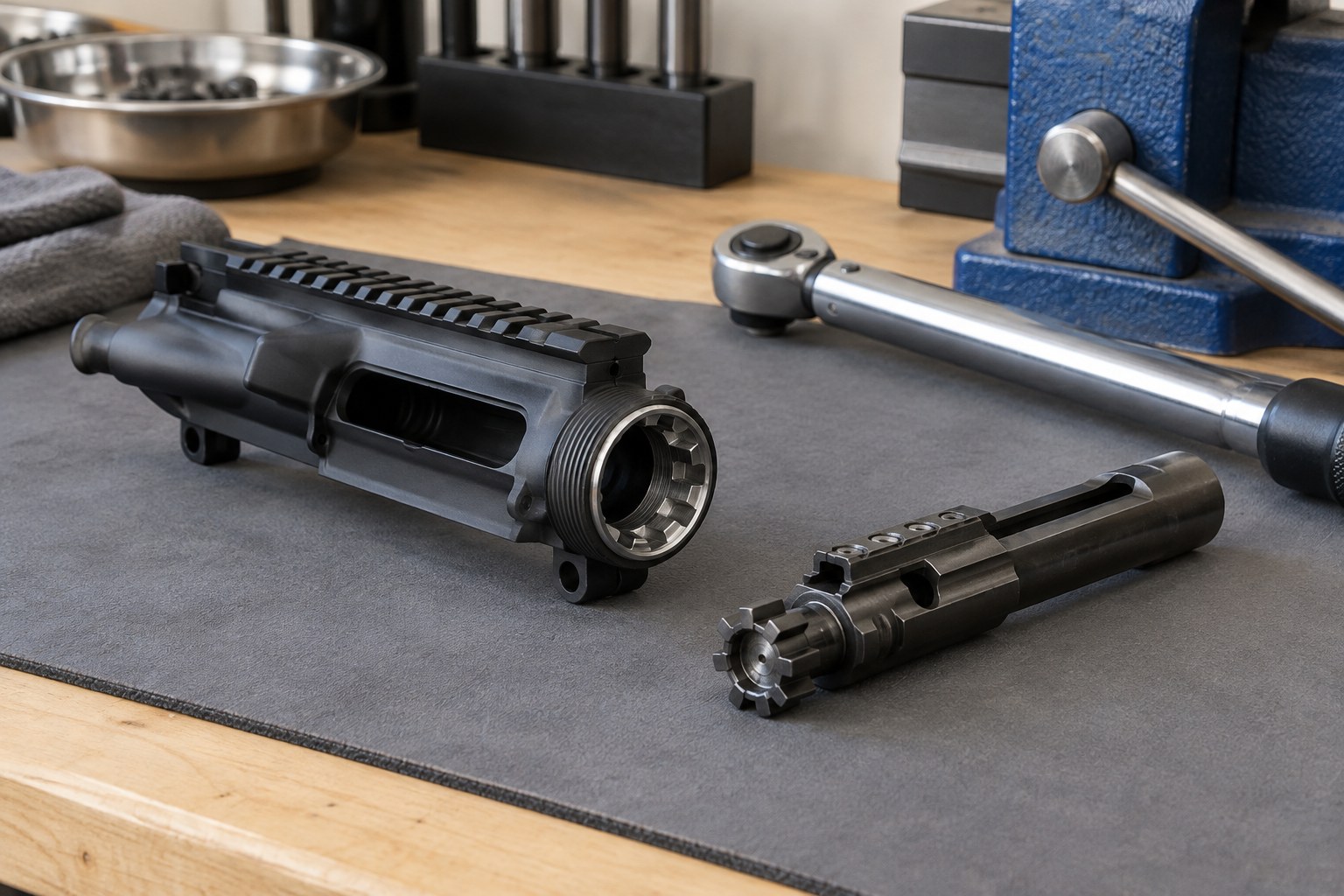
An AR15 barrel extension is the machined steel piece at the rear of the barrel that turns a bare tube into a chamber the bolt can lock into. It carries the locking lug recesses, the feed ramps, and the indexing pin that keep a rifle timed and safe to fire. At AR15Parts.com, we help Denison and Texoma builders match a barrel extension to a bolt, a caliber, or an upper receiver before they order parts. Get the pairing wrong and a rifle can fail to feed, fail to lock up, or develop a headspace problem that a gunsmith needs to catch before the first range trip.
Questions about matching a barrel, bolt, and upper before you order? Reach out below.
Key Takeaways
- The AR15 barrel extension threads onto the rear of the barrel and carries the locking lug recesses that the bolt rotates into to close the action.
- M4-cut upper receivers have a deeper feed ramp cut that extends from the barrel extension into the receiver, while standard rifle-cut receivers keep the feed ramp entirely on the barrel extension.
- AR-15 barrel extensions are not interchangeable with AR-10 or LR-308 pattern barrel extensions, and AR-10 and LR-308 patterns are not interchangeable with each other.
- Bolt face dimensions vary by caliber family, so a 6.5 Grendel, 6mm ARC, or 458 SOCOM build needs a bolt machined for that cartridge, not a standard 5.56 NATO bolt.
- Headspace is the fit between the barrel and barrel extension on one side and the bolt on the other, and it should be checked with gauges whenever those parts are mixed.
- A barrel extension is a pressed and pinned assembly, not a part meant for a builder to swap at home, so headspace work belongs with a qualified gunsmith.
What Is an AR15 Barrel Extension and What Does It Actually Do?
The barrel extension is a separate steel component that is threaded onto the rear of the barrel and then pinned in place so it cannot rotate or back out. Once it is installed, the barrel extension effectively becomes part of the chamber. The rearmost portion of the chamber throat lives inside the barrel extension, and the extension's face is what the bolt closes against.
The Locking Lugs That Turn the Barrel Extension Into a Locked Breech
A mil-spec AR-15 bolt uses a ring of rotating locking lugs machined around its head. When the bolt carrier moves forward and the bolt rotates into battery, those lugs turn into matching lug recesses cut into the inside of the barrel extension. That interface is what actually holds the cartridge in the chamber during firing, since the upper receiver itself does very little of that work. If the lugs on a bolt do not match the lug pattern cut into a particular barrel extension, the bolt will not lock up correctly, so bolts and barrel extensions have to belong to the same family of parts.
The Extractor Cut, Feed Ramps, and Indexing Pin
Besides the locking lug recesses, the barrel extension includes an extractor cut for the bolt's extractor claw to ride in, and the beginning of the feed ramp that guides a cartridge up out of the magazine and into the chamber. A small pin, sometimes called the indexing pin, is pressed through the barrel and into the barrel extension during manufacturing. That pin keeps the extension from rotating relative to the barrel, which keeps the feed ramp, the extractor cut, and the gas port timed correctly relative to each other. This is a manufacturing step, not something a builder repeats when swapping parts at home.
M4 Feed Ramps vs Standard Rifle Feed Ramps: Why the Cut Matters
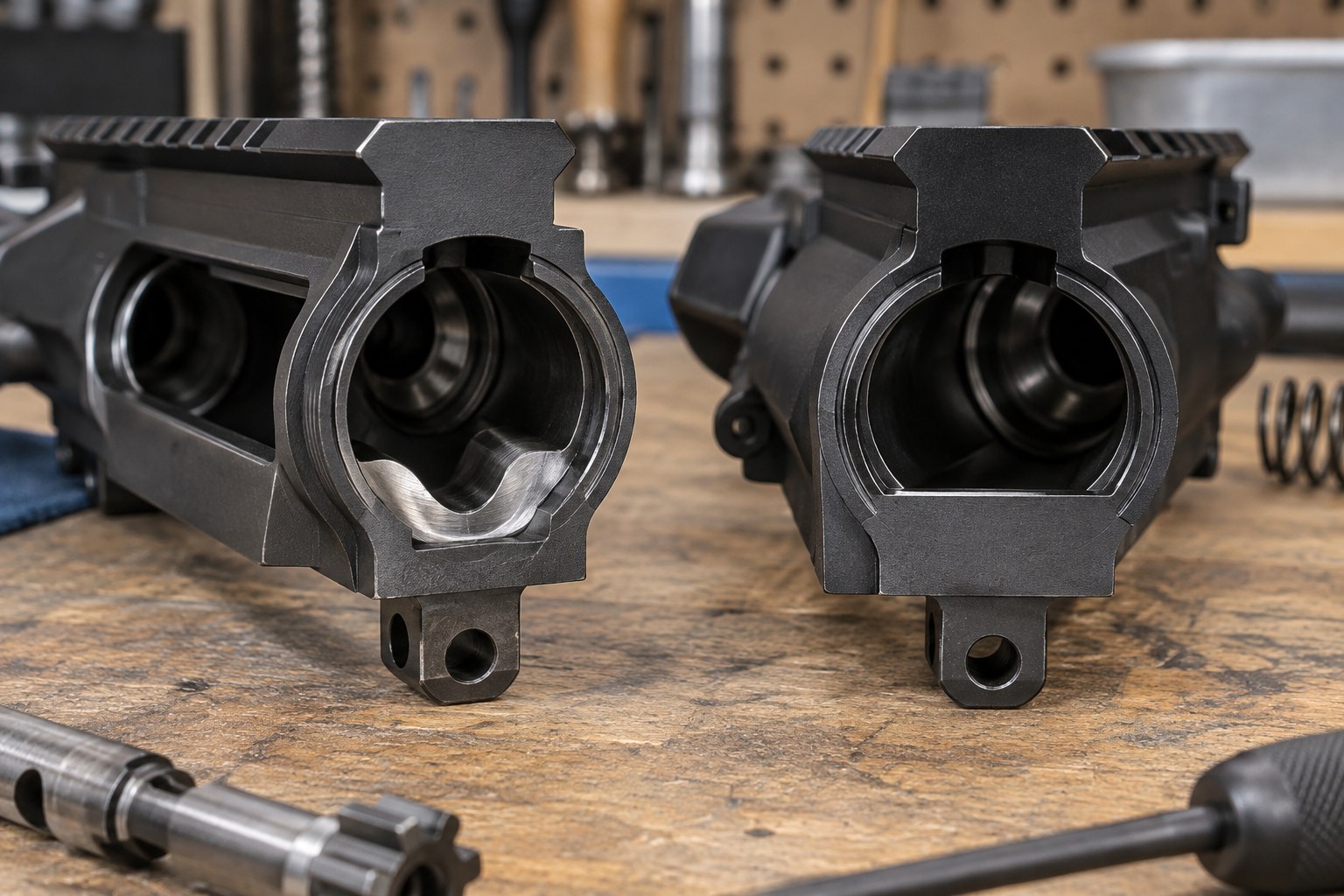
Not every barrel extension and upper receiver combination cuts the feed ramp the same way, and mixing the two styles is a common source of feeding problems.
How to Tell an M4-Cut Upper Receiver From a Standard Rifle-Cut Upper
On a standard, or "rifle-cut," setup, the feed ramp is machined entirely into the barrel extension, and the upper receiver behind it has a flat feed area with no matching ramp cut. On an M4-cut, or "M4 feed ramp," setup, the ramp cut extends past the barrel extension and continues into the front of the upper receiver itself, giving the ramp a longer, scalloped look where the barrel extension meets the receiver. The two barrel extension styles look similar from a distance, but the M4-cut extension is intended to pair with an M4-cut upper receiver so the ramp surfaces line up without a step or ledge where a round could catch.
Matching Your Barrel Extension to Your Upper Receiver
A standard-cut barrel extension can generally work in an M4-cut upper receiver, since the receiver simply has extra relief that the barrel extension does not use. The reverse pairing, an M4-cut barrel extension in a standard-cut upper receiver, is the combination to avoid, since the ramp geometry will not match and a round can hang up on the ledge between the extension and the receiver. Compare the ramp cut on your barrel extension with the ramp cut inside your upper receiver before final assembly, and when in doubt, ask before you buy so the parts arrive matched. Reviewing options for a complete upper receiver alongside your barrel choice is the simplest way to keep the two in sync.
AR-15 vs AR-10 and LR-308 Barrel Extensions: Not Interchangeable
Builders coming from an AR-15 background sometimes assume a larger-frame AR-10 style rifle uses the same barrel extension pattern, just scaled up. It does not.
Why an AR-10 Pattern Barrel Will Not Fit an LR-308 Upper, or the Other Way Around
AR-10 pattern rifles and LR-308 pattern rifles both fire cartridges like 308 Winchester, but they grew from two different receiver families with different barrel extension and barrel nut dimensions. A barrel extension built for one pattern will not thread and index correctly in an upper receiver built for the other pattern, even though the rifles look similar from the outside and share a caliber. An AR-15 barrel extension, in turn, is smaller in diameter than either large-frame pattern and is not interchangeable with either one.
Confirm the Platform Before You Order a Barrel
Before ordering a barrel or complete upper for a larger-caliber build, confirm which large-frame pattern your existing upper receiver and bolt carrier group belong to. Mixing patterns is one of the most common fitment mistakes in AR-style builds, and it is not something that shows up until the parts are on the bench and refuse to mate correctly. Our team can help confirm which pattern a given barrel or bolt carrier group is built for before you place an order.
Bolt Face and Caliber Matching: Why Headspace Depends on More Than the Barrel
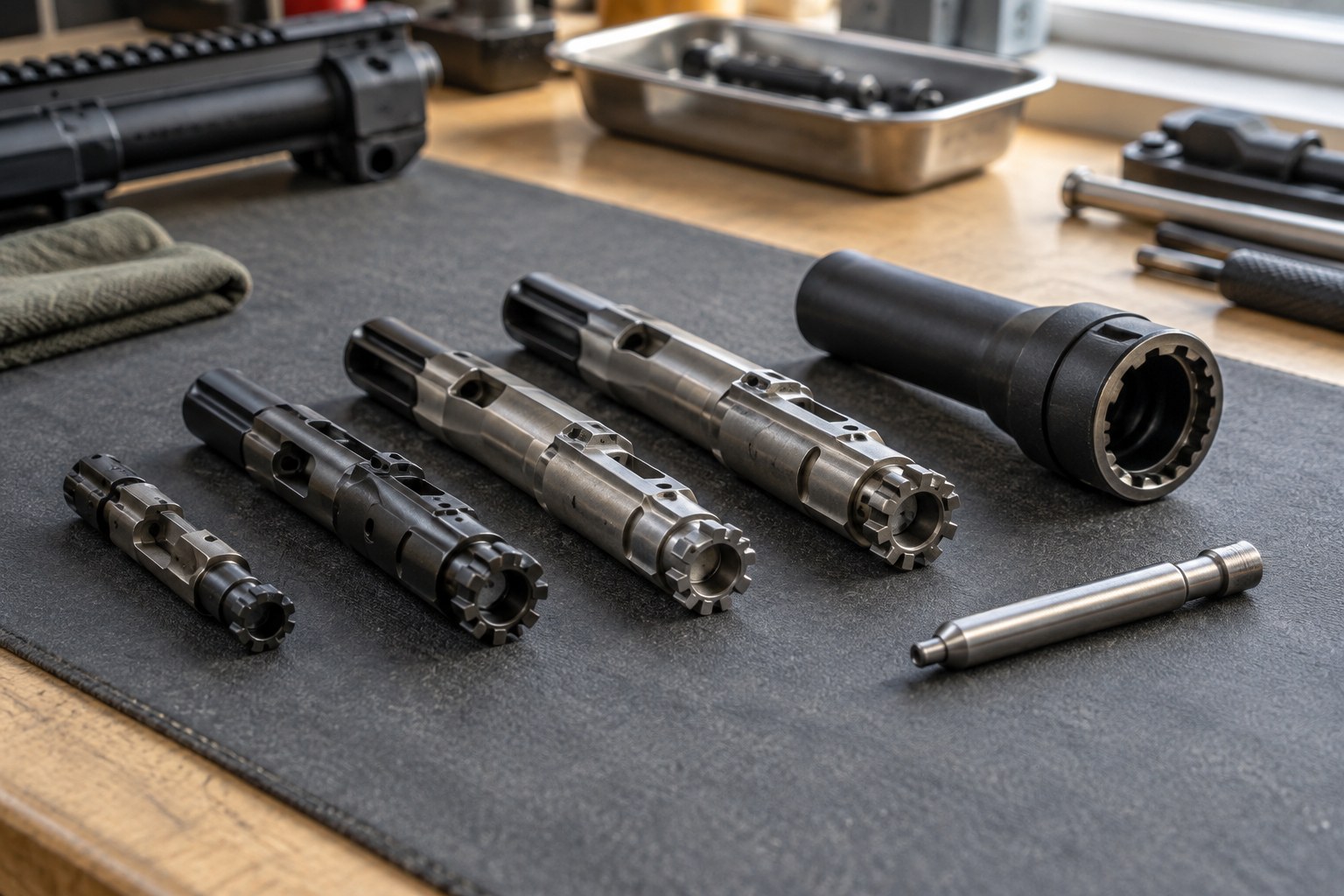
Even within the AR-15 family, the bolt face has to match the case head of the cartridge the barrel is chambered for. A barrel extension alone does not guarantee a working rifle if the bolt behind it is cut for the wrong cartridge.
6.5 Grendel and 6mm ARC Use a Larger, Shared Bolt Face
6.5 Grendel and 6mm ARC both use a case head that is larger than 5.56 NATO or 223 Wylde, so both cartridges require a bolt machined with a larger bolt face rather than a standard 5.56-pattern bolt. Because 6mm ARC was designed around the same case head diameter as 6.5 Grendel, the two cartridges share a common bolt face family, though the barrel, chamber, and often the magazine still need to match the specific cartridge. Within 6.5 Grendel itself, bolt dimensions have varied between manufacturers over the years, so a Grendel bolt should be checked against the barrel extension and chamber it will be paired with rather than assumed to be a universal fit.
458 SOCOM and Other Large-Case Calibers Need a Dedicated Bolt
458 SOCOM and 450 Bushmaster fire cartridges with a case head much larger than 5.56 NATO, and both require a bolt purpose-built for that larger case, including a wider extractor cut, rather than a modified standard bolt. Pairing the wrong bolt with a large-bore barrel extension can prevent the bolt from closing at all, or worse, allow it to close without proper support behind the case head.
| Cartridge Family | Bolt Face Needed | Interchangeable With Standard 5.56 Bolt? |
|---|---|---|
| 223 Wylde / 5.56 NATO | Standard small-frame AR-15 bolt face | Baseline, not applicable |
| 300 Blackout | Standard small-frame AR-15 bolt face | Yes, same bolt face as 5.56 NATO |
| 6.5 Grendel / 6mm ARC | Larger Grendel-pattern bolt face | No |
| 458 SOCOM / 450 Bushmaster | Dedicated large-case bolt with wide extractor cut | No |
Browse current 6.5 Grendel barrel and 6mm ARC barrel options, or current 458 SOCOM barrel options, and confirm the matching bolt before you build.
Headspace, Gauging, and Why the AR15 Barrel Extension Is Not a User-Replaceable Part
Headspace is the fit between the chamber, which lives partly in the barrel and partly in the barrel extension, and the bolt face behind it. The Sporting Arms and Ammunition Manufacturers' Institute (SAAMI) defines a headspace gauge as a device used to determine the distance between the breech face and the point in the chamber where the cartridge is meant to seat. Go and No-Go gauges are the standard tools for checking that this distance falls within a safe range for a given cartridge.
Why Mixing Parts Means Gauging Again
Because headspace is a relationship between two parts, changing either one changes the measurement. Swapping a bolt, installing a different barrel, or combining a barrel extension and bolt from different manufacturers all call for a fresh headspace check with Go and No-Go gauges rather than an assumption that mil-spec parts will always mate perfectly. This is especially true outside common calibers like 5.56 NATO and 223 Wylde, where bolt face and chamber tolerances can vary more between makers.
Why We Recommend a Qualified Gunsmith for Headspace Work
The barrel extension is pressed onto the barrel and pinned at the factory, and it is not designed to be removed or reinstalled by a builder working at home. If you are assembling a complete upper from separate parts, mixing a bolt from one source with a barrel from another, or troubleshooting a rifle that will not lock up consistently, have a qualified gunsmith check headspace with proper gauges before you fire the rifle. Never attempt to modify the gas port, the feed ramp, or the extractor cut yourself, and always work with an unloaded firearm on the bench. For a deeper look at how headspace is measured, our AR Upper Hub guide on AR-15 headspacing covers the gauges and process in more detail, and any complete upper from AR15Parts.com ships headspaced and function-checked before it leaves the facility.
AR15 Barrel Extension Help for Denison and Texoma Builders
North Texas humidity and the swings in temperature around Lake Texoma can be hard on a rifle that sits in a safe most of the year and then gets pulled out for deer or hog season. A little surface corrosion on a bolt or barrel extension is common after a season of range days and field use, and it is worth a careful inspection before you assume a feeding or lockup issue is a compatibility problem.
If you are planning a caliber swap, building a large-frame AR-10 or LR-308 pattern upper, or just trying to confirm whether a bolt and barrel extension you already own will work together, our team can help you confirm fitment before you order.
AR15Parts.com can be reached at 4000 Texoma Parkway, Denison, TX 75020 or by phone at (888) 706-0633, Monday through Friday.
Frequently Asked Questions
Can I Replace a Barrel Extension by Itself?
No, a barrel extension is not typically sold or installed as a standalone user part. It is threaded and pinned onto a specific barrel at the factory, and separating the two requires the correct tooling plus a fresh headspace check afterward. Most builders replace the barrel as a complete assembly with its extension already fitted.
How Do I Know if My Upper Receiver Has M4 Feed Ramps?
Look at the front interior of the upper receiver where it meets the barrel extension. If the ramp cut continues from the barrel extension into the receiver in a scalloped shape, it is an M4-cut receiver. If the receiver face behind the extension is flat with no ramp continuation, it is a standard rifle-cut receiver. When unsure, compare against a known M4-cut receiver or ask our team for help identifying yours.
Will an AR-10 Barrel Fit My LR-308 Upper Receiver?
Not reliably. AR-10 pattern and LR-308 pattern upper receivers use different barrel extension and barrel nut dimensions, even though both fire similar cartridges like 308 Winchester. Confirm which large-frame pattern your upper and bolt carrier group belong to before ordering a barrel, since the two patterns are not interchangeable.
Do 6.5 Grendel and 6mm ARC Use the Same Bolt?
They use the same bolt face family, since 6mm ARC was designed around the same case head diameter as 6.5 Grendel. That said, the barrel, chamber, and magazine still need to be correct for the specific cartridge you are shooting, and headspace should still be confirmed for your exact bolt and barrel combination.
Why Does Headspace Matter So Much on a Custom Build?
Headspace controls how much room a fired cartridge case has inside the chamber before the bolt supports it. Too much or too little can affect reliable function and safe case support, which is why any time a bolt, barrel, or barrel extension is changed or mixed with parts from a different source, a qualified gunsmith should verify headspace with Go and No-Go gauges before live fire.
Can I Just Buy a Bolt That Matches My Caliber and Install It Myself?
Installing a correct bolt into an existing bolt carrier group is a common step in many builds, but pairing a new bolt with an existing barrel and barrel extension still calls for a headspace check afterward. If you are not comfortable gauging headspace yourself, have a qualified gunsmith verify the fit before you fire the rifle.
Ready to Get Started with AR15Parts.com?
Call (888) 706-0633 or email [email protected], Monday through Friday, 8:00 AM to 4:00 PM Central, and our team can help you confirm which barrel extension, bolt, and upper receiver combination fits your build before you order.