

The 350 Legend is a straight-wall cartridge built for real-world hunting distances, and understanding its ballistics tells you exactly what it can and can't do in the field. For hunters around Denison who take most whitetail shots at 150 to 200 yards, that data matters before you buy a rifle or upper. AR15Parts.com assembles and ships from 4000 Texoma Pkwy in Denison, TX 75020, and we offer 350 Legend upper configurations for compatible AR builds.
Compare velocity, energy, and bullet drop across major factory loads so you can make an informed decision. Ready to build a 350 Legend rifle? We can help you find the right upper for your hunt.
Key Takeaways
- The 350 Legend delivers muzzle velocities between 2,100 and 2,325 fps depending on bullet weight and load.
- Muzzle energy typically runs 1,600 to 1,900 ft-lbs, making it effective on whitetail deer inside 200 yards.
- Bullet drop at 200 yards averages 6 to 9 inches with a 100-yard zero, depending on the load.
- The 350 Legend qualifies as a straight-wall cartridge, meeting hunting regulations in zones where bottleneck cartridges are restricted.
What Is the 350 Legend and Why Do the Numbers Matter?
The 350 Legend is a straight-wall rifle cartridge that produces roughly 1,600 to 1,900 ft-lbs of muzzle energy from a standard AR-15 platform while meeting straight-wall hunting regulations. Winchester introduced it in 2019 with three goals: fit a standard AR-15 lower, deliver real hunting energy, and qualify as a straight-wall case under state rules. It hit all three. If you are looking at 350 Legend upper assemblies and want to understand what the cartridge actually does downrange, the specs are where you start.
Cartridge Specs at a Glance
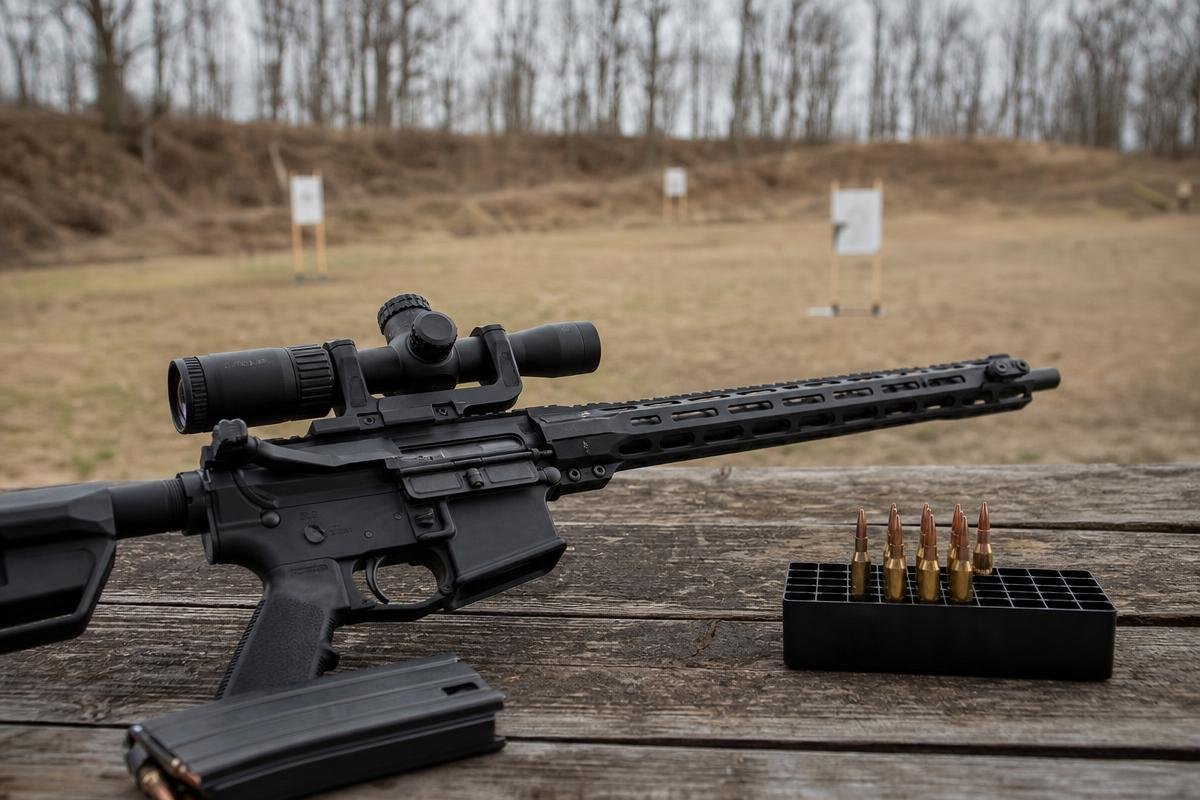
Case length is 1.71 inches. Bullet diameter is .357 inches, the same as a standard .357 Magnum projectile. SAAMI maximum pressure is 55,000 psi. Common grain weights run from 145 gr and 150 gr on the lighter end, through 160 gr, 170 gr, and 180 gr in the hunting-weight range, up to 255 gr for subsonic loads. That spread gives you real flexibility depending on whether you are chasing deer, hogs, or running suppressed.
Because it headspaces on the case mouth and uses a rebated rim, it feeds reliably from a standard AR-15 lower paired with a dedicated upper. No lower modification needed. The complete unit installs onto your existing receiver in minutes.
Why the Straight-Wall Designation Changes the Conversation
A straight-wall cartridge has no taper or bottleneck. That geometry is what many Midwestern and Southern states use to define legal deer hunting cartridges in restricted zones. The 350 Legend was engineered specifically to qualify under those rules while producing significantly more energy than traditional pistol-caliber straight-wall options.
For hunters planning trips to states with straight-wall-only deer rules, that distinction can matter. Texas has no straight-wall-only counties; check the current rules for any out-of-state destination separately. The mixed brush and Red River bottom land around Denison put most shots in the 150 to 200 yard window, and that terrain constraint, tight sightlines broken by post-oak and cedar, is exactly why this cartridge fits the region so well. The velocity and energy figures in the sections below tell you whether it fits your hunt.
350 Legend Ballistics Chart: Velocity, Energy, and Drop by Load
| Load | Muzzle Vel. (fps) | 100-yd Vel. (fps) | 200-yd Vel. (fps) | Muzzle Energy (ft-lbs) | 100-yd Energy (ft-lbs) | 200-yd Energy (ft-lbs) | Drop at 100 yds (in) | Drop at 200 yds (in) |
|---|---|---|---|---|---|---|---|---|
| Winchester 145 gr FMJ | 2,350 | 2,050 | 1,770 | 1,779 | 1,354 | 1,009 | 0.0 | -7.2 |
| Winchester 150 gr Deer Season XP | 2,325 | 2,020 | 1,740 | 1,801 | 1,360 | 1,008 | 0.0 | -7.8 |
| Winchester 160 gr Power-Point | 2,225 | 1,910 | 1,630 | 1,758 | 1,297 | 944 | 0.0 | -8.6 |
| Hornady 165 gr FTX | 2,100 | 1,800 | 1,530 | 1,615 | 1,187 | 858 | 0.0 | -9.4 |
| Federal 180 gr Fusion | 1,900 | 1,600 | 1,340 | 1,443 | 1,023 | 717 | 0.0 | -11.8 |
| Winchester 255 gr Open Tip (Subsonic) | 1,060 | 990 | 925 | 636 | 555 | 484 | 0.0 | -31.0 |
All figures are zeroed at 100 yards from a 16-inch barrel and are derived from manufacturer published data and independent 16-inch barrel testing. Individual results may vary by barrel length and ambient conditions. A 20-inch barrel typically adds 50 to 80 fps across any of these loads, which tightens drop slightly at 200 yards. Matched the load to your hunt? Find the upper that fits your build.
Muzzle to 200 Yards: What the Numbers Show
350 legend bullet drop stays manageable out to 150 yards with the lighter loads. At 200 yards, the 150 gr Deer Season XP drops roughly 7 to 9 inches zeroed at 100. That is a holdover you can account for, but it is not a flat-shooting cartridge. The reason the 150-yard mark keeps coming up around here is terrain: the thick post-oak and cedar cover that borders the Red River rarely opens far enough to force a longer poke, so most hunters are working well within that window regardless of load.
The 255 gr subsonic load is a different animal entirely. It sheds velocity fast and drops over 30 inches at 200 yards. Keep that load inside 75 yards and it performs its intended job. It is not a hunting load at distance.
How Bullet Weight Affects Retained Energy Downrange
350 legend velocity and energy follow a predictable pattern: lighter bullets start faster and hold trajectory longer, heavier bullets start slower but carry more momentum at close range. At 100 yards, the 150 gr Deer Season XP still produces around 1,360 ft-lbs. That is enough for clean deer kills at distances common to this timber country.
Heavier bullets like the 180 gr Fusion drop to around 1,023 ft-lbs at 100 yards. Still adequate for deer, but the steeper velocity loss makes them better suited to shots inside 100 yards. The 150 gr load's ballistic coefficient sits near .223, which partly explains why drop accelerates past 200 yards even from a fast muzzle start. That low BC also means wind matters, a point worth remembering before you stretch a shot. If you are building a platform for this cartridge, our 350 Legend upper assemblies are available in compatible configurations.
350 Legend Effective Range: What You Can Realistically Harvest
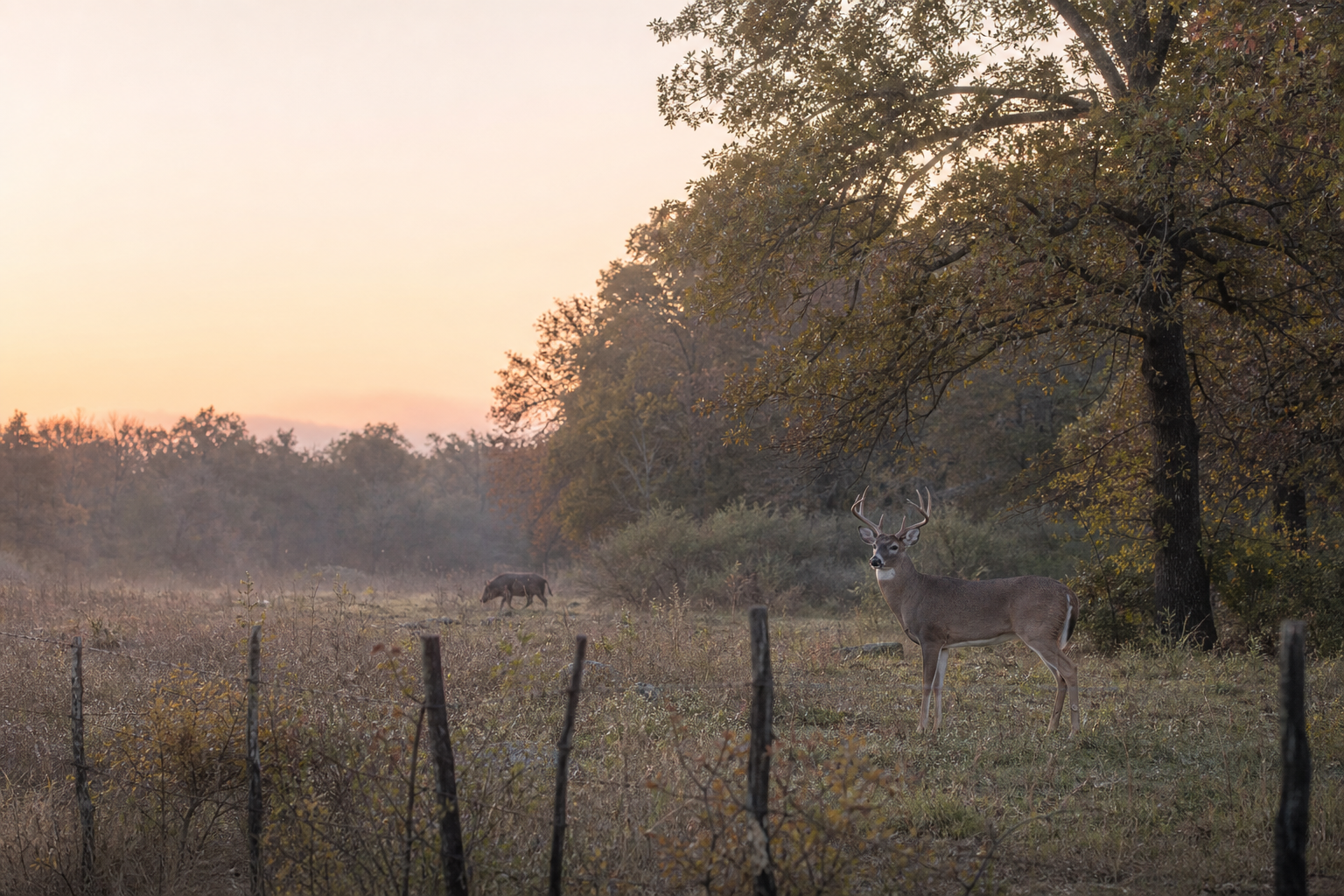
Knowing the numbers on paper is one thing. Knowing where to hold your shot in the field is another. Around Lake Texoma the timber country and post-oak flats rarely open up past 200 yards, which lines up neatly with 350 legend effective range. This cartridge has a practical ceiling, and honest hunters should know where it sits.
Deer and Hog: The 150-Yard Standard
A 150 gr load retains roughly 1,100 to 1,200 ft-lbs at 150 yards. That is well above the commonly cited 1,000 ft-lbs threshold for ethical deer-sized game. Push out to 200 yards and you are right at that threshold, somewhere between 900 and 1,000 ft-lbs depending on the load. That is the edge of responsible shooting on deer, not a comfortable margin. Call 150 yards your standard and 200 yards your hard limit.
For hogs, the 180 gr Federal Fusion is the better choice inside 100 yards. Its controlled-expansion bullet is designed for penetration on tough shots. Hogs are tough animals. A lighter, faster bullet that fragments early does not do the job the way a deep-driving 180 gr projectile does at close range. If you are building a dedicated hog rifle, look at our 350 Legend uppers configured for heavier loads.
Coyote and Varmint Use at Extended Distances
The 145 gr FMJ will reach coyotes past 200 yards, but the modest ballistic coefficient works against you. In a 10 mph crosswind at 200 yards, a 150 gr bullet drifts approximately 5 to 6 inches. That drift can turn a well-placed shot into a marginal hit. Wind calls matter more past 150 yards with this cartridge than they do with higher-BC options.
350 legend hunting performance holds up well inside its limits. Respect those limits and this cartridge delivers clean kills. Push past them and you are gambling on conditions. The velocity and energy figures covered in the ballistics chart section above give you the load-by-load data to make that call before you ever pull the trigger.
350 Legend vs. 30-30 and 400 Legend: How the Ballistics Stack Up
350 Legend vs. 30-30 Winchester
On paper, 350 legend vs. 30-30 ballistics are close. A 30-30 pushing a 150 gr bullet from a 24-inch lever-action barrel produces roughly 2,390 fps and 1,902 ft-lbs at the muzzle. A 350 Legend running the same bullet weight from a 16-inch AR barrel comes in at approximately 2,325 fps and 1,800 ft-lbs. At 100 to 150 yards, that gap is not meaningful on deer.
Where the 350 Legend separates itself is platform and legal status. It feeds from a detachable box magazine, runs standard AR components, and has a straight-wall case that may qualify where state hunting rules restrict bottleneck cartridges. Check the current regulations for your hunting destination before choosing either cartridge.
If you want to build on that platform advantage, confirm the product configuration and compatibility details before ordering a 350 Legend upper.
350 Legend vs. 400 Legend
Winchester introduced the 400 Legend in 2023. It fires a .400-inch diameter bullet at approximately 2,150 fps in a 215 gr load, producing around 2,200 ft-lbs of muzzle energy. That is a real energy advantage at close range over the 350 Legend's roughly 1,800 ft-lbs.
The trade-off is trajectory and load availability. At 200 yards, 350 legend ballistics run flatter, and factory load options are far broader. If you are hunting large hogs or bear at close range and want maximum stopping power, the 400 Legend has an argument. For deer at 100 to 200 yards across the post-oak flats and river bottom common to this area, the 350 Legend covers the job with less recoil and more ammo choices. We carry complete AR uppers in multiple calibers if you want to compare options side by side before committing to a build.
Questions about which caliber fits your hunting setup? Call us at 888.706.0633 and we will walk through the numbers with you.
How Barrel Length Changes 350 Legend Velocity
Barrel length has a direct effect on 350 legend velocity and energy, and the numbers are worth knowing before you build. Winchester's published data for the 150 gr Deer Season XP is based on a 16-inch test barrel, rated at 2,325 fps at the muzzle. That is the baseline most hunters are working from.
16-Inch vs. 20-Inch: The Velocity Trade-Off
A 20-inch barrel typically adds 50 to 80 fps over a 16-inch tube. With that same 150 gr load, you are looking at roughly 2,375 to 2,405 fps and an additional 40 to 60 ft-lbs of muzzle energy. That gain is real, but it is modest. Inside 200 yards, which covers most deer shots in this part of the state, the terminal difference between those two numbers is small enough that bullet placement matters far more than the extra fps.
A longer barrel also gives you a longer sight radius and noticeably less muzzle blast. For open-country pasture shots or varmint work where 350 legend effective range gets pushed past 200 yards, a 20-inch barrel earns its keep with a slightly flatter trajectory and better retained velocity at distance.
Choosing the Right Barrel for Your Intended Use
Tight timber and blind hunting favor the 16-inch barrel. A shorter, lighter rifle is easier to swing and handle in cover, and ballistics stay fully adequate inside 200 yards. If you split your season between dense brush near Lake Texoma and open pasture ground further out, that trade-off is worth thinking through before you order.
Compare available 350 Legend barrel lengths and confirm the product configuration and compatibility details before ordering.
350 Legend in Texas: Straight-Wall Rules and Hunting Season Fit
Texas Straight-Wall Cartridge Regulations
Under Texas general deer season rules, centerfire rifles are permitted, and Texas has no straight-wall-only counties. Check current Texas Parks and Wildlife requirements before hunting with your 350 Legend setup.
Some other states restrict deer hunting cartridges to straight-wall designs in certain areas. If you travel to hunt, check the current rules for your specific destination rather than assuming the same cartridge regulations apply everywhere.
Deer Season Timing and Why the 350 Legend Fits
General firearms deer season in this part of Texas typically opens in early November and runs through early January, with archery starting in October. That gives you a solid window. The mixed brush, river bottom, and post-oak terrain common to the Lake Texoma corridor tends to keep shots inside 150 yards, which sits squarely in the 350 legend effective range sweet spot. You are not giving anything up at those distances.
Recoil is another practical factor. This cartridge produces felt recoil close to a .243 Winchester. Younger hunters and recoil-sensitive shooters can run it comfortably through a full season without developing a flinch. That matters when you are putting rounds downrange at a deer standing at the edge of the timber at last light.
If you are building a dedicated hunting setup, our 350 Legend upper assemblies are available in compatible configurations for your lower. We ship them nationwide from our Denison, TX facility.
Frequently Asked Questions
What Is the Muzzle Velocity of a 350 Legend?
Velocity depends on bullet weight. Winchester's 150 gr Deer Season XP runs 2,325 fps from a 16-inch barrel. A 145 gr FMJ load pushes closer to 2,350 fps. Step up to a 180 gr load and you drop to roughly 1,900 fps. Plan on losing or gaining 25 to 40 fps per inch of barrel as you go shorter or longer.
How Much Does a 350 Legend Drop at 200 Yards?
Zeroed at 100 yards, a 150 gr load drops approximately 7 to 9 inches at 200 yards. Atmospheric conditions and specific load affect that number. It is comparable to a 30-30 from a lever gun. A practiced shooter who knows the holdover can make that shot confidently on deer-sized targets.
Is the 350 Legend Powerful Enough for Deer at 200 Yards?
Yes. A 150 gr load retains roughly 900 to 1,100 ft-lbs at 200 yards, which meets or exceeds the 1,000 ft-lbs threshold widely cited for ethical deer harvest. Shot placement is still the primary variable. In the mixed brush and river-bottom terrain common across this region, most shots fall well inside that range anyway.
How Much Recoil Does a 350 Legend Produce in an AR-15?
Felt recoil is mild, roughly comparable to a .243 Winchester or a light .308 load. The AR platform's buffer system and semi-auto action absorb a meaningful portion of the impulse. Most shooters find it easy to stay on target for a fast follow-up shot.
Do I Need a Special Lower Receiver for a 350 Legend Build?
No. A standard mil-spec lower receiver works without modification. You need a dedicated 350 Legend upper, a correct barrel, and a 350 Legend magazine. Nothing changes below the upper. That makes it a straightforward swap if you already own an AR-15 lower.
What Barrel Length Should I Use for Hunting with a 350 Legend?
A 16-inch barrel covers most hunting situations inside 200 yards with no meaningful ballistic penalty. A 20-inch barrel adds 50 to 80 fps and is worth considering for open-country varmint work. Browse our complete AR uppers to compare barrel configurations across calibers before you decide.
You have the numbers. Now put them to work. AR15Parts.com carries 350 Legend upper assemblies, barrels, and components, all shipped from 4000 Texoma Pkwy in Denison, TX 75020. Call us at 888.706.0633 with questions about your build, or browse our complete AR uppers in multiple calibers to see how this cartridge stacks up against other platform options.