
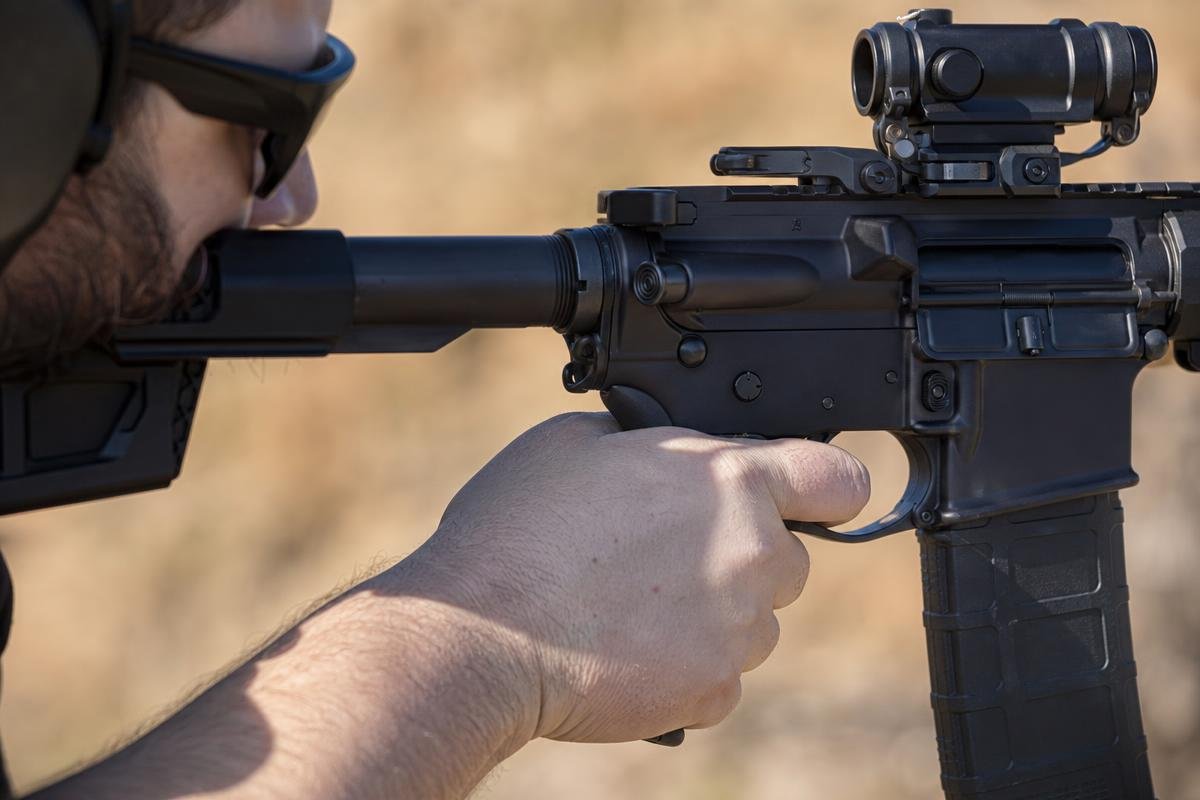
AR-15 grip angle affects where your wrist sits, how your trigger finger lands, and how well you manage recoil through a string of fire. A poor fit can make the rifle feel less natural, while a better fit may improve presentation consistency and comfort during longer range sessions. At AR15Parts.com, we stock pistol grips across the common angle ranges, from the standard mil-spec geometry to steeper vertical options, and we ship eligible orders nationwide subject to current product and destination restrictions from our Denison, TX facility. Not sure which grip angle fits your hand? Browse our pistol grips and lower parts, or contact our team.
Key Takeaways
- AR-15 grip angle influences firing-wrist position, but stock fit, stance, grip circumference, trigger reach, and individual anatomy also matter.
- AR-15 grip angles vary by model, and published angle figures can use different reference axes, so compare manufacturer specifications using the same measurement convention.
- A mismatched grip angle forces wrist compensation that increases fatigue and slows split times under sustained fire.
- Grip texture and hand position also affect control during hot-weather range sessions where sweat is a factor.
- Swapping to a better-fit grip is a low-cost, no-gunsmithing change that can fit many mil-spec lower receivers, depending on compatibility.
Grip angle is one of the most overlooked variables on the platform, yet it sets your wrist position behind the trigger. That position controls where the muzzle points on first presentation, how recoil travels through your hands, and how fast you get back on target. Before we get into product picks, it helps to define exactly what we are measuring.
Practical grip-angle categories range from traditional swept designs to more vertical options, and each can affect wrist position, recoil control, trigger reach, and fatigue differently for each shooter. That is more than a forum thread gives you. Whether you are building a carbine or a precision upper, we can help you identify compatible parts for your lower.
What Is AR-15 Grip Angle and Why Does It Matter?
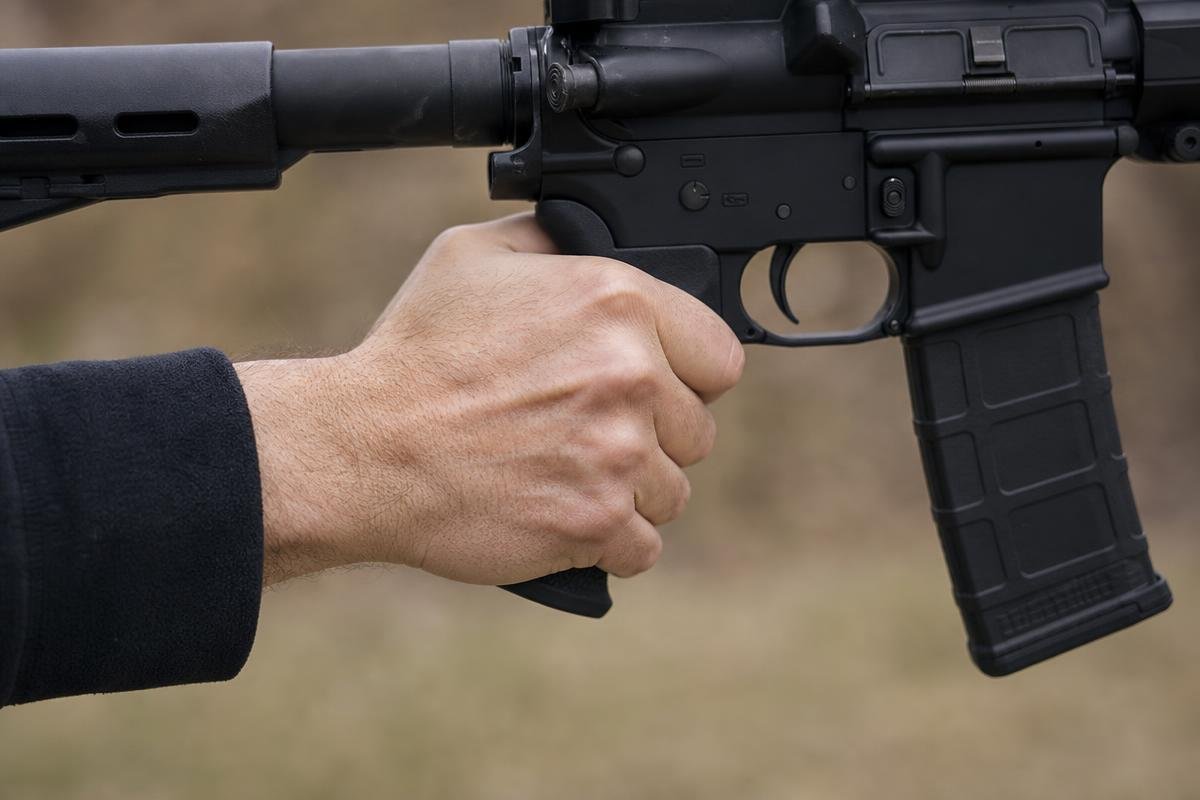
AR-15 grip angle describes how far forward or rearward the grip’s centerline leans relative to a stated reference axis, commonly a true vertical line. That single measurement changes where your wrist sits behind the trigger, which directly affects how naturally the sights align when you raise the rifle and how cleanly you can pull the trigger straight rearward.
A poor fit between your anatomy and your grip angle forces your wrist into a bent or torqued position. That tension translates into lateral pressure on the trigger face, which pushes shots off-center before the round even leaves the barrel.
How Grip Angle Is Measured
Using vertical as the reference, a true vertical grip is 0 degrees. Other grips should be compared only when manufacturers use the same reference axis.
Here is a quick field test. Let your shooting arm hang relaxed at your side, then raise it as if presenting a rifle. Note the angle your wrist naturally falls into. That is your anatomically neutral position. The grip angle that matches it most closely will require the least muscular correction to hold on target.
The Spectrum from Swept to Vertical
Three angles cover the practical range of AR-15 pistol grip options. Each suits a different hand geometry and shooting style.
| Grip Angle | Wrist Position | Best For | Common Grips |
|---|---|---|---|
| More vertical | Wrist position varies by shooter, stance, stock setup, and grip shape | Shooters transitioning from handguns; AK-style muscle memory | Magpul MOE-K2 |
| Traditional swept | A familiar baseline for many general-purpose builds | General carbine use, duty rifles, most body types | Magpul MOE, standard A2 grip |
| Near vertical | May keep the wrist closer to neutral in compact or squared stances | Longer trigger fingers, competition geometry, support-hand-heavy technique | Ergo Grip vertical profiles |
No single angle is universally correct. The right choice should support comfortable trigger reach and a consistent rearward press with minimal unintended lateral pressure. If you want to see how different grip configurations fit a complete build, browse our complete uppers or look at our complete rifles ready to run to compare build configurations before you swap parts.
How AR-15 Grip Angle Shapes Your Firing Wrist Position
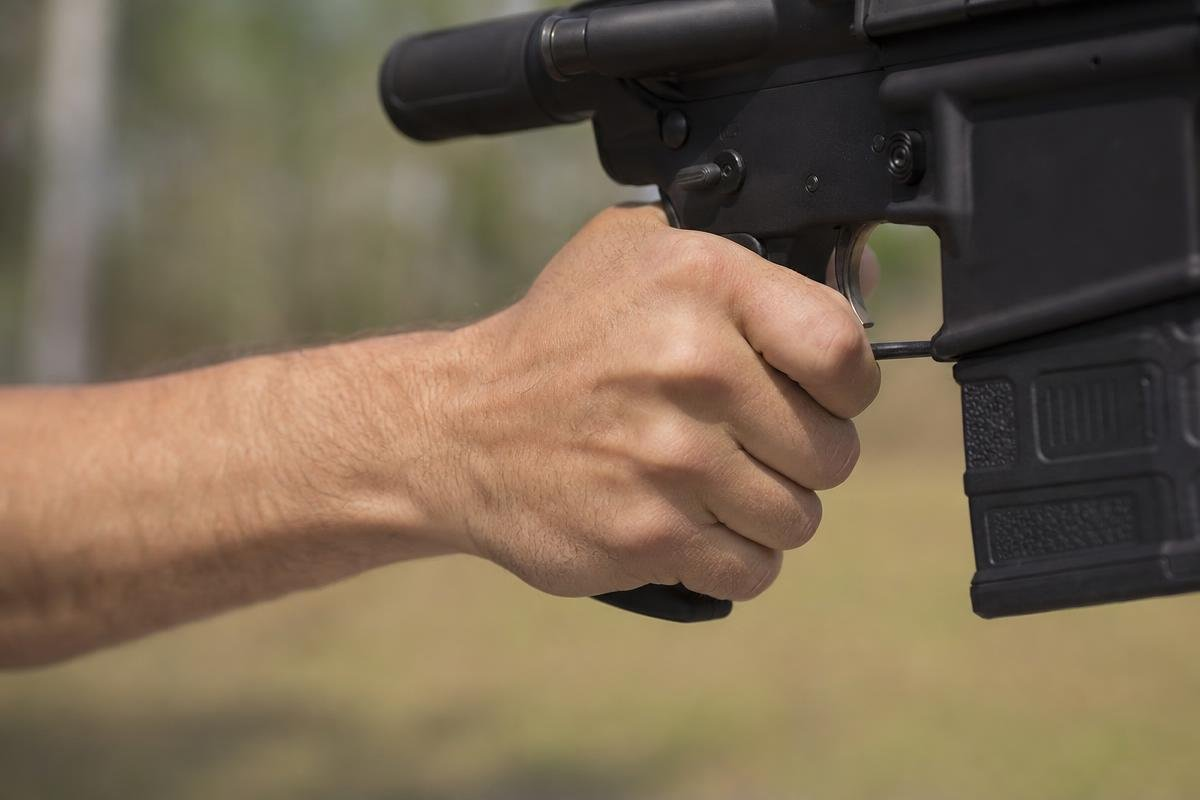
Your grip angle forces the wrist into a fixed cant relative to the bore the moment you close your hand around the pistol grip. A swept grip changes wrist angle and may increase forearm tension for some shooters. Hold that position through a full magazine and you feel it. A more vertical grip may keep the wrist closer to neutral for some shooters, while the overall effect still depends on stance, stock position, and individual anatomy.
Neither geometry is wrong. The problem shows up when the grip angle does not match your natural wrist anatomy. That mismatch creates compensations that show up as shot dispersion, slower splits, and inconsistent presentations.
Wrist Canting and Trigger Finger Alignment
Correct trigger technique requires the first pad of your index finger to contact the trigger face and pull straight rearward. When shooting with a mismatched grip angle, the finger rotates laterally across the trigger face instead of pulling straight back. That lateral deviation pushes shots left or right depending on which direction the finger is canting. It is a mechanical problem, not a marksmanship problem, and changing the grip angle is often the faster fix.
This is also why two shooters can pick up the same rifle and get different horizontal dispersion patterns. Their wrist anatomy differs. The grip angle that keeps one shooter's finger perfectly aligned puts the other shooter's finger at a five-degree cant.
How a Mismatched Angle Sends Shots High on Presentation
When grip angle does not fit the shooter, it may contribute to inconsistent muzzle presentation from low-ready. Your eye registers the front sight above the target, and you push the muzzle down to correct. That correction adds time and introduces inconsistency across repetitions. In recoil control drills, timed transitions, or target-to-target movement, that extra step compounds quickly.
At the range, you may notice this most during timed transitions. If your presentations are consistently muzzle-high and your zero is confirmed, evaluate your grip angle before adjusting your technique. Compare grip options with your stock and stance before changing your build.
How the Support Hand Grip Angle Affects Recoil Control
Your support hand and your pistol grip hand are two separate mechanical systems. Most shooters focus on pistol grip angle and ignore the support side entirely. That is a mistake. The angle and rotation of your support wrist has a direct effect on how fast you can drive the muzzle back down between shots.
The Support Wrist's Role in Managing Muzzle Rise
A support hand rotated too far under the handguard, palm-up or neutral, gives you almost no mechanical push against muzzle rise. The wrist is in a weak position. It absorbs the movement instead of opposing it.
Rotating the support hand forward into a thumb-over-bore or C-clamp position may put the support wrist in a stronger orientation for some shooters. This position can help manage muzzle movement during rapid fire, independently of the pistol-grip angle.
Handguard Geometry and Support Hand Angle
Handguard diameter determines how far you can actually rotate the support hand. A slim free-float handguard with a diameter of 1.5 to 1.75 inches lets the thumb clear the top of the rail and rotate aggressively toward the bore. A wider drop-in handguard physically blocks that rotation. Your thumb runs out of room before the wrist reaches the stronger position.
If you are running a wide handguard and wondering why your C-clamp grip feels awkward, the handguard is likely the limiting factor, not your technique. The geometry differences between free-float and drop-in profiles matter here, and many of our complete uppers are configured with free-float handguards that give you the clearance to run a more aggressive support hand position out of the box.
Grip Angle, Fatigue, and Extended Range Sessions
Your grip angle choice shows up in your forearm after 200 rounds, not after 20. Shooters running carbine drills or multi-stage competition courses feel this difference clearly. A poor angle match does not just affect accuracy. It accumulates as tendon stress across the session.
How Wrist Position Loads the Forearm Tendons
A swept-back grip changes wrist position and may increase forearm tension for some shooters. Over an extended range session, especially in hot weather when sweat can make a secure hold harder to maintain, that cumulative load becomes noticeable. A more vertical grip keeps the wrist closer to its neutral anatomical position, which reduces that stress over time.
Hand size interacts with this directly. Shooters with smaller hands may find a more angled grip shortens trigger reach enough to reduce the over-extension fatigue that builds through a long drill. That is a real ergonomic trade-off, not a marketing claim.
Choosing an Angle for High-Round-Count Drills
For slow-fire bench or prone work, grip angle matters less. You have time to settle your hold and make micro-corrections. For carbine transitions, timed stages, or a multi-day practical rifle course, a grip angle that better matches your wrist position may reduce repeated corrections. Fewer corrections per repetition means less fatigue across the session.
Stock length of pull and grip angle also interact. Adjusting one without considering the other shifts your whole firing geometry. If you are dialing in a new grip, check your stock fit at the same time. Try different grip angles at the range before committing to a permanent lower parts kit configuration. Our complete rifles ready to run give you a working baseline to test from.
Questions about grip options or building out your lower? Call us at (888) 706-0633 and our team will point you in the right direction.
Trigger Reach, Hand Size, and Finding Your Natural Angle
Your hand size has a direct effect on which AR-15 grip angle actually works for you. A grip that fits a large hand perfectly will fight a smaller hand on every trigger pull. Getting this right is less about preference and more about anatomy.
How Hand Size Changes the Optimal Grip Angle
Hand size, finger length, grip circumference, stock position, and stance all affect fit; a more vertical grip may feel better for some shooters but is not universally tied to larger hands. A vertical grip places the trigger face at the first pad of the index finger without any lateral stretch. Pull the trigger from the crease instead of the pad and you introduce side pressure, which moves shots off-center.
Some shooters with smaller hands may prefer a swept or angled grip, but circumference and trigger reach can matter as much as angle. A more swept or more vertical grip may change trigger reach, but grip circumference and stock position should be evaluated at the same time. Run a quick check right now: grip your rifle, keep your wrist position neutral, and look where the trigger contacts your finger. Crease contact means the angle or circumference is wrong for your hand.
The Natural Point of Aim Test
This test costs nothing and takes two minutes. Before you run it, set your stock to the correct length of pull. A stock that is too long or too short will skew the result, so make sure that is dialed in first. If you are building from scratch, configure the rifle correctly before testing grip angle.
With the firearm unloaded and cleared, the muzzle pointed in a safe direction, and all range rules followed, mount the rifle, close your eyes, and bring it to your natural shooting position. Open your eyes. Where the muzzle points is where your body's wrist angle naturally wants to sit. If the muzzle is consistently high, your grip angle is fighting your anatomy. A steeper or shallower grip may help, but stock fit, stance, technique, and zero should also be evaluated. Run the test three times and average the result. That is your answer.
How Heat and Sweat Affect AR-15 Grip Fit
Grip Texture for Hot-Weather Range Sessions
Heat and sweat can reduce friction between your palm and the grip surface, making it harder to maintain a consistent hand position. Along with grip angle, consider how texture and grip circumference affect your hold during hot-weather range sessions.
Grips with aggressive stippling or rubberized overmolding may help maintain purchase when your palm is wet. At the range, compare textures with and without gloves to see which helps you hold a consistent position.
A grip that feels secure in mild weather may feel different when your hands are sweaty. Consider how its shape and texture affect your hold alongside wrist position and trigger reach.
Choosing Grip and Lower Parts Online
Swapping a grip is one of the lowest-cost, highest-impact changes you can make to your build. We stock grip options for compatible mil-spec lower receivers and ship from our Denison, TX facility. If you have questions about grip models or lower parts kit compatibility, call us at (888) 706-0633 and ask our team about grip and lower parts kit compatibility.
Shooters who want a turnkey option can browse our complete rifles ready to run without sourcing individual components. We ship nationwide subject to current product and destination restrictions.
Frequently Asked Questions
What is the mil-spec standard AR-15 grip angle, and how do aftermarket grips differ?
The A2-style grip is a common standard-pattern option, but published angle figures vary by reference axis and stripped or aftermarket lowers may ship without a grip. Compare manufacturer specifications using the same reference convention, then evaluate grip circumference, trigger reach, stance, and stock position rather than relying on a two-degree label alone.
Does AR-15 grip angle actually affect accuracy, or is that a myth?
Grip angle does not change your barrel's mechanical accuracy. What it changes is trigger pull consistency and natural point of aim on presentation. If your wrist is canted because the angle is wrong for your hand, you apply lateral pressure on the trigger without realizing it. That shows up as group dispersion under time pressure, not on a bench with unlimited time to settle. Inconsistent presentation from low-ready may indicate a fit issue, but grip angle should be assessed alongside technique, stock fit, and zero.
How do I know for certain my current AR-15 grip angle is wrong?
Three signs may suggest a grip-fit problem. First, your trigger finger contacts the shoe at the crease of the first joint rather than the pad. Second, shots drift high on the first presentation from low-ready, then correct when you slow down and reset. Third, your forearm or wrist becomes fatigued after 50 to 100 rounds across a range session. With the firearm unloaded and cleared and the muzzle pointed in a safe direction, run a natural point-of-aim check: close your eyes, mount the rifle, open your eyes, and see where the muzzle sits. If it is consistently off-target without any adjustment, the grip angle is a likely cause.
Can I fix a grip angle mismatch without touching my lower receiver?
Yes. Before changing the grip, unload and clear the firearm and follow the lower and grip manufacturer’s instructions. Retain the safety-selector detent spring where applicable, then complete the required safety and function checks; consult a qualified gunsmith if uncertain. It is one of the least expensive and fastest changes on the platform, with pricing that varies by grip model and material. If you want to pair a new grip with a full upper build, explore our complete uppers or check out our complete rifles ready to run.
Grip angle is one of the few changes you can make to your AR-15 that can be relatively affordable, with pricing that varies by grip model and material, and it affects every round you fire. If your trigger finger is landing in the wrong spot, your shots are drifting high on presentation, or your forearm is giving out before your magazine does, the grip is the first place to look. Browse our lower parts and grip options, or call (888) 706-0633 to talk through which grip angle fits your hand and your shooting style. We ship from Denison, TX, and shipping times vary by product availability, destination, and current handling times.
Ready to Get Started with AR15Parts.com?
Call (888) 706-0633 or use our contact form to ask our team about parts and compatibility. We can help you compare grip options and check lower parts kit compatibility before you order.