
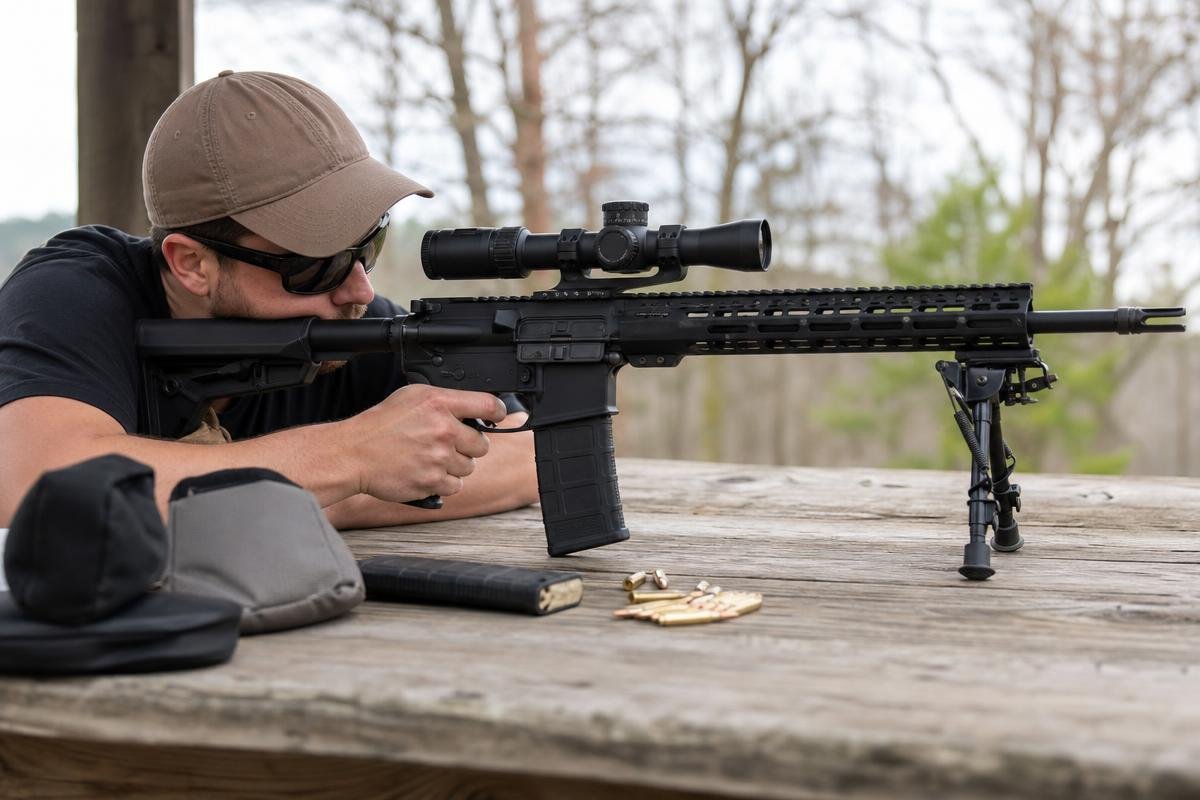
At AR15Parts.com, we ship from our Denison, TX facility at 4000 Texoma Pkwy, Denison, TX 75020. We help you choose an AR-15 LPVO by matching magnification, reticle, weight, eye relief, and mount setup to the distances you actually shoot. Start with your rifle’s role, then choose a scope that gives you a usable 1x view up close and enough magnification for your farthest practical target. Need help matching an LPVO to your AR build? Call our team and discuss the rifle, cartridge, and shooting distances you have in mind.
Key Takeaways
- A true or near-true 1x setting supports fast target acquisition at close range.
- Choose 1-6x for general use, 1-8x for added target detail, and 1-10x for distance-focused shooting.
- Choose an LPVO for your AR-15 based on normal distance, target size, shooting position, and rifle role.
- Reticle design, focal plane, illumination, weight, mount height, and eyebox affect practical performance as much as magnification.
What an LPVO Does for an AR-15

An AR-15 LPVO can cover close targets and intermediate distances, but the wrong scope can slow you down and make the rifle harder to run. Before buying, decide what distance, target size, and shooting position your rifle must handle.
Start with the role of your rifle, not a generic best-LPVO list. A 5.56 rifle used for fast range work needs different glass than a rifle set up for deliberate hits at longer distances. In North Texas, bright sun, changing target contrast, wind, and open-range conditions can make a visible illuminated center point and a reliable holdover reticle more useful than extra magnification alone.
Compare magnification range, reticle design, focal plane, illumination, eye relief, eyebox, weight, durability, and mount setup, plus when a red dot or prism sight may fit better. Browse our complete AR-15 rifles if you are building the optic setup around a turnkey rifle.
Start With the Distance and Job Your AR-15 Must Cover
Choose an AR-15 LPVO after defining your normal distances, target sizes, and shooting positions. A scope that works well on a close-range carbine may add unnecessary weight or limit speed on a rifle used mostly from standing positions.
Close-Range Speed Starts With a Usable 1x Setting
A true or near-true 1x setting helps you acquire targets quickly at close range. This matters during standing, kneeling, and improvised positional shooting, where shooting with both eyes open gives you a wider view of the target area.
For a general-purpose rifle used inside roughly 300 yards, prioritize a clean 1x image and a bright center aiming point over extra top-end power.
More Magnification Helps With Smaller or Farther Targets
Higher magnification helps you identify smaller targets and place more precise holds at intermediate distance. A 6-inch target at 300 yards demands more visual detail than a full-size steel target at 100 yards.
Expect practical distance to change with ammunition, wind, target contrast, shooter skill, and the rifle's zero. Magnification helps you see and aim, but it does not guarantee hits at a fixed distance.
Rifle Configuration Changes the Useful Distance
A 16-inch 5.56 NATO carbine is commonly set up for general-purpose use, where a 1-6x AR-15 LPVO often fits the rifle's role. Review our 5.56 NATO upper receivers if you are building around that cartridge and barrel format.
A 6.5 Grendel rifle is often selected for more distance-oriented shooting. Its flatter trajectory and retained energy can justify more top-end magnification, especially on smaller targets. Our 6.5 Grendel upper options give you a useful starting point for that type of build.
Choose Between 1-6x, 1-8x, and 1-10x Magnification
Your rifle's role and target requirements determine which magnification range makes sense. An AR-15 LPVO should give you usable 1x speed and enough top-end detail for the farthest target you expect to identify and engage.
| Range | Strongest Use | 1x Speed | Top-End Detail | Eyebox | Size and Weight | Ideal Buyer |
|---|---|---|---|---|---|---|
| 1-6x | General-purpose shooting | Often easier to use quickly | Good for common carbine distances | Often more tolerant | Often more manageable | Balanced rifle build |
| 1-8x | Mixed-distance shooting | Varies by optic design | More target detail | Can tighten at 8x | Can add weight | One rifle for broad use |
| 1-10x | Distance-focused shooting | Varies significantly by model | Highest detail | Often requires more exact head position | Often larger and heavier | Precision-oriented shooter |
Optical clarity, true 1x behavior, weight, field of view, and eyebox vary significantly by model and price tier. Compare the actual specifications, reticle layout, and mounting requirements before choosing a scope.
Is a 1-6x LPVO Enough for an AR-15?
Yes, 1-6x is enough magnification for most general-purpose AR-15 rifles. It keeps the scope manageable at 6x while providing a wide, fast view near 1x for closer work.
This is the practical answer in a 1-6x versus 1-8x decision for many shooters. A full-size steel target may be workable well beyond typical carbine distances at 6x, while a small paper target, difficult lighting, or precise aiming requirement may call for more visual detail. Pair this range with a 5.56 rifle or one of our 5.56 NATO upper receivers when your build needs a balanced optic rather than maximum magnification.
What You Gain and Give Up With 1-8x
A 1-8x gives you more target detail at the top end. That added magnification can help you read a target better and hold more precisely at longer distances.
The tradeoff is often a tighter eyebox at 8x, a less forgiving 1x image, added weight, or higher cost. Check those details on the actual scope, because optical design matters as much as the magnification number. If your rifle must work from close positions but you also want to inspect smaller targets at distance, 1-8x can be the middle ground.
Who Should Consider a 1-10x LPVO
A 1-10x LPVO fits shooters who place target identification and precise aiming at distance ahead of minimum weight. It makes more sense on a distance-oriented build than on a light general-purpose carbine.
Expect a more exact head position, especially at 10x, plus a larger scope body and higher cost. A distance-focused build using a cartridge with more reach, such as 6.5 Grendel, is a more natural match for this magnification range. Have the magnification range narrowed down? Call us to discuss the optic, rifle configuration, and mount setup before you buy.
Match the Reticle, Focal Plane, and Illumination to Your Use
The reticle determines how quickly you can aim at 1x and how consistently you can hold for distance. This part of an AR-15 LPVO matters as much as the magnification range. Match it to your cartridge, zero, and the targets you expect to shoot.
Pick a Reticle That Works at 1x and at Distance
A simple illuminated center dot or horseshoe gives you a fast reference for close targets. A BDC reticle adds drop marks, while a ranging reticle may include holdover and wind references for longer shots.
BDC marks are approximate, not universal. They only track closely when ammunition velocity, barrel length, zero distance, atmospheric conditions, and target distance match the reticle calibration. A 5.56 load from one of our 5.56 NATO upper receivers can print differently than another load from a shorter barrel. Confirm every hold on paper and steel before relying on it.
Should You Choose a First- or Second-Focal-Plane LPVO?
Choose first focal plane, or FFP, if you need reticle hold marks to remain accurate at more than one magnification setting. Choose second focal plane, or SFP, if you prefer a reticle that stays the same apparent size and expect to use its calibrated holds at the stated power.
With FFP, the reticle changes apparent size as magnification changes, so subtensions such as holdover and wind marks remain valid throughout the range. SFP keeps the reticle the same apparent size, and its hold marks are usually calibrated at one stated power, often maximum magnification. SFP is often easier to see at 1x, while FFP is useful if you regularly hold at intermediate power.
Check Illumination in Bright Conditions
Daylight-bright illumination means the center aiming point stays visible against a sunlit target at 1x. It should work like a clear reference point, not disappear in bright conditions or force you to hunt for the reticle.
Turn the illumination through its settings before buying. Excessive brightness can cause reticle bloom, where the lit center looks fuzzy and covers too much of the target. A controlled, visible center point makes an AR-15 LPVO faster for close work while the etched reticle remains available if the battery is off.
Not sure whether an FFP, SFP, BDC, or simple illuminated reticle fits your rifle? Speak with our team about your cartridge and planned zero.
Check Eyebox, Eye Relief, Weight, and Durability Before Buying
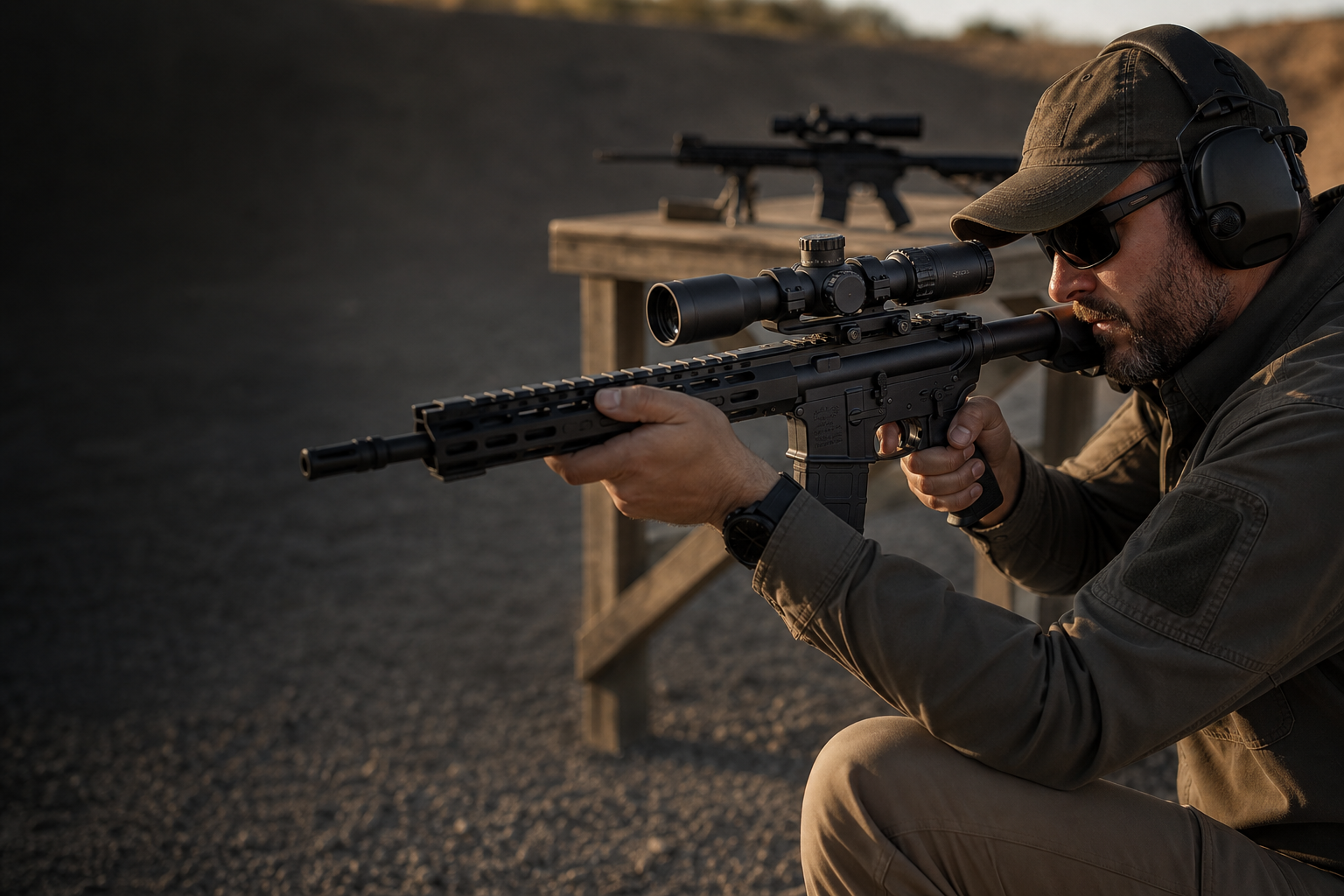
An AR-15 LPVO can have the right magnification and reticle but still fit poorly behind your rifle. Check how it presents an image from real positions before you commit to a scope and mount.
Test Eye Relief and Eyebox From Real Shooting Positions
Eye relief is the distance from the ocular lens to your eye. Eyebox is the usable head-position window that still gives you a full sight picture. A forgiving eyebox lets you mount the rifle quickly without searching for the image.
With an unloaded rifle pointed in a safe direction, shoulder it standing, kneeling, and from a supported position. At 1x and maximum power, you should see a full image without moving your head around. Check field of view, edge distortion, and low-power clarity during fast target transitions.
Balance the Optic and Mount as One System
Scope weight changes how an AR-15 handles, especially once you add a mount. Keep all mount attachment points on the upper receiver rather than the handguard, then position the scope for proper eye relief. This protects the mounting interface while allowing proper scope placement.
Mount centerline height also affects your cheek weld and head position. Confirm that your chosen height gives you a natural view without lifting your head off the stock. Test the setup on complete AR-15 rifles or the upper configuration you plan to run.
Inspect the Features That Affect Long-Term Use
Turn the magnification ring, adjust the turrets, and check that clicks are distinct and repeatable. Look for recoil resistance, waterproof construction, protected illumination controls, and a mount that holds its position under firing.
Confirm zero after installation, after a hard impact, and after a major configuration change. A heavier 1-10x scope may add capability, but it also adds mass that your mount and rifle must carry through every transition. Match the optic to the balance of your rifle, not just its magnification range.
Need help checking LPVO fit, mount height, or rifle balance? Call us at (888) 706-0633.
LPVO vs. Red Dot vs. Prism Sight and How to Pick the Optic Type
An AR-15 LPVO, red dot, and prism sight solve different sighting problems. Pick based on your expected distance, need for target detail, battery dependence, and how your eyes see the reticle.
Red Dots for Simple Close-Range Speed
A red dot is compact, light, and fast for close-range shooting. It gives you an uncluttered aiming point with both eyes open, but it provides no magnification for reading small targets or identifying detail farther out.
In an LPVO versus red dot decision, choose the dot if fast presentation matters more than hold references and magnified observation. A red dot can be a better fit on a lightweight carbine built around close work.
LPVOs for Variable Magnification and Hold References
An LPVO can replace a red dot if your rifle must cover close targets and longer shots. At 1x, it can be run quickly, while higher magnification helps you see target detail and use elevation or wind holds.
You give up some simplicity. An AR-15 LPVO adds scope weight, a mount-height decision, eye position requirements, and more controls to manage. It fits well on 5.56 NATO upper receivers used across mixed distances.
Prism Sights for an Etched Reticle Option
A prism sight uses an etched reticle that remains visible without illumination. This gives you a defined aiming reference if the battery is off, though most prism sights have fixed magnification and less field of view than a true 1x optic.
Some shooters with astigmatism see an etched prism reticle more clearly than a projected dot. Individual vision varies, so look through the optic before buying if possible. For help matching an optic to your rifle, contact AR15Parts.com at (888) 706-0633.
Mount the LPVO at the Right Height and Confirm Your Zero
An AR-15 LPVO only works as intended when the mount position gives you a repeatable sight picture. Mount it on the upper receiver, set the scope for your natural shooting position, and confirm zero with the ammunition you plan to carry or shoot.
Start With a One-Piece Cantilever Mount
A one-piece cantilever mount is the common starting point for an AR-15 LPVO. It moves the scope forward for proper eye relief while keeping both mounting points on the receiver.
Do not bridge the upper receiver and handguard. A handguard can move independently under pressure, heat, or support loading. That movement can shift the optic relationship to the bore. This applies whether you use a complete AR-15 rifle or a separate upper and lower setup.
Start Around 1.5 to 1.54 Inches, Then Check Fit
A centerline around 1.5 to 1.54 inches is the conventional AR-15 LPVO mount-height baseline. A 1.70-inch mount is a popular taller option for a more upright head position.
Choose mount height based on stock fit, cheek weld, shooting position, and any helmet or night-vision requirements. Shoulder the unloaded rifle with your eyes closed, then open them. You should see a full sight picture without lifting your head or crawling the stock.
Level, Torque, and Zero the Setup Safely
Mounting is not complete until the rifle is zeroed and the zero is confirmed. Start with the firearm unloaded and pointed in a safe direction. Install the mount on the receiver, then follow the mount maker's torque specifications for the crossbolts and ring screws.
- Level the rifle in a stable support.
- Level the reticle with suitable tools before final ring torque.
- Check eye relief at 1x and maximum magnification.
- Zero with your intended ammunition, then fire a confirmation group.
Recheck fasteners after initial firing if the mount manufacturer calls for it. If you need help pairing an optic with a new upper, our 5.56 NATO upper receivers give you a practical general-purpose AR platform to start from. Before finalizing your setup, contact AR15Parts.com for help pairing your rifle with an appropriate mount and optic configuration.
Build an LPVO Setup Around Your Rifle
For help choosing an AR-15 LPVO, start with the rifle you plan to shoot. We ship from our Denison, TX facility at 4000 Texoma Pkwy, Denison, TX 75020, and our team can help you plan compatible components by phone or through our contact form before you commit to an optic.
Treat the Rifle and Optic as One System
An AR-15 LPVO should match the whole rifle, not a generic best-LPVO list. Barrel length, gas system, stock fit, cheek weld, and ammunition all affect balance, recoil movement, and how consistently you can get behind the scope. A light carbine with a short barrel handles differently than a longer rifle built around a precision load. Start with a complete AR-15 upper, then select an optic and mount that fit the rifle’s lawful intended use.
Plan the Build Before Choosing the Final Optic Setup
Plan the rifle first, then choose the final optic setup. A 5.56 carbine may favor a lighter scope and simple holdover reticle, while a longer-range build may justify more magnification and a reticle matched to its ammunition. Confirm the barrel, gas system, stock position, mount height, and load before buying. Our 6.5 Grendel upper options give you a different distance and ammunition plan than a general-purpose 5.56 setup.
Frequently Asked Questions
What Is the Best General-Purpose LPVO Magnification?
A 1-6x is often the practical general-purpose choice. In the 1-6x vs 1-8x LPVO decision, target size and intended distance should decide the extra magnification.
Is 6x Enough for 500 Yards?
Yes, 6x can work at 500 yards with an appropriately sized target and a capable rifle-ammunition combination. More magnification helps identify targets and refine your aiming point.
Should I Choose First Focal Plane or Second Focal Plane?
Choose first focal plane if you need hold marks to remain valid throughout the magnification range. Second focal plane keeps the reticle visually consistent, but holds are commonly calibrated at one power setting.
Can an LPVO Replace a Red Dot?
An LPVO can replace a red dot if you need both close-range speed and magnification. In an LPVO vs red dot comparison, a red dot remains lighter and faster for strictly close work.
What AR-15 LPVO Mount Height Should I Use?
Roughly 1.5 to 1.54 inches is the conventional AR-15 LPVO mount-height baseline; 1.70 inches is a popular taller option. Choose based on stock fit, shooting position, cheek weld, and any helmet or night-vision requirements.
Do I Need Backup Sights With an LPVO?
Backup sights are optional, but they provide a mechanical aiming reference if the optic is damaged or unavailable. They can be useful on a rifle set up for field use.
If you are planning a build, compare our complete AR-15 rifles and complete AR-15 uppers. Contact AR15Parts.com at (888) 706-0633. Our team can help match firearms, parts, and accessories to your intended role.
Ready to Get Started with AR15Parts.com?
Call (888) 706-0633 to speak with our team directly. We're ready to answer your questions, walk you through your options, and help you find the right solution for your needs. Whether you're just starting to plan or ready to move forward, we'll make the process simple and stress-free. Reach out today and let's talk about how we can help.