


Choosing AR-15 optics starts with how you use your build. Red dots favor close-range speed, fixed-power scopes suit predictable distances, and LPVOs offer adjustable magnification. Mount height, rail space and reticle compatibility matter too. We carry complete uppers, barrels and build components in a wide range of calibers, shipped from our Denison, TX facility at 4000 Texoma Pkwy, Denison, TX 75020. Compare the optic types and mounting options below before you buy, and contact our team for parts and compatibility advice.
AR-15 Optics: Types and Buying Takeaways
- AR-15 optics include fast red dots, fixed-power scopes for predictable distances, and LPVOs that cover close and mid-range targets.
- Red dots are lighter and faster at close range but offer no magnification for shots past 100 yards.
- A 1-6x LPVO can be a practical choice for shooters who use both 100- and 200-yard range bays.
- Sealed tube-style red dots can protect the emitter from heat, dust, and humidity better than open-emitter designs.
- Your intended use, barrel length, and caliber should drive the optic choice before budget does.
What Is a Red Dot Optic and How Does It Work on an AR-15?
A red dot optic is a non-magnifying sight that projects an LED reticle onto a reflective lens, allowing fast target acquisition at true 1x. You look through the glass, place the dot on the target, and shoot. Because there is no magnification, both eyes stay open and your field of view stays wide. The dot appears superimposed on whatever you are looking at, so the shooting process feels almost instinctive up close.
Most AR-15 red dots use a 2 MOA or 3 MOA dot. At 100 yards, a 2 MOA dot covers roughly 2 inches of the target. That is precise enough for practical accuracy at typical range distances. Choosing the best optic for your AR-15 starts with understanding what each design actually does, not just what it looks like on the rail.
Tube-Style vs Open-Emitter Red Dots
Tube-style red dots, like the Aimpoint PRO and Aimpoint CompM5, enclose the emitter in a sealed housing. Some models advertise battery life in the tens of thousands of hours, but the exact runtime depends on the model and brightness setting. The sealed design holds up to dust, rain, and humid conditions. For a 300 Blackout complete upper, a tube-style optic offers better emitter protection in blowing dust and wet conditions.
Open-emitter designs, like the Trijicon RMR and Leupold DeltaPoint Pro, are lighter and give a wider field of view. The trade-off is exposure. An open lens picks up debris faster in dusty conditions. They work, but they demand more frequent cleaning.
Typical Magnification and Window Size Specs
Red dots run at fixed 1x. Window sizes range from 20mm to 40mm. A 33mm to 40mm window speeds up target acquisition because you do not need to center your eye precisely behind the glass. For close-range AR-15 use, a larger window is the practical choice. If you are building on one of our complete AR-15 uppers, matching the optic footprint to your intended engagement distance matters before you buy.
When Does a Fixed-Power Scope Make Sense?
A fixed-power scope keeps one magnification, which can suit a build used mostly at predictable mid-range distances. Unlike a red dot, it requires attention to eye relief; unlike an LPVO, it cannot dial down for closer targets. Before buying, check your upper's rail space, scope tube diameter, mount height and eye relief.
Where Do LPVOs Fit Among AR-15 Optics?
An AR-15 LPVO, or low power variable optic, is a riflescope that starts at or near 1x magnification and increases to a higher power via a throw lever or power ring. That variable range is what separates it from a fixed-power scope and from a red dot. You get close-range speed at 1x and genuine magnified precision when you need to read a target at 200 yards across open pasture.
Magnification Range: 1-4x, 1-6x, 1-8x, and 1-10x
The magnification ceiling changes the weight, eye box, and practical role of the optic. A 1-4x is compact and light, a good fit for a carbine-length build used inside 150 yards. A 1-6x is a common choice for a general-purpose AR-15 and can cover both 100-yard and 200-yard targets without the bulk of higher-magnification options. A 1-8x or 1-10x extends your reach further but narrows the eye box and adds noticeable weight to the front end. On a suppressed hunting rifle, a 1-6x can cover a wide range of common shot distances.
True 1x vs Approximate 1x
Not every LPVO delivers a genuine 1x at its lowest setting. A well-designed 1x setting can support both-eyes-open shooting with minimal distortion, but an LPVO still requires proper eye relief and alignment. Approximate 1x designs introduce slight image magnification that slows your target acquisition at speed. When you are comparing the best optic for AR-15 use at close range, confirm the manufacturer specifies true 1x, not just "1x minimum."
Reticle Types: BDC, Mil, MOA, and Illuminated
BDC reticles are calibrated to a specific cartridge and barrel length. A 5.56 NATO BDC zeroed on a complete 5.56 NATO upper will not hold correctly if you swap to 300 Blackout or 6.5 Grendel without re-zeroing. A holdover reticle can use evenly spaced MOA marks so you can apply a verified hold for a specific caliber and load rather than relying on an unrelated BDC curve.
That makes Mil and MOA reticles the smarter choice if you run multiple uppers. Illuminated reticles with a center dot or chevron replicate red-dot speed at 1x, which is the primary close-range advantage of a quality low power variable optic AR-15 setup over a fixed-power scope.
Comparing AR-15 Optics by Distance and Use
No single optic wins every scenario. A red dot prioritizes close-range speed, a fixed-power scope suits a defined distance, and an LPVO adds flexibility when distances change. Your intended use and build determine which belongs on the rail.
Close-Range Speed: Inside 50 Yards
Inside 50 yards, a red dot wins. Both eyes stay open, there is no power ring to rotate, and the dot lands on target fast. Competition shooters running 3-Gun or USPSA carbine stages choose red dots for exactly this reason. An LPVO set to true 1x is close, but the tube and eye box still slow you down compared to an open-emitter red dot under time pressure.
Mid-Range Precision: 100 to 300 Yards
At 100 to 300 yards, a 1-6x or 1-8x LPVO is the better tool. A 2-3 MOA red dot covers roughly 4 to 6 inches of target at 200 yards. That is workable for center-mass hits on a silhouette, but it is not precise enough for consistent accuracy on a smaller target or for reading wind and drop. Dial the LPVO to 4x or 6x, use the calibrated reticle, and you have real precision at distance.
Range distances vary, but 100-yard and 200-yard bays are useful benchmarks for comparing optic performance. A 1-6x LPVO makes both distances practical on the same rifle without swapping optics. On a suppressed hunting build, reticle calibration to your subsonic or supersonic load matters even more.
Home Defense, Competition, and Hunting Scenarios
For home defense on a carbine build, use a red dot. Simpler, lighter, and nothing to fumble under stress. For competition stages that mix close and mid-range targets, the LPVO gives you more flexibility across the course.
For hunting, shot distance varies with terrain, conditions, equipment, and the shooter's demonstrated ability. When magnification and additional precision are needed, an LPVO can outperform a red dot. A complete 5.56 NATO upper for AR-15 paired with a 1-6x LPVO can support that use case. A red dot may offer less precision on smaller targets at longer distances. Shopping for a compatible upper? Browse our complete uppers and contact our team for compatibility advice.
Can You Run Both? Co-Witnessed and Offset Optic Setups Explained
Yes, you can run an AR-15 LPVO and a red dot on the same rifle. This is not a gimmick. It is a legitimate setup used by 3-Gun competitors, PRS carbine shooters, and serious general-purpose builders who want magnified reach without sacrificing close-range speed.
Offset Red Dot Mounts: 45-Degree and 90-Degree
A 45-degree offset mount positions a compact red dot at a 45-degree angle to the bore axis. You rotate the rifle slightly to bring the red dot into your sight picture for close targets, without touching the magnification ring on your AR-15 LPVO. This is the dominant setup in 3-Gun competition and PRS carbine stages where targets can shift from 10 yards to 200 yards in the same stage.
Your handguard has to support the offset mount. M-LOK and KeyMod systems accept offset adapters differently, so check your specific handguard's rail real estate before buying a mount. Check mount clearance and rail space before taking the setup to the range.
Co-Witnessing: Absolute vs Lower-Third
Co-witnessing aligns your iron sights through the red dot window. Absolute co-witness places the front sight post at the center of the dot. Lower-third co-witness drops the irons to the bottom third of the window, leaving the dot unobstructed during normal use. Co-witnessing only applies when the red dot is your primary optic, not when it is mounted in an offset position.
Weight and Balance Trade-Offs
A dual-optic setup adds weight depending on the red dot and mount. On a lightweight pencil-profile build, that negates most of your weight savings. Factor this in before committing to the configuration. Our complete AR-15 uppers give you a starting point to build around before adding optics weight.
Have questions about offset mounts or optic compatibility with your build? Call us at (888) 706-0633 for parts and compatibility advice.
How to Match Your Optic to Your AR-15 Build Specs
Barrel Length and Gas System Pairing
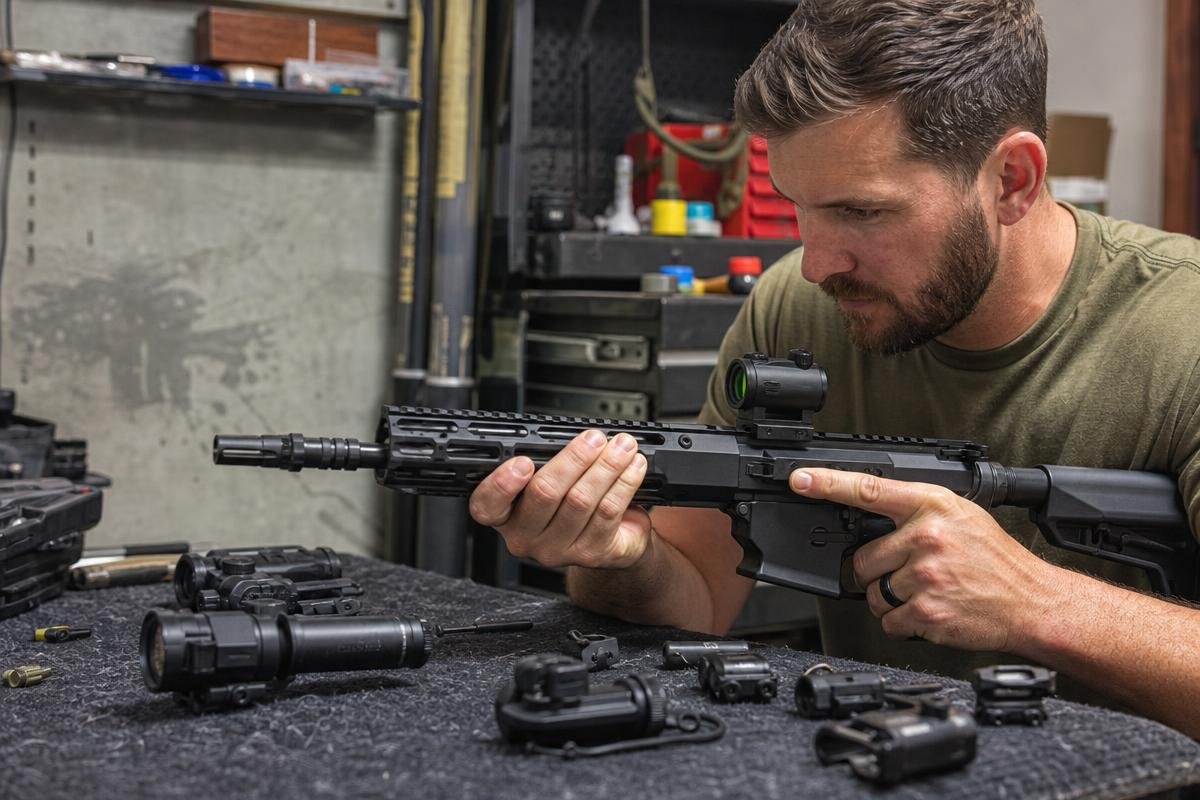
A 16-inch mid-length setup can pair well with an AR-15 LPVO, but practical accuracy depends on the barrel, ammunition, optic, mount, and shooter. If you are running a 10.5-inch pistol upper with a carbine gas system, pair it with a red dot instead. The shorter platform and greater muzzle blast can make a lightweight red dot the more practical choice for some users. Browse our complete AR-15 uppers to see which barrel configurations we stock.
Caliber Considerations and Reticle Compatibility
A 5.56 NATO BDC reticle will not hold true for 300 Blackout supersonic loads past 100 yards. The ballistic curves are different enough that your holdovers become guesswork. For a suppressed 300 Blackout build, a mil or MOA reticle can be more adaptable than a 5.56-specific BDC. The same applies to 6.5 Grendel and 6mm ARC builds. If you swap uppers between calibers, a mil or MOA reticle can be a practical choice. Check our 300 Blackout uppers and our complete 5.56 NATO uppers for AR-15 to confirm your chamber before selecting a reticle.
Rail Height, Mount Height, and Cheek Weld
Most AR-15 flat-top receivers run a standard Picatinny rail. LPVOs typically require a 30mm or 34mm tube mount. Mount-height requirements vary by stock, cheek weld, shooting position, and optic design. Follow the mount and optic manufacturers' specifications for the exact setup. Getting mount height wrong forces you to crane or drop your head to find the eye box, which kills both speed and shot consistency. Match your mount height to your stock before you torque anything down.
Which AR-15 Optics Setup Fits Your Build?
Four Questions to Work Through Before You Buy
Stop guessing. Answer these four questions and the right optic becomes obvious.
- What is your primary engagement distance? Inside 100 yards, 100 to 300 yards, or both?
- Is this build dedicated to one role or general-purpose? A home defense carbine and a hunting rifle are not the same problem.
- How much does your build weigh now, and what is your weight ceiling? An LPVO and mount usually add noticeable weight compared with a red dot, so compare the exact manufacturer specifications. That matters on a long carry.
- Does your stock position and mount provide consistent eye relief? Some LPVO designs require more consistent head position than a red dot demands.
When Variable Magnification Is the Better Buy
Choose an AR-15 LPVO for general-purpose builds, hunting rifles, and precision carbine competition. If you expect to engage targets beyond 100 yards with any regularity, the variable magnification earns its weight. For a suppressed 300 Blackout build, verify that the reticle's holdovers match the cartridge and load.
When the Red Dot Is the Clear Choice
Choose a red dot for dedicated home defense builds, short-barreled and pistol-configuration ARs, and 3-Gun stages where close-range speed is the primary metric. If weight is a hard constraint, the red dot wins. For a general-purpose build that needs both close and extended range, revisit the offset dual-optic section above.
Optics Choices for Different AR-15 Builds
Matching Optics to Conditions and Distances
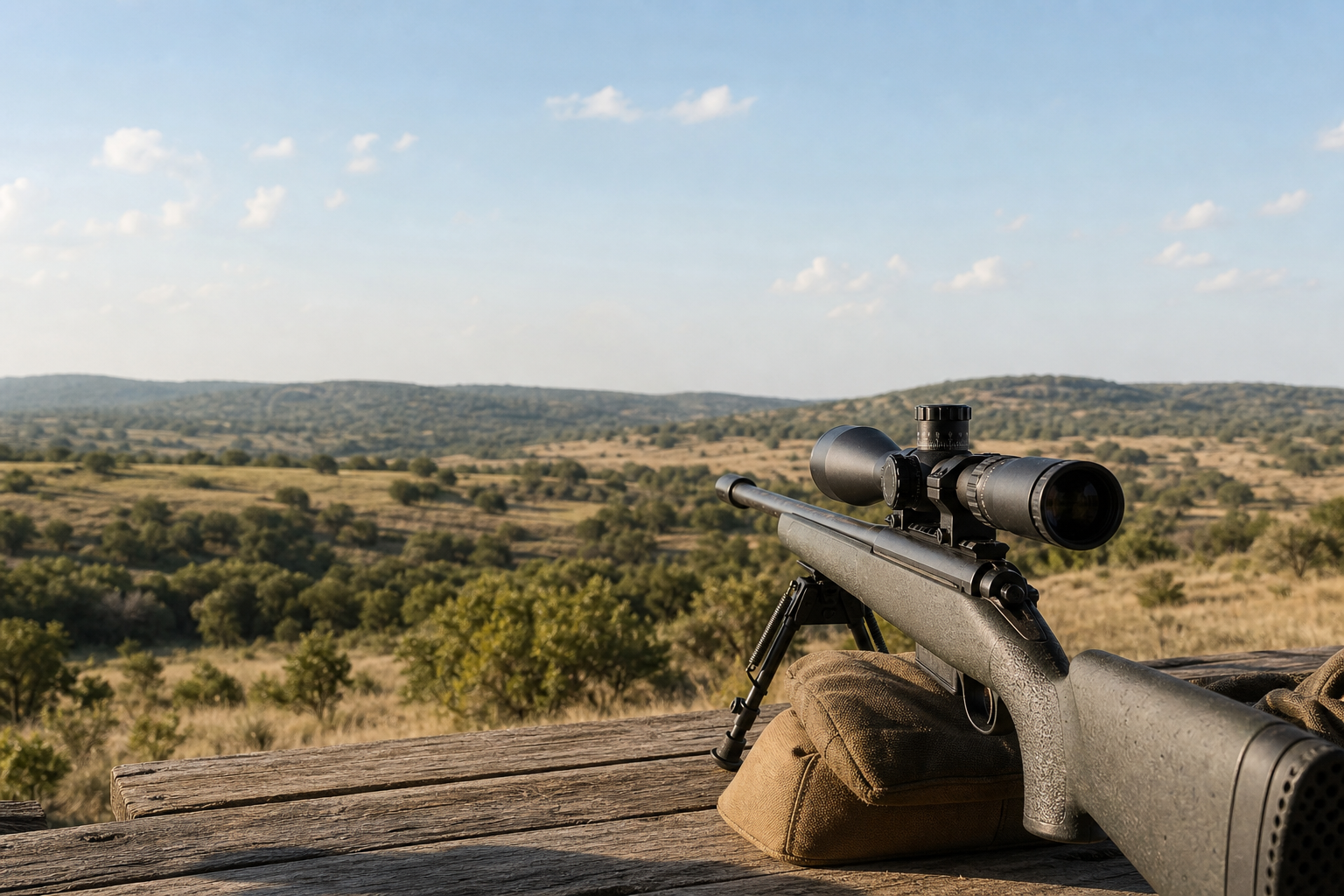
Shooting distances and conditions vary by location and use. A 1-6x AR-15 LPVO offers magnification for targets at different distances. If your range offers 100-yard and 200-yard bays, that magnification range can cover both without changing optics.
Heat, dust, and humidity can be hard on optics. Sealed tube-style red dots protect the emitter better than open-emitter designs in dusty or wet conditions. If you run a red dot and a low power variable optic on separate uppers, compare housing durability for each optic.
Caliber and Reticle Compatibility
5.56 NATO and .223 Wylde are common AR-15 chamberings, and our 5.56 NATO complete uppers cover that ground. 300 Blackout is another common AR-15 chambering. 6.5 Grendel and 6mm ARC are also used for longer-range AR-15 applications.
Each caliber carries a different ballistic arc, which means BDC reticles calibrated for one round will read incorrectly on another. A mil or MOA reticle on a general-purpose AR-15 LPVO solves that. It works across multiple uppers without swapping optics. We carry complete uppers in a wide range of calibers, all shipping from 4000 Texoma Pkwy, Denison, TX 75020.
Frequently Asked Questions
What magnification range is best for a general-purpose AR-15?
A 1-6x LPVO is the most practical choice for a do-everything build. At 1x you get both-eyes-open speed for close targets. At 6x, practical precision depends on target size, cartridge, conditions, and the shooter's ability. Heavier 1-8x and 1-10x scopes require a more stable position to use the top end effectively, which limits their value for general use.
Can a red dot replace iron sights on an AR-15?
Yes, a red dot can serve as your primary sighting system. Most experienced builders still keep folding backup iron sights on the rail as a redundancy. If the battery dies or the emitter takes damage, you want a fallback.
How much does a quality red dot or LPVO cost?
Pricing varies by brand, construction, reticle design, glass quality, magnification range, and availability. Compare current product specifications and pricing before choosing an optic.
Will an LPVO work on a suppressed 300 Blackout build?
An AR-15 LPVO mounts and functions normally on a 300 Blackout complete upper. The optic itself is unaffected by suppressor use. The key issue is your BDC reticle: it must be calibrated to 300 Blackout ballistics, not 5.56. Suppressor use can change balance and backpressure, so follow the upper and suppressor manufacturers' guidance for buffer and gas-system setup.
How much eye relief does an AR-15 LPVO require?
Eye relief varies by model, and every LPVO requires the shooter to remain within the manufacturer's specified range. That is far less forgiving than a red dot, which has essentially unlimited eye relief. Mount height and stock length of pull both affect whether you get a consistent cheek weld at the correct distance.
Is an LPVO a good choice for a home defense AR-15?
For a dedicated home defense rifle, a red dot is the simpler choice. An AR-15 LPVO set to 1x functions similarly to a red dot at close range, but the eye box is tighter and the power ring adds a manipulation step under stress. Simpler is faster when it matters most.
Ready to pair the right optic with the right upper? Browse our complete AR-15 uppers in a wide range of calibers at AR15Parts.com, or call us at (888) 706-0633. We ship nationwide from 4000 Texoma Pkwy, Denison, TX 75020. Tell us your caliber and upper specifications, and we can help you check parts compatibility before you buy.
Ready to Get Started with AR15Parts.com?
Call (888) 706-0633 or contact our team for parts and compatibility advice. We can help you check component specifications and choose compatible parts for your build.