
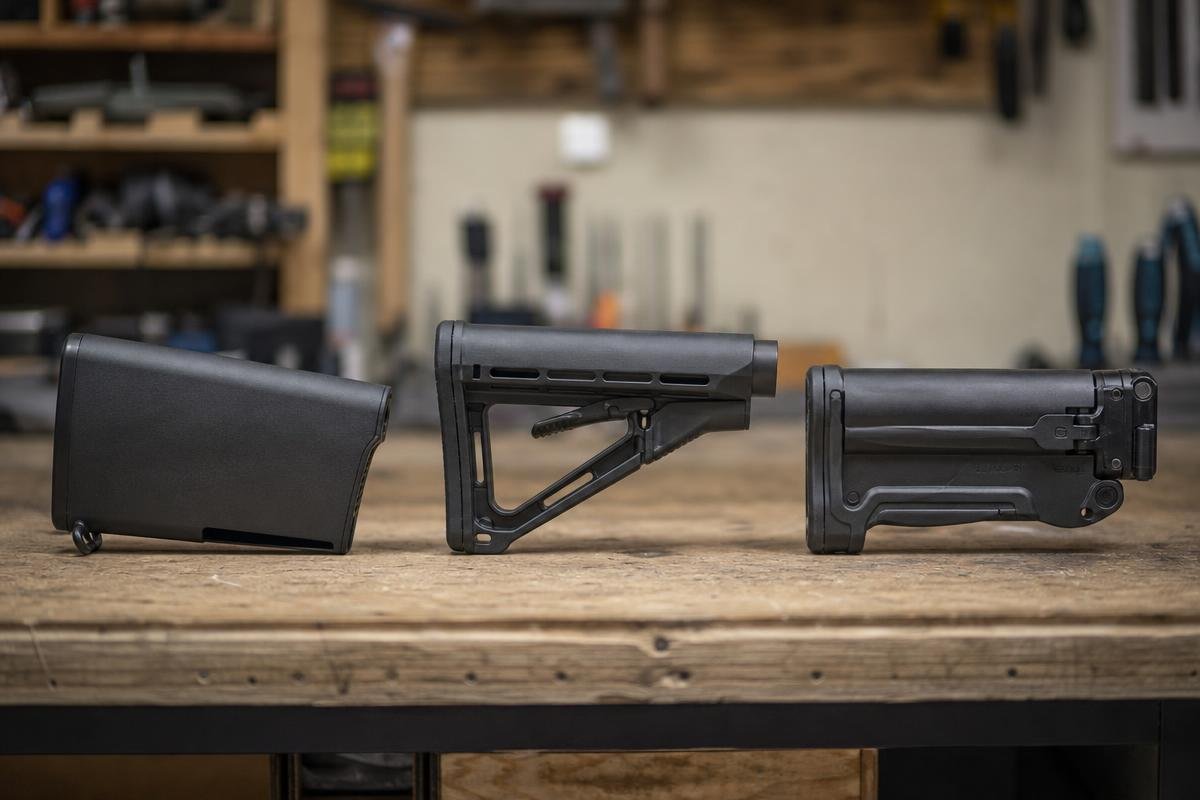
Choosing the right AR-15 stock changes how the rifle fits, handles, and stores, and the wrong choice costs you comfort and accuracy. We carry fixed and adjustable AR-15 stock kits at AR15Parts.com, shipping from our Denison, TX facility. We compare how each type works, its trade-offs, and how to match a stock to your build. Not sure which stock fits your lower? Tell us your build and we'll match you to the right option.
Key Takeaways
- Fixed stocks offer the most rigid, consistent cheek weld but cannot adjust for shooter size or body armor.
- An adjustable AR-15 stock lets you dial in length of pull and works across multiple shooters on the same rifle.
- Folding stocks reduce overall rifle length for storage and transport but require a folding adapter on a standard lower receiver.
- Mil-spec buffer tube diameter is the first spec to confirm before ordering any stock.
- Your intended use, range shooting, home defense, or field carry, should drive the stock choice more than price or appearance.
The wrong AR-15 stock turns a solid build into a rifle that fights you. Cheek weld shifts. Length of pull is off. Recoil pushes your head instead of your shoulder absorbing it. None of that is a comfort issue. It is a mechanical problem that affects accuracy, split times, and fatigue over a long range session.
No single AR-15 stock works for every shooter or every mission. Fixed stocks deliver a consistent, rigid platform. Adjustable stocks let one rifle fit multiple body types. Folding stocks cut overall length for storage and transport, with real trade-offs you need to understand before you buy. We compare all three types using practical specs to help you choose an AR-15 stock for your build.
AR15Parts.com ships parts and complete assemblies nationwide from 4000 Texoma Parkway, Denison, TX 75020. Browse our complete AR-15 uppers in 19-plus calibers or our complete AR-15 rifles while you work through this comparison.
What Does an AR-15 Stock Actually Do?
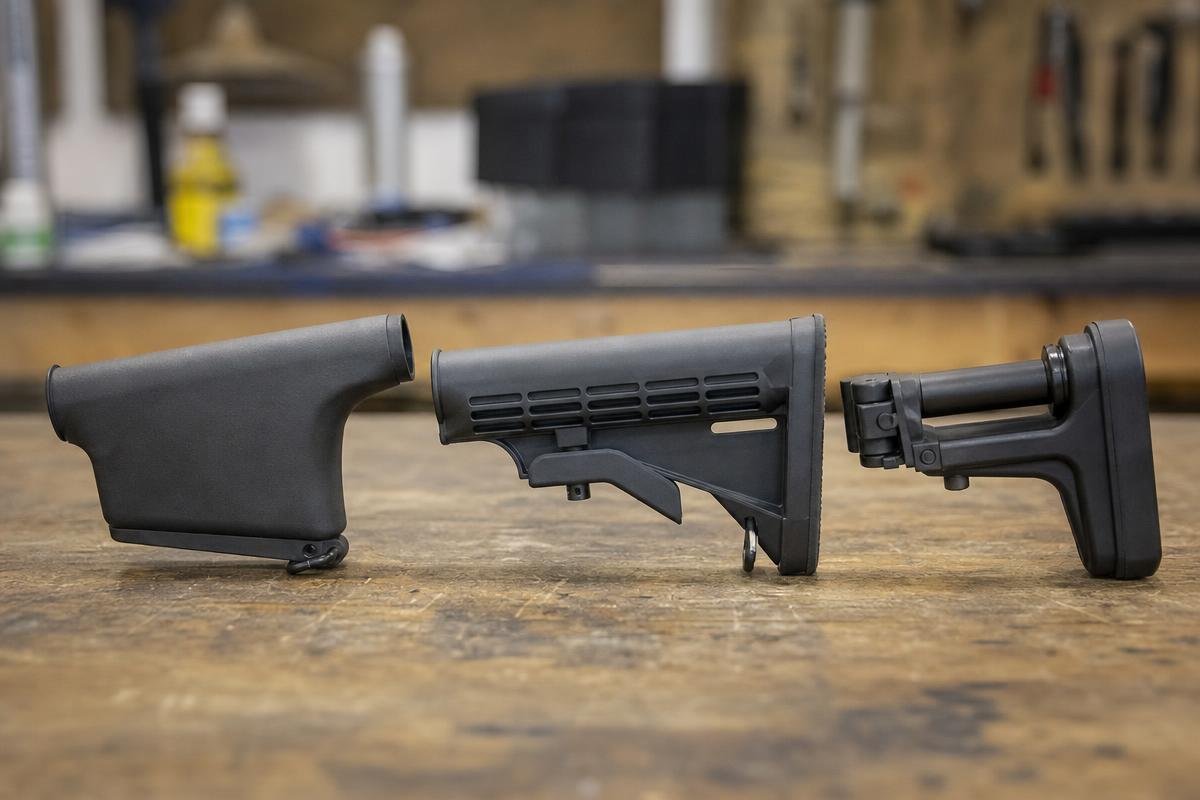
The stock does three jobs: it anchors the rifle against your shoulder, positions your eye behind the optic or iron sight, and channels recoil back into your body in a controlled path. Get the stock wrong and none of the other components matter. A precision barrel and a quality optic still produce poor groups if your cheek weld shifts between shots.
Length of Pull and Cheek Weld
Length of pull (LOP) is the distance from the trigger face to the center of the buttpad. An A2 fixed stock generally runs approximately 13 to 13.5 inches in length of pull, depending on the stock and measurement method. That fits a lot of shooters in a t-shirt, but add body armor or a heavy jacket and it becomes too long. Cheek weld consistency controls your eye alignment with the optic or sights. If your face lands in a different spot each time, your point of impact moves with it, regardless of how good the barrel is.
Note that complete AR-15 rifles ship with a stock already installed, so knowing your preferred LOP before you buy saves a swap later.
Recoil Management and Stability
The stock transfers recoil impulse through the buffer tube into your shoulder. Fixed stocks have no mechanical play, so that transfer is direct and consistent. Collapsible stocks introduce minor slop at the locking notches. Most field shooters never notice it. Competitive precision shooters sometimes do. The difference matters more at distance than it does inside 100 yards.
How Stock Type Affects Your Shooting Position
Prone, standing, and vehicle-mounted positions all favor different LOP settings. In rural Grayson County and across the Texoma region, truck-carry and ranch work mean shooters transition between positions quickly. A fixed stock commits you to one LOP. An adjustable stock lets the same rifle serve a standing field shot and a cramped vehicle exit without a tool change. If you want to see how a given stock pairs with a receiver set, browse our complete upper receiver options before you finalize a stock choice.
Fixed AR-15 Stocks: Stability Without Compromise
A fixed stock gives up one thing: adjustability. What you get in return is a stock with zero mechanical slop, no locking levers to wear out, and a cheek weld that sits in exactly the same position every time you shoulder the rifle. In a fixed vs adjustable AR-15 stock comparison, that consistency is the whole argument for going fixed.
The A2 Fixed Stock: Mil-Spec Geometry
The A2 buttstock is a single-piece polymer unit. It mounts to a rifle-length buffer tube, not a carbine tube, so confirm your lower is set up for that configuration before ordering. Length of pull generally runs approximately 13 to 13.5 inches, depending on the stock and measurement method. Weight is approximately 9 to 11 ounces, depending on manufacturer. There are no moving parts inside except a trapdoor compartment at the toe, which holds a small cleaning kit.
That trapdoor is the only thing that opens. Everything else is fixed. No levers, no pins, no play. On precision builds and dedicated bench guns where consistency matters, that rigidity translates directly to repeatable results at the bench. An A2 stock requires a compatible rifle-length receiver extension, buffer, and spring, but it does not require a rifle-length gas system.
Who Should Run a Fixed Stock
Fixed stocks work best when one shooter fires the rifle from one position repeatedly. Dedicated bench guns, prone precision builds, and range-only rifles are the obvious fits. If you share the rifle with shooters of different builds, a fixed stock becomes a liability. That conversation belongs in the next section on adjustable options.
Texas has no state-level assault-weapon restrictions, so Denison-area shooters pick fixed stocks for performance reasons, not paperwork. If you are building for a customer shipping to California, New York, or New Jersey, the AR-15 stock comparison changes significantly.
Legal Considerations for Fixed Stocks
A fixed stock appears in featureless build configurations in California, New York, and New Jersey. It is one piece of a compliance puzzle, not the whole answer. The full feature set on the rifle determines compliance, not the stock alone. Verify your state law before you build. We do not provide legal advice, and state statutes change, so confirm the current rules for your jurisdiction with a qualified source. Once you know which features your build needs, our team can help you match the correct stock, buffer tube, and buffer weight to that spec.
Adjustable AR-15 Stocks: One Rifle, Multiple Shooters
A collapsible stock solves one specific problem: different shooters, one rifle. Around Denison, home-defense rifles often get shared between family members of different sizes. A fixed stock fits one body well. An adjustable stock fits several.
How Collapsible Stocks Work on a Carbine Buffer Tube
The stock slides along the carbine buffer tube and locks into a machined notch via a lever or button on the stock body. Before you buy, confirm your buffer tube spec. Mil-spec tubes measure approximately 1.148 inches in outer diameter. Commercial-spec tubes measure approximately 1.168 inches. These are not interchangeable. A mil-spec stock generally will not fit over the larger commercial-spec tube. A commercial-spec stock on the smaller mil-spec tube generally fits loosely. This is one of the most common build mistakes we see.
Position Count and LOP Range
Most collapsible stocks offer 6 positions. That gives you a length-of-pull range of roughly 10.5 to 13 inches, covering a wide spread of shooter sizes and gear configurations. Extended models run 7 or 8 positions for taller shooters or those running body armor who need extra reach. That LOP range is the core of the fixed vs. adjustable AR-15 stock debate: fixed stocks lock you into one number, adjustable stocks let you dial it in per shooter or per task.
Best Use Cases for Adjustable Stocks
Collapsible stocks work best on patrol rifles, home-defense builds, and any rifle that transitions between prone and standing positions. Most factory carbines ship with a collapsible stock for exactly this reason. If your build will be used by multiple people or in varied positions, an adjustable stock is the practical choice for that AR-15 stock comparison. A fixed stock may still outperform it in pure precision work, but for general-purpose use, adjustability wins.
Folding AR-15 Stocks: Compact Storage with Real Trade-Offs
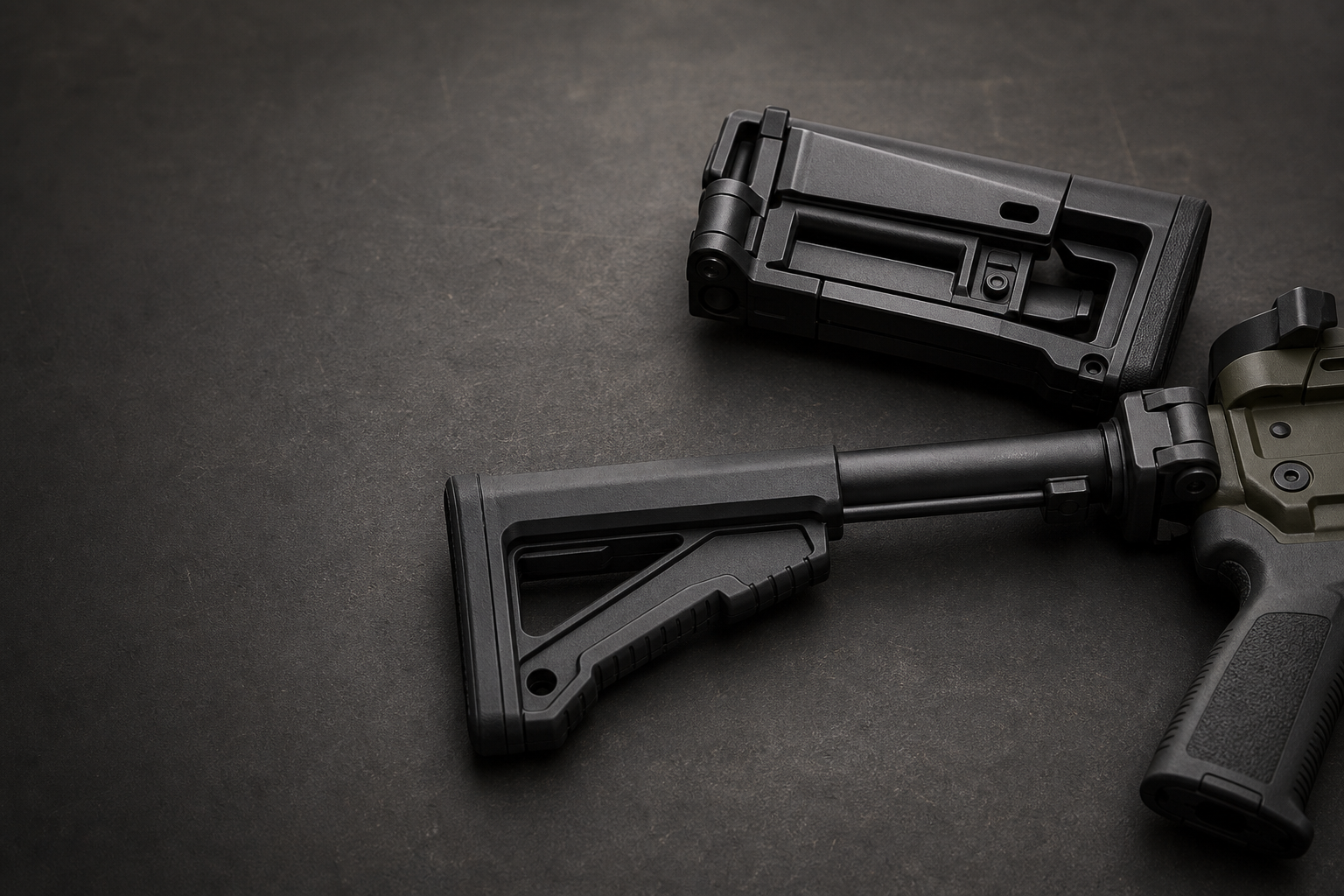
A folding AR-15 stock is not a drop-in swap. A standard AR-15 lower cannot fold without a side-folding adapter installed between the lower receiver and the buffer tube. The adapter allows the receiver extension and attached stock to fold in the direction specified by the manufacturer. Added length, folded dimensions, and operating limitations vary by adapter and stock model.
How Folding Mechanisms Work on AR-15 Lowers
A conventional adapter installs between the lower receiver and receiver extension. Model-specific components, commonly including a bolt-carrier extension, bridge the added distance while the compatible buffer and spring remain in the receiver extension. Other folding systems may require a bufferless upper or specialized carrier, so follow the specific manufacturer's instructions. Certain uppers in our caliber lineup are sometimes paired with folding setups when the build is designed around a non-standard charging system from the start.
The Critical Limitation: Follow the Folding System's Operating Instructions
This is the trade-off that matters most in any AR-15 stock comparison. Most conventional receiver-extension adapters must be locked open before normal firing and cycling, while some purpose-built bufferless systems can operate folded. Follow the specific manufacturer's instructions before use. If quick deployment matters, a folding setup is not your first choice.
When a Folding Stock Makes Sense
Vehicle and truck storage is the most practical use case for local shooters. A folded rifle fits behind a truck seat or inside a pack in a way a standard carbine stock simply cannot. For ranchers and deer hunters working land along the Red River corridor, that compact footprint matters during North Texas rifle season when the gun rides between the truck and a blind. It also matters for range transport. What it is not well suited for is primary home defense, especially in low-light conditions where deployment speed counts.
If you want to see complete build options before committing to a folding configuration, browse our complete AR-15 rifles to get a sense of how different stock setups affect overall length and handling.
Have questions about folding adapters or which stock type fits your build? Call us at (888) 706-0633 or reach out directly.
Fixed vs. Adjustable vs. Folding: Side-by-Side Comparison
Comparison Table: Key Specs at a Glance
All three AR-15 stock types solve different problems. This table puts the core specs in one place so you can compare them without digging through separate sections.
| Spec | Fixed | Adjustable | Folding |
|---|---|---|---|
| Buffer tube required | Yes | Yes | Model-specific; conventional adapters use a buffer tube |
| Typical LOP | Approximately 13 to 13.5 in | 10.5 to 13.5 in | Varies by stock used |
| Position count | 1 | Typically 6, up to 8 on extended models | Varies with attached stock; folding adds one folded position |
| Can fire while folded | N/A (does not fold) | N/A (does not fold) | Model-specific; follow manufacturer instructions |
| Approximate weight | Approximately 9 to 11 oz (A2) | 5 to 12 oz | Stock weight plus model-specific adapter weight |
| Common use case | Precision, duty, competition | General purpose, multi-shooter | Transport, storage, PDW builds |
| Legal complexity | Low | Low | Moderate (state laws vary) |
Weight and Balance Differences
A fixed A2 stock runs roughly 9 to 11 oz, depending on manufacturer. Basic collapsible stocks fall between 5 and 12 oz depending on material and cheek riser. A folding adapter adds model-specific weight on top of the attached stock and can shift the balance point rearward. That shift is noticeable on a rifle you carry for hours. If you are building a complete AR-15 rifle for field use, factor adapter weight into your total build weight before you commit.
Durability and Maintenance Considerations
Fixed stocks have the fewest moving parts. There is almost nothing to inspect or replace. Collapsible stocks need periodic checks on the locking lever and position notches, especially on high-round-count rifles. Shooters running hundreds of rounds per range session should inspect those notches for wear every few months.
Folding adapters add a pivot pin and a locking detent to the equation. Check the adapter-to-lower fitment and pivot pin wear regularly. Run a function check after any stock change before heading to the range. Shooters who put real round counts through their rifles at area ranges should watch those maintenance intervals closely, since they matter more than most people expect. If you have questions about compatibility, contact AR15Parts.com before you order.
How to Choose the Right AR-15 Stock for Your Build
The right AR-15 stock starts with two things: your buffer tube spec and your primary use case. Get those wrong and nothing else matters. Before you order anything, pull the lower receiver and identify what you have.
Match Stock Type to Barrel Length and Gas System
An A1- or A2-style fixed stock requires a compatible rifle-length receiver extension, buffer, and spring, while some other fixed stocks use carbine extensions. Gas-system length is a separate upper-receiver specification. Select the receiver extension, buffer, and spring as a compatible recoil-system set, then evaluate the complete firearm's function.
Folding stocks add another variable. Most folding adapters attach between the lower and the buffer tube, which affects overall length and sometimes buffer weight. Confirm the adapter is compatible with your lower before ordering.
Consider Your Primary Use Case First
Three scenarios cover most builds. First, a dedicated precision or bench rifle with a single shooter: use a fixed stock. The stability and consistent cheek weld are worth the trade-off in adjustability. Second, patrol, home defense, or a shared rifle: use an adjustable collapsible stock. It fits multiple shooters and stores in a vehicle without modification. Third, pack carry or storage-constrained use: a folding stock works, but check the manufacturer's operating instructions before firing folded; most conventional adapters need to be locked open for normal cycling.
Mil-Spec vs. Commercial Buffer Tube: Get This Right Before You Buy
Mil-spec buffer tubes measure 1.148 inches in outer diameter. Commercial tubes measure approximately 1.168 inches. Stocks are not interchangeable between the two specs. A mil-spec stock generally will not fit over the larger commercial-spec tube. A commercial-spec stock on the smaller mil-spec tube generally fits loosely.
This is a common reason for stock returns and exchanges. Check your lower receiver or existing buffer tube before placing an order. If you are unsure, call us at (888) 706-0633 before you buy. We can confirm the spec and point you to the correct stock for your build.
AR-15 Stock Upgrades: What Shooters in Denison and the Texoma Region Actually Run
Local Climate and Storage Conditions That Affect Stock Choice
Summer heat along the Red River is no joke. North Texas heat and humidity can matter for anyone storing a rifle in a vehicle or outdoor safe. Polymer stocks handle that heat well. What needs attention is the hardware on folding adapters: pivot pins and small springs can corrode after a humid summer if the rifle sits in a truck or an unventilated safe.
Buffer tubes are worth thinking about here too. Mil-spec anodized aluminum resists oxidation better than bare aluminum in high-humidity conditions. If you are running a collapsible stock on a build stored in North Texas or just across the state line in southern Oklahoma, anodized is the right call.
Common Build Configurations Shipped From Denison, TX
A common general-purpose configuration pairs a carbine-length collapsible stock with a 16-inch upper. That configuration covers the majority of general-purpose and home-defense builds. For 20-inch precision or compliance builds, a fixed A2 stock is the more common pairing. Both are ready to drop onto your lower with no fitting required.
We carry uppers across 19-plus calibers to pair with your stock choice. For build-specific questions, call (888) 706-0633 before you order. Our team can help you find the right AR-15 stock for your build by phone or contact form.
Frequently Asked Questions
Can I put a folding stock on a standard AR-15 lower receiver?
Yes, but not directly. A standard AR-15 lower uses a buffer tube that runs into the receiver, which physically blocks folding. You need a folding adapter installed between the lower and the buffer tube. Confirm whether your adapter and upper can operate while folded; conventional buffer-tube systems typically require the stock to be locked open for normal cycling.
What is the difference between mil-spec and commercial buffer tubes?
Mil-spec carbine extensions measure approximately 1.148 inches in outside diameter and typically have a flat rear face. Commercial-spec extensions measure approximately 1.168 inches and commonly have a slanted rear profile. The two are not interchangeable. Check your lower receiver spec before ordering any collapsible stock AR-15 setup, or you will end up with a stock that wobbles or will not seat.
Does a fixed stock make my AR-15 more accurate?
It eliminates mechanical play, which can improve shot-to-shot consistency on a precision build. In most field conditions, most shooters notice no difference. Barrel quality, trigger, and ammunition are larger accuracy factors than stock type.
Are folding stocks legal in all states?
Legality depends on the firearm's complete configuration and the user's jurisdiction. Verify current federal, state, and local law with a qualified source before purchasing or installing a folding system.
What is the lightest AR-15 stock option for a lightweight build?
Minimalist collapsible stocks can weigh as little as 4 to 5 ounces. An A2 fixed stock typically weighs 9 to 11 ounces, depending on manufacturer. Pair a lightweight stock with a pencil-profile barrel and slim handguard if total rifle weight is the priority.
Can I switch between stock types without replacing my lower receiver?
Yes. The lower receiver itself does not need replacement in either case. Switching from a carbine collapsible to a fixed stock requires swapping the buffer tube, buffer, and spring in addition to the stock. Adding a folding adapter requires no lower modification at all.
If you need help matching a stock to your buffer tube spec or barrel length, reach our team before you order. We also carry complete AR-15 uppers in 19-plus calibers ready to drop onto your lower. Call (888) 706-0633 or contact our team online.
Ready to Get Started with AR15Parts.com?
Call (888) 706-0633 to speak with our team directly. We're ready to answer your questions, walk you through your options, and help you find the right solution for your needs. Whether you're just starting to plan or ready to move forward, we'll make the process simple and stress-free. Reach out today and let's talk about how we can help.