
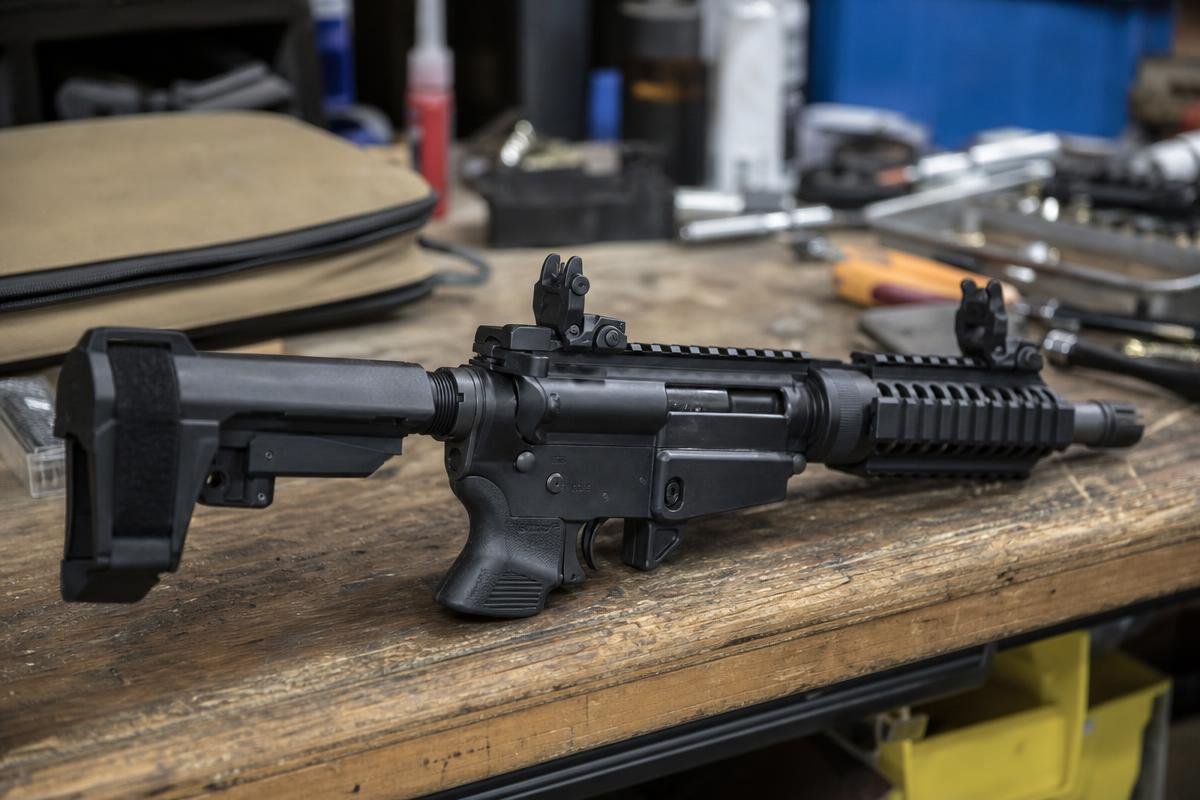
An AR pistol brace and backup sights play different roles on a compact build. A brace assists stabilization, while backup sights provide a fallback aiming system if your optic fails. When choosing between a pistol and a rifle, consider the complete firearm's configuration and where your sights will mount.
A brace does not determine legal classification by itself; the complete firearm and current law matter. We ship from our Denison, TX facility and can help you compare compatible parts. Call us at (888) 706-0633 or contact our team before ordering.
Key Takeaways
- Backup sights provide a redundant aiming system and mount to a compatible rail; co-witness depends on the optic and sight heights.
- Folding and fixed backup sights each suit different build priorities, from compact truck guns to duty rifles.
- A pistol brace and backup sights serve different mechanical roles, while legal classification depends on the firearm's complete design and current law.
- Sight radius depends on front and rear sight placement; compact handguards may limit the space between them.
- Federal, state, and local requirements can apply, so buyers should verify current law for the firearm's complete configuration.
Backup sights and a brace can appear on the same AR pistol, but they do different jobs. Sights provide a fallback aiming system; a brace assists stabilization, while legal classification depends on the complete firearm.
AR Pistol Brace Builds: Where Do Backup Sights Fit?
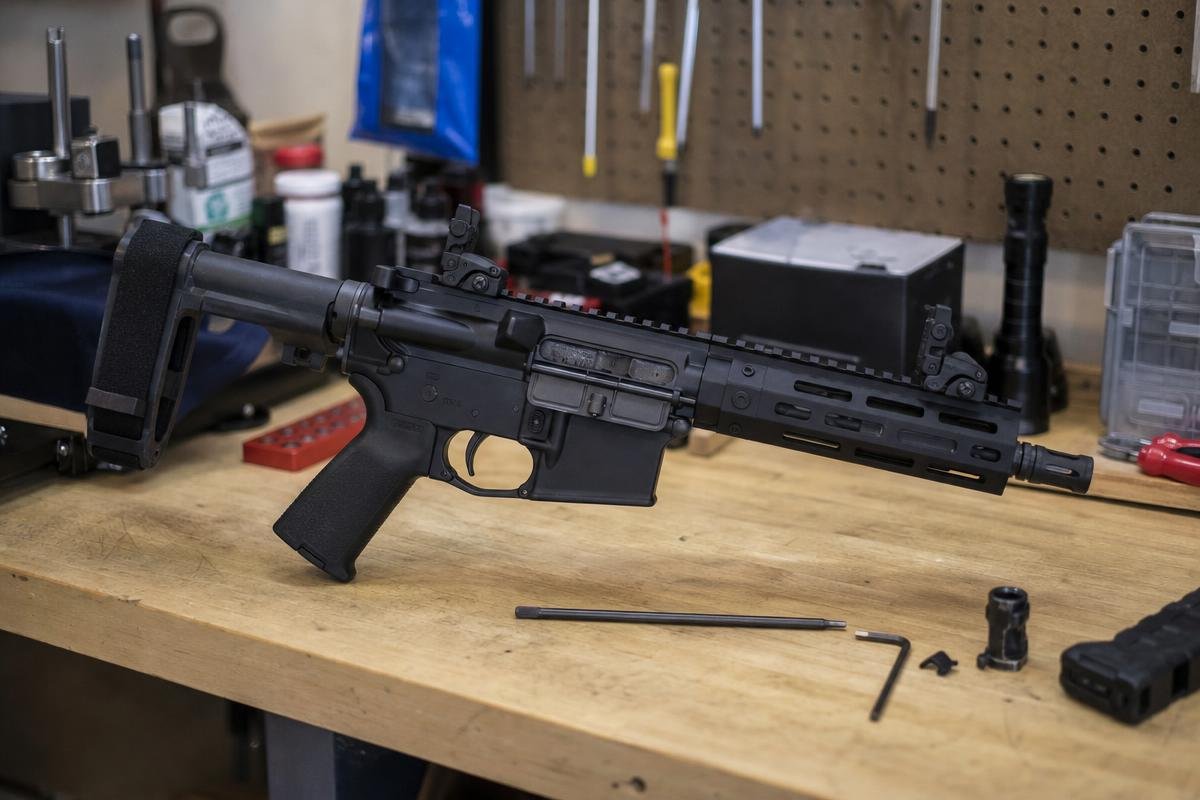
Backup sights give you a functional aiming system if your primary optic fails, loses zero, or runs out of battery. On a pistol build, they serve a specific and limited role. They are not your primary aiming system. They are your fallback. Understanding that distinction shapes every decision you make about which BUIS to mount and how to mount it.
Compact pistol builds are popular with area shooters for good reason. A short overall length rides easily behind a truck seat for ranch and property work, and Texas generally allows a lawfully possessed handgun to be carried in a private vehicle without a permit if it is concealed or holstered and the person is not prohibited from possessing a firearm, which makes a properly configured AR pistol a practical vehicle gun for rural landowners. Folding BUIS and short handguards suit the tight space of a cab or a hallway. Those are practical considerations for customers planning a compact build.
Fixed vs. Folding BUIS: Which Works on a Short Rail?
Pistol-configuration ARs typically run 7 to 10 inch handguards with M-LOK or Picatinny rail sections. Rail space is limited. A fixed front BUIS permanently occupies a slot that you may need for a weapon light, pressure switch, or suppressor mount. That is a real trade-off on a short build.
Folding BUIS solve that problem. Front and rear sights fold flat when not in use and deploy in under a second. With a low-profile gas block under a free-float handguard, mount the front BUIS on the handguard's top rail. Use a gas-block-mounted sight only on an exposed compatible railed gas block and follow the sight manufacturer's height and heat restrictions. For a pistol build, look for these features before you buy:
- Folding design, front and rear
- Low-profile rear aperture that clears your optic body
- Rail-mounted front sight with no fixed front sight base required
- Absolute co-witness compatible height
- Tool-free deployment
Sight Radius on a Pistol-Length Build
Sight radius is the distance between the front and rear sights, so it depends on where you mount them, not barrel length alone. A compact handguard may limit front-sight placement and shorten that distance, making precise iron-sight aiming more difficult at longer ranges.
This is exactly why BUIS on a pistol build are emergency backups, not primary aiming tools. If your red dot goes down at close range, folding irons get you back in the fight. They are not a substitute for a quality optic. Plan your build accordingly. We carry AR-15 complete uppers in pistol-friendly barrel lengths, including 300 Blackout complete upper assemblies that are purpose-built for this configuration.
Co-Witness Height and Optic Compatibility
Co-witness depends on the optic mount's centerline relative to the BUIS height. Standard AR-height mounts may provide absolute or lower-third co-witness, while a low mount may not co-witness with standard BUIS at all.
Before you order BUIS, confirm the mount height of your optic. Mismatched co-witness height means your backup sights are not usable in a failure scenario, which defeats the purpose entirely.
Not sure which BUIS clears your optic? Browse our backup sight and upper options, or contact our team to compare compatibility before ordering.
What Makes an AR-15 a Pistol vs. a Rifle?
The classification is not about how the firearm looks. Under 26 U.S.C. § 5845, classification depends on the firearm's complete design, including whether it is designed to be fired from the shoulder, barrel length, overall length where applicable, and its original configuration. Verify current controlling law and ATF guidance before configuring the firearm. Getting either measurement wrong before you build can put you in NFA territory without the required paperwork.
The 16-Inch Barrel Threshold
A shoulder-fired rifle with a barrel under 16 inches is generally regulated as a short-barreled rifle under federal law; it does not cease being a rifle solely because the barrel is shorter. Common AR pistol barrel lengths run at 7.5 inches, 10.5 inches, 11.5 inches, and 12.5 inches. Each of those lengths also changes the gas system. A 7.5-inch or 10.5-inch barrel typically runs a pistol-length gas system. An 11.5-inch or 12.5-inch barrel usually pairs with a carbine-length gas system.
Gas system length affects dwell time and directly impacts reliability, so barrel length is a functional decision as much as a legal one. If you are looking at pistol-length upper assemblies, the barrel and gas system come matched from the factory.
Overall Length and the ATF Classification Rule
Barrel length alone does not complete the picture. The ATF also looks at overall length. Federal law does not impose a universal under-26-inch maximum on pistols. Measurement methods and the 26-inch threshold depend on the firearm's classification and complete configuration, so verify current guidance before relying on an overall-length calculation.
The table below is a high-level comparison and does not replace current legal guidance for a specific firearm.
| Configuration | Barrel Length | Buttstock Allowed | NFA Required | OAL Threshold |
|---|---|---|---|---|
| AR Rifle | 16 inches or longer | Yes | No | 26 inches or longer |
| AR Pistol | Under 16 inches | No | Generally no, if lawfully configured | No universal under-26-inch maximum |
| SBR | Under 16 inches | Yes | Prior ATF approval required; current federal tax is $0 | Also includes certain weapons made from rifles under 26 inches |
What Happens if You Receive a Pistol-Configured AR as a Gift
If a person intends to make an SBR from a lawfully configured pistol, prior ATF approval is generally required through Form 1; Form 4 applies to a transfer of an existing registered NFA firearm. The current federal making or transfer tax for an SBR is $0. The firearm's original configuration and complete build history can affect classification, so confirm current guidance before changing the barrel or rear attachment.
Federal, Texas, and local requirements may apply to possession, transport, and configuration. Verify current law and the registration requirements for the specific firearm with a qualified source. For questions about your specific build, consult a licensed attorney or contact the ATF directly.
Pistol Brace vs. Buttstock: Mechanical and Legal Differences
How a Pistol Brace Works
A stabilizing brace was designed for one-handed firing. It mounts directly to the buffer tube and wraps around the shooter's forearm using a foam or rubber strap. It does not include a recoil pad. It is not engineered to transfer recoil through the shoulder pocket the way a stock does.
A brace does not by itself determine classification. Evaluate the complete firearm under current statutory definitions, controlling decisions, and current ATF guidance.
How a Buttstock Works
A buttstock is designed to be shouldered. It transfers recoil through your shoulder pocket and gives you a stable cheek weld for accurate follow-up shots. Fixed stocks, like the A2-style, are a single rigid piece. Adjustable carbine-style stocks collapse or extend along the buffer tube. Folding stocks hinge at the rear of the receiver. Each type changes how the firearm handles and how the ATF classifies it.
The NFA Implications of Swapping One for the Other
This is where the brace versus stock question becomes a legal one, not just a mechanical one. The barrel-length classification is covered in the table above, so we will not repeat it here. The key operational point is that prior ATF approval is generally required before making an SBR. A person making the firearm generally uses Form 1, while Form 4 applies to a transfer, and the current federal SBR tax is $0.
One more thing worth knowing is that configuration changes can affect whether the firearm is currently configured as an NFA firearm, and a registrant may request removal from the registry after a permanent change. Obtain current ATF or legal guidance for the specific firearm. ATF guidance on shouldering a brace has also shifted at different points over the years. We are not going to editorialize on that history, but you should check current ATF guidance before making any configuration decision on your build.
If you are building around a pistol-length gas system and need a complete upper to start, browse our 300 Blackout complete upper assemblies or our 5.56 NATO complete upper receivers, both available in barrel lengths suited to pistol builds.
Practical Trade-Offs: AR Pistol vs. AR Rifle for Real-World Use
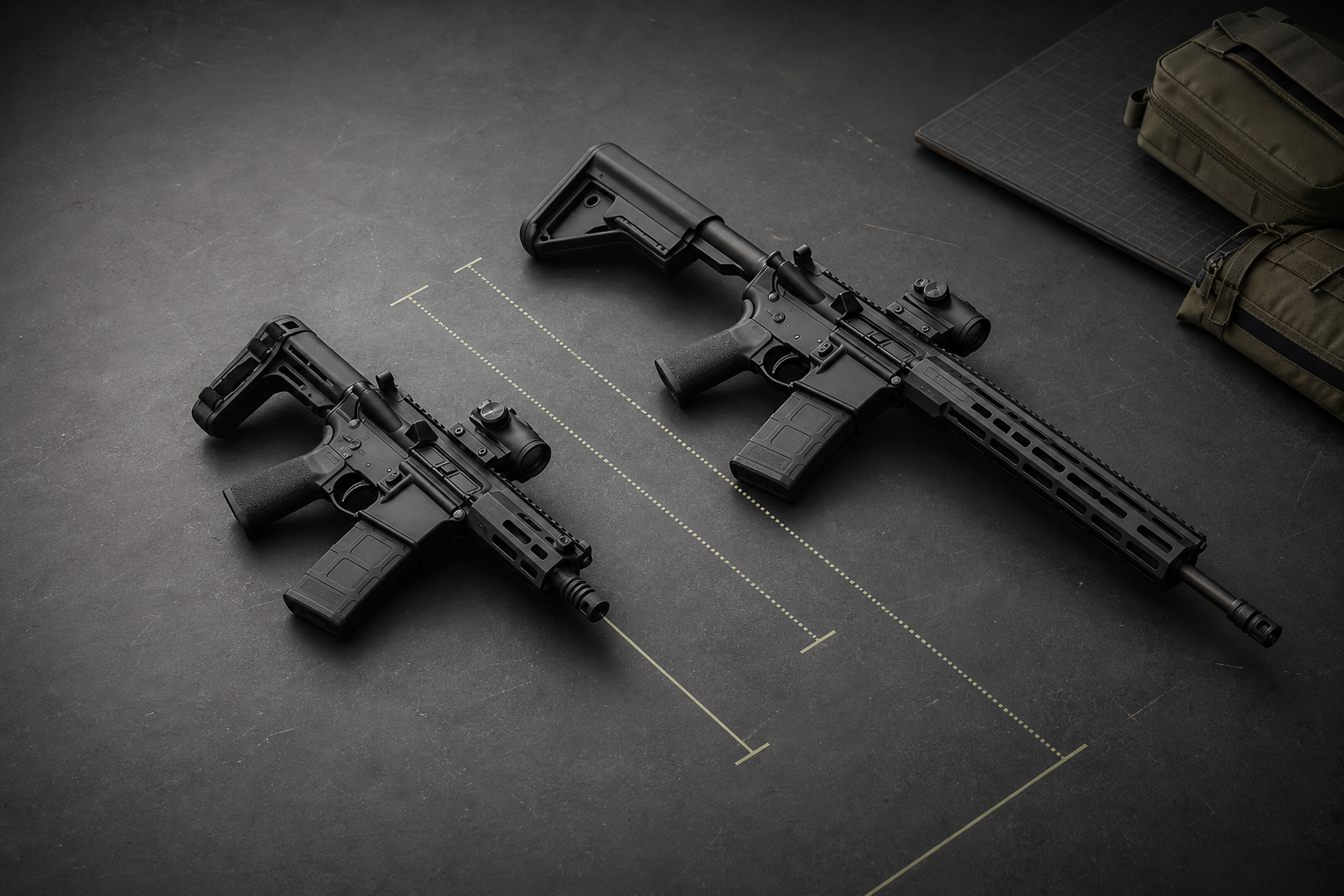
The differences between an AR pistol and a full rifle come down to three measurable factors: size, muzzle behavior, and effective range. None of these are opinions. They are physics, and the numbers should drive your decision based on how you actually plan to use the rifle.
Maneuverability and Weight
A 10.5-inch pistol build with a brace typically runs 5.5 to 6.5 lbs unloaded. A 16-inch carbine runs 6.5 to 7.5 lbs. That weight difference matters less than the overall length difference. A pistol build with the brace collapsed measures roughly 25 to 27 inches. A standard carbine runs 32 to 35 inches. That 6 to 8 inches of difference is significant inside a vehicle cab or a hallway.
Around the Lake Texoma country and the ranchland north of Sherman, the pistol configuration has become a popular truck gun for exactly this reason. Short overall length fits behind a seat or in a cab-length storage area where a full carbine simply does not. Landowners running fence lines, checking cattle, or dealing with hogs and coyotes on the back forty want something compact that rides in the cab and comes out fast. If your primary use case is a vehicle or a confined space, the pistol build has a clear practical edge.
Noise, Flash, and Muzzle Blast
Shorter barrels burn propellant less completely before the bullet exits. On a 7.5-inch 5.56 barrel, the concussive blast is significantly higher than on a 16-inch barrel. A 10.5-inch barrel is more manageable but still produces more flash and report than a carbine. For indoor or vehicle use, this matters. Choose a lawful muzzle device for the intended use, recognizing that compensators can increase side blast and concussion. Our AR-15 complete uppers in pistol-friendly barrel lengths offer a starting point; check each product listing for included muzzle devices.
Accuracy and Effective Range
A 10.5-inch 5.56 barrel loses roughly 200 to 300 fps compared to a 16-inch barrel. Inside 100 yards, that velocity loss has minimal practical impact for home defense or close-quarters work. Past 300 yards, the drop in velocity and a potentially shorter sight radius with iron sights can both work against you. A rifle-length build is the better choice for precision work at distance.
This is the core of the decision: pistol builds are optimized for short-range, confined-space use. Rifle builds are optimized for range and precision. Pick the one that matches your actual use case, not the one that looks better on paper.
Building an AR Pistol in Denison, TX: What Local Buyers Should Know
State Law and Federal NFA Rules for AR Pistols
An upper receiver alone is generally not the serialized firearm, while an FFL transfer of the serialized firearm generally requires Form 4473 and the applicable background-check process. Classification depends on the complete firearm and its original configuration, and federal, state, and local requirements should be verified before assembly.
If you later intend to make an SBR by adding a buttstock, prior ATF approval is generally requested through Form 1; Form 4 applies to a transfer of an existing registered NFA firearm. The determining factors are barrel length, overall length, and whether a buttstock is attached. A pistol brace does not automatically reclassify your firearm, but how you use it matters, and ATF guidance in this area has shifted over the years. Verify current ATF rulings directly and consult a licensed attorney for questions specific to your build before making that change.
Choosing Parts for Your Pistol Build
We carry complete upper assemblies in 7.5-inch, 10.5-inch, and 11.5-inch barrel lengths across multiple calibers. Our complete uppers are built to order, assembled in-house, headspaced, and function-checked before shipping. Each upper is intended for a compatible mil-spec-pattern lower, subject to caliber, magazine, bolt, buffer-system, receiver-pattern, and product-specific requirements.
Caliber choice matters more on a short barrel. The 300 Blackout is a strong pick for pistol builds. Subsonic loads perform well out of 7.5-inch barrels and pair cleanly with a suppressor. If you want wider ammunition availability, 5.56 NATO upper receivers are a common pistol-build option.
Customers in the Sherman and Pottsboro area and nationwide can call us at (888) 706-0633 to check product availability before ordering. We ship from our Denison, TX facility at 4000 Texoma Pkwy, Denison, TX 75020.
Adding backup sights to your pistol build is worth planning before your upper ships. They keep you on target if your optic fails, and they mount the same way on a pistol-length rail as on a full rifle.
Want help comparing sight and upper compatibility? Contact our team before ordering.
Frequently Asked Questions
Do backup sights work on an AR pistol?
Yes, but sight radius depends on where you mount the sights; a compact handguard can limit their spacing and make precision at distance more difficult. Folding BUIS are the practical choice here. They preserve rail space on short handguards and deploy fast when your optic fails. Absolute co-witness with a low-profile red dot mount is the most common setup.
What is the difference between a pistol brace and a buttstock?
A pistol brace is designed to assist stabilization, but it does not by itself determine legal classification. Evaluate the complete firearm under current law and guidance. A buttstock is designed to be shouldered and can make a firearm with a barrel under 16 inches an SBR, depending on its complete configuration and history.
Does installing a buttstock on an AR pistol make it an SBR?
Installing a buttstock on a firearm with a sub-16-inch barrel can create an SBR, depending on the firearm's complete configuration and history. Prior ATF approval is generally required through Form 1 when making the SBR, while Form 4 applies to a transfer, and the current federal SBR tax is $0. Confirm current guidance before making the change.
What barrel length makes an AR-15 a pistol?
Barrel length alone does not make an AR-platform firearm a pistol, and federal law does not impose a universal under-26-inch maximum on pistols. Classification depends on the complete design and original configuration, so verify current guidance before building.
Can I own an AR pistol in this area without an NFA stamp?
A lawfully configured pistol is generally not registered as an SBR, but federal, state, and local requirements depend on the complete firearm and the transfer method. An FFL transfer of the serialized firearm generally requires Form 4473. Verify current law and ATF guidance before building.
Ready to review your pistol build? Compare the currently available 300 Blackout and 5.56 NATO complete upper receivers, then confirm caliber, magazine, bolt, buffer-system, receiver-pattern, and product-specific compatibility before ordering. Call (888) 706-0633 to confirm availability before you order.
Ready to Get Started with AR15Parts.com?
Call (888) 706-0633 to speak with our team directly. We're ready to answer your questions, walk you through your options, and help you find the right solution for your needs. Whether you're just starting to plan or ready to move forward, we'll make the process simple and stress-free. Reach out today and let's talk about how we can help.