
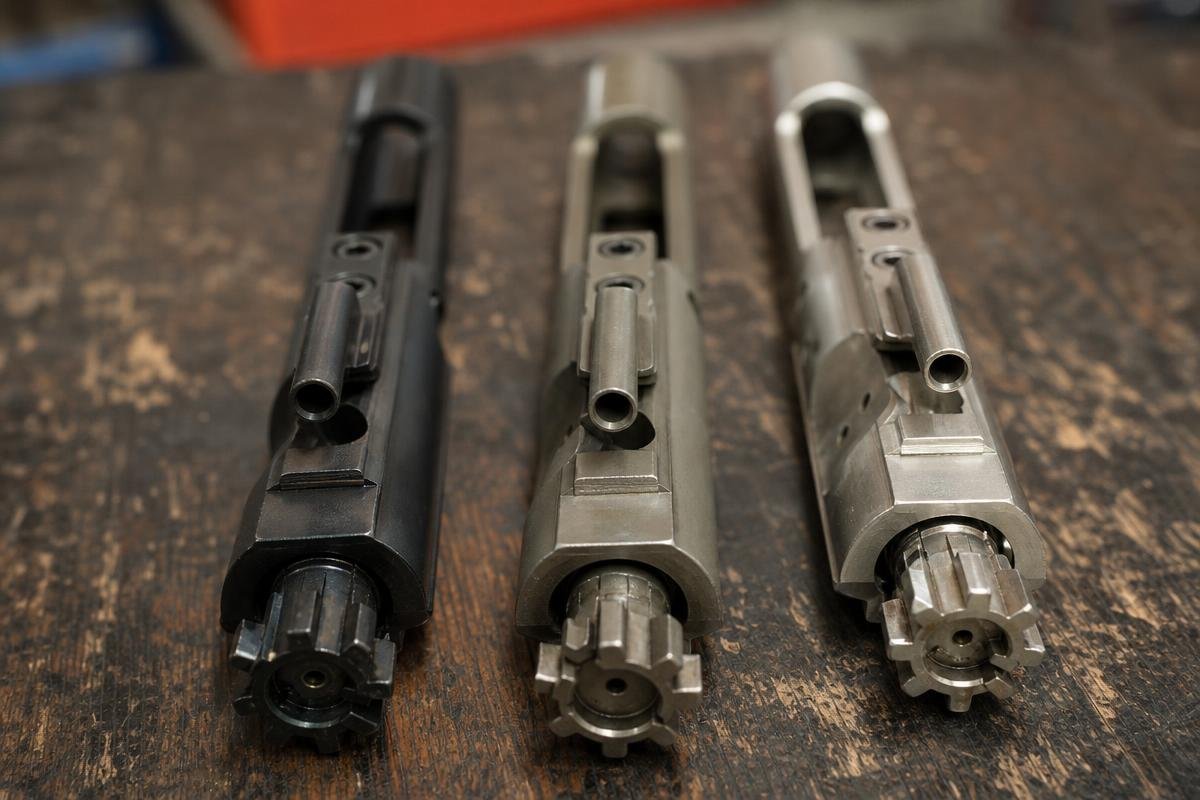
Carpenter 158 vs 9310 is a bolt-steel comparison; 8620 usually enters the discussion as carrier steel. Bolt material and heat treatment both matter when choosing a BCG. At AR15Parts.com, we can help you compare bolt and carrier materials before you order. Have questions about which BCG steel is right for your build? We can help you choose before you buy.
Key Takeaways
- Carpenter 158 is commonly identified as the traditional military-specification bolt steel, but any mil-spec claim should be tied to the applicable procurement requirements.
- 9310 is a case-hardening alloy with comparable strength to C158 and is widely used in quality commercial BCGs.
- When comparing bolt steels, heat treatment and manufacturer quality matter as much as alloy choice.
- 8620 is a lower-cost steel typically found in budget BCGs and is not recommended for the bolt in hard-use rifles.
- A bolt made from any of these alloys can fail if the heat treatment is done wrong, so manufacturer reputation matters as much as material.
Carpenter 158 BCG: Bolt Steel vs. Carrier Steel
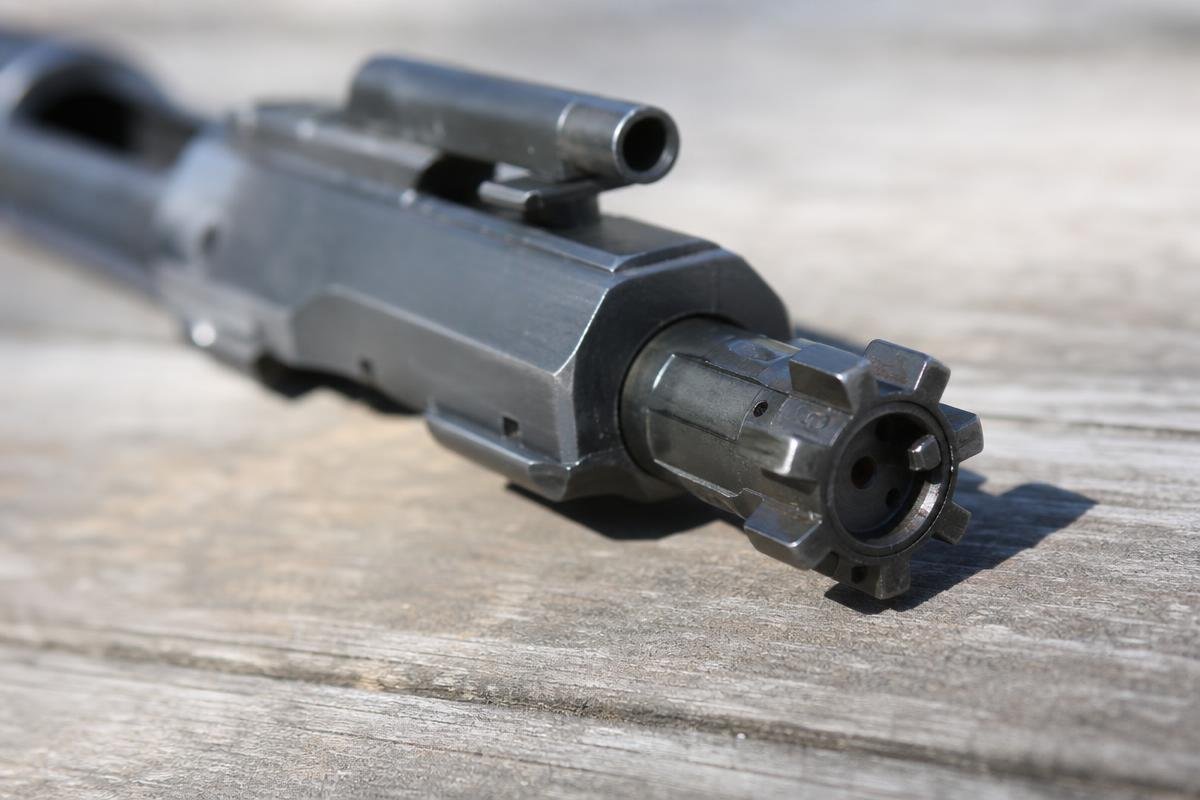
Carpenter 158 is a proprietary alloy produced by Carpenter Technology Corporation. It is not a generic steel grade you can pull from a standard mill catalog. The designation refers to a specific, controlled chemistry: a modified 8620-family steel with added vanadium and a tighter carbon range than standard 8620. That tighter chemistry is what makes it consistent enough for military specification.
The Alloy Composition Behind the Designation
Carpenter 158's mechanical properties vary by heat-treatment process and production lot. Carburizing is a case-hardening process that diffuses carbon into the part's surface, producing a hard outer shell over a softer, impact-absorbing core. For a bolt, that combination matters. The locking lugs need surface hardness to resist battering, while the body needs enough ductility to absorb the shock of firing without cracking.
Applicable bolt-material and hardness requirements must be verified against the relevant technical data package or procurement documentation; MIL-B-11595E should not be cited as the bolt-steel authority.
Why the Military Chose Carpenter 158 for the M16 Bolt
The military did not pick Carpenter 158 arbitrarily. It selected an alloy that could be carburized predictably, heat-treated to consistent hardness, and inspected to a repeatable standard across multiple suppliers. Those standards exist for a reason: they were written from field failures, not marketing. That consistency is exactly why so many of the builders we talk to want to confirm which steel is in a BCG before they commit to it.
One point worth understanding before you shop for a complete 5.56 NATO upper: "mil-spec bolt steel" means Carpenter 158 specifically. It does not mean 9310. It does not mean standard 8620. If a manufacturer calls a 9310 bolt mil-spec, that claim is inaccurate on the steel specification. The bolt may still be excellent, but the steel is not what the applicable procurement requirements call for.
What Is AISI 9310 Steel?
AISI 9310 is a nickel-chromium-molybdenum alloy steel developed originally for aerospace gearing and high-load transmission components. It found its way into AR-15 bolt production because its core properties translate well to the repeated stress and heat of a cycling bolt. Understanding the Carpenter 158 vs. 9310 bolt steel comparison starts at the alloy level, not at the marketing level.
How 9310 Differs From Carpenter 158 at the Alloy Level
The most significant difference between 9310 and Carpenter 158 is nickel content. 9310 carries roughly 3.0 to 3.5 percent nickel, compared to Carpenter 158's 0.25 to 0.45 percent. That higher nickel concentration gives 9310 deeper case hardenability and a tougher core at equivalent surface hardness. When the case-hardened exterior takes a hit, the core underneath has more capacity to absorb that energy without cracking.
Tensile strength on properly heat-treated 9310 lands in the 155,000 to 165,000 psi range, which is comparable to Carpenter 158 under similar heat-treatment cycles. The difference is that 9310 is more sensitive to temperature variation during carburizing. A manufacturer running 9310 needs tighter process control in the furnace. As noted in the Key Takeaways, heat treatment can matter as much as the alloy, and 9310 is the clearest example of that. Reputable makers who specify 9310 account for this in their production protocols. Shops cutting corners on heat treat are the real variable, not the steel itself.
9310 is not mil-spec for the bolt. That designation belongs exclusively to Carpenter 158 per the original government specification. That fact does not make 9310 a lesser material. It means 9310 was not the steel the spec was written around, not that it underperforms.
Where 9310 Excels as a Bolt Material
9310's tougher core shows up most clearly in high-cycle and high-pressure applications. Hunters chasing hogs on the leases and river-bottom country around Lake Texoma often run high round counts, and competitive shooters running suppressed setups put more back-pressure and thermal stress on a bolt than a standard unsuppressed carbine does. For high-volume or suppressed use, 9310's deeper hardenability is a potential mechanical advantage when supported by the finished part's heat-treatment and test data. Among the bolt steels available today, 9310 is a legitimate choice when sourced from a manufacturer with documented heat-treatment controls.
Building a suppressed or high-round-count rifle? Browse our 9310 BCG inventory or call for current availability.
What Is 8620 Steel, and Where Does It Fit?
8620 is a low-alloy steel containing moderate amounts of nickel, chromium, and molybdenum. It machines well, responds to case hardening, and costs less than Carpenter 158 or 9310. Those properties make it a practical choice for certain BCG components, but not all of them. Understanding where 8620 belongs in a bolt carrier group matters more than most buyers realize.
8620 as a Carrier Steel vs. a Bolt Steel
The bolt carrier body functions as a reciprocating mass and a gas-sealing surface. It does not absorb the locking-lug stress that the bolt head takes on every firing cycle. For that role, 8620 is adequate. Its strength characteristics hold up fine under the cycling loads a carrier sees, and pairing an 8620 carrier with a C158 or 9310 bolt head is a common and sensible combination. A shooter running high round counts on a hog hunt will not have a problem with a quality 8620 carrier in that setup.
The bolt head is a different story. It takes the full force of chambering, locking, and extraction on every round. That demands deeper case hardenability than 8620 reliably delivers under sustained fire, which is why quality makers keep it out of the bolt head.
Why You Rarely See 8620 Bolts in Quality BCGs
8620 has shallower case hardenability than either Carpenter 158 or 9310. Under sustained fire, that shallower hardened layer wears faster at the locking lugs. Reputable manufacturers reserve 8620 for the carrier body and specify C158 or 9310 for the bolt head. When comparing 8620 vs Carpenter 158 BCG listings, that distinction is the one to check first.
If a BCG listing describes an 8620 bolt, ask the manufacturer for their heat-treatment specifications before purchasing. It is not automatically a disqualifier, but it warrants a closer look. If you want guidance before ordering, call us at (888) 706-0633 or browse our complete 5.56 NATO uppers and 300 Blackout complete uppers for suppressed builds, each built with verified-spec bolt carrier groups.
Carpenter 158 vs 9310: Bolt Steels and 8620 Carrier Steel
The three steels differ in ways that matter at the bolt, not just on paper. Here is how they stack up on the specs that actually affect bolt performance and longevity.
| Steel | Mil-Spec for Bolt | Approx. Tensile Strength | Nickel Content | Case Hardenability | Typical BCG Use | Cost Tier |
|---|---|---|---|---|---|---|
| Carpenter 158 | Yes | Varies by heat treatment | Low | Moderate | Bolt | Mid |
| AISI 9310 | No | ~155,000 to 165,000 psi | High (~3.0 to 3.5%) | Deep | Bolt | Mid to High |
| 8620 | No | ~130,000 to 145,000 psi | Low to Moderate | Shallow | Carrier | Low to Mid |
Tensile strength alone does not establish which bolt will last longer; heat treatment and finished-part quality matter too. The gap widens with 8620, which is why that steel fits the carrier better than the bolt. Locking lugs need hardness that 8620 struggles to reach consistently.
Heat Treatment Difficulty and What It Means for Quality Control
Each steel responds differently to the carburizing process, and that response shapes how a manufacturer controls quality. Carpenter 158 is more forgiving during carburizing. That predictability is a large part of why it became the mil-spec standard. 9310 rewards tighter process control with deeper case hardness, but a shop that cuts corners on soak time or quench rate will produce a weaker bolt from better steel. 8620 is the easiest to heat-treat overall, but hitting the right locking-lug hardness is where manufacturers using it for bolts run into trouble.
You cannot inspect heat treatment by looking at a bolt. Buy from manufacturers who publish their heat-treat specs or have a documented quality control record. If a maker will not tell you how the part was processed, that tells you something. Coating choices matter too, so weigh the phosphate, nitride, and nickel-boron finish options before finalizing your build.
Have questions about BCG steel or need help picking the right bolt carrier group for your build? Call us at (888) 706-0633 to talk through the options, or contact our team online.
Does the Steel Type Actually Matter for Most Shooters?
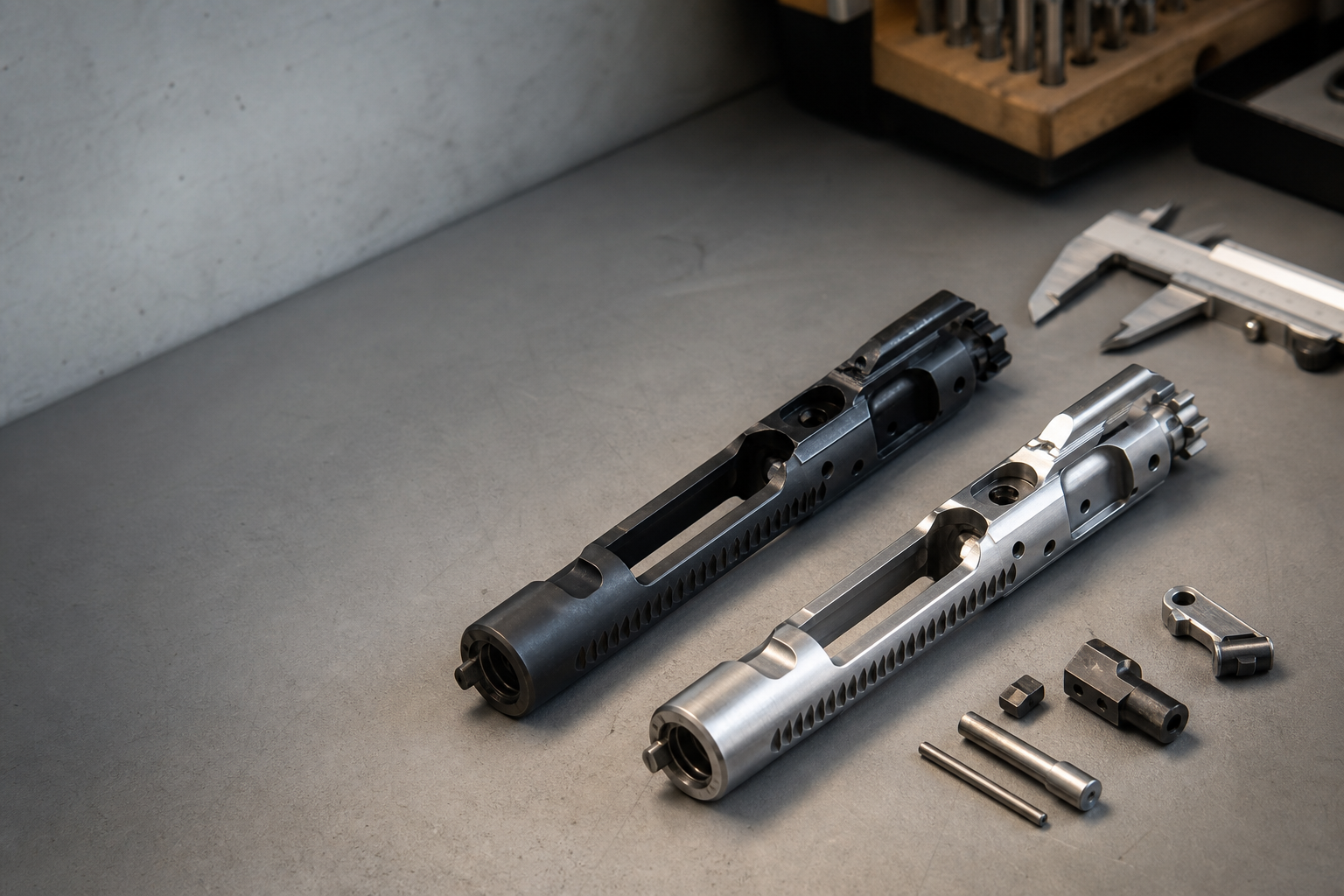
For most semi-auto builds, the honest answer is no. A properly carburized and heat-treated C158 bolt and a properly heat-treated 9310 bolt perform nearly identically under normal service conditions. Extractors and gas rings may require replacement before the bolt itself, while cam-pin-hole wear remains a separate bolt-inspection concern. Those smaller components are your real wear points, not the bolt steel itself.
The Practical Performance Gap Between C158 and 9310
Most shooters running a complete 5.56 NATO upper or a .223 Wylde complete upper at normal round counts will never stress either steel to a point where the difference shows. A hog hunter or deer hunter running a semi-auto AR falls squarely in this category. Mil-spec Carpenter 158 is the proven, tested choice for that use case, and it has decades of documented service life behind it.
When Steel Choice Becomes More Important
Edge cases are where the comparison gets real. Suppressed builds run elevated bolt velocity and higher sustained heat. Full-auto and select-fire platforms cycle harder and faster than any semi-auto carbine. Builds with short gas systems can also run hot enough to accelerate lug wear over time. In those conditions, 9310's deeper case hardenability may offer a marginal advantage in long-term durability.
If you are running a suppressed 300 Blackout complete upper, which is common in this region, the edge-case argument for 9310 carries more weight. The gas system also drives how much stress reaches the bolt, so matching gas port size and system length to your barrel and can matters as much as steel choice. For a standard semi-auto carbine, mil-spec bolt steel in C158 is the best steel for an AR-15 bolt at any round count most shooters will ever reach.
Why Manufacturers Choose One Steel Over Another
Steel selection at the manufacturer level is rarely about finding the "best" material. It is about matching the right alloy to the production environment, the end customer, and any applicable compliance requirements. For mil-spec bolt steel AR-15 production, those factors point manufacturers in different directions depending on who is buying the finished product.
The Case for Carpenter 158: Consistency and Mil-Spec Compliance
Contracts that incorporate a requirement for Carpenter 158 must use that material unless an approved deviation or substitute is authorized. That compliance reality is exactly what shapes the BCG supply chain serving those buyers, and it is why so many of the parts we stock trace back to C158.
Beyond contract requirements, C158 carries decades of documented heat-treat parameters and a stable supply chain. Manufacturers know precisely how the material behaves through carburizing and case hardening. That predictability reduces scrap rates and keeps production consistent across large runs. For high-volume producers, that matters as much as the metallurgy itself.
The Case for 9310: Toughness and Aerospace-Grade Pedigree
Manufacturers targeting the commercial precision or high-end duty market sometimes choose 9310 for its deeper case hardenability and aerospace-grade pedigree. Choosing 9310 over C158 in the Carpenter 158 vs. 9310 bolt steel debate is a performance-positioning decision, not a compliance decision. It signals a different customer priority, not a different quality standard.
Neither approach is wrong. A manufacturer using C158 is not cutting corners, and one using 9310 is not overbuilding. If you want to talk through which BCG fits your specific build, call us at (888) 706-0633. We also carry complete 5.56 NATO uppers and 300 Blackout complete uppers for suppressed builds if you are sourcing the whole assembly at once.
Picking the Right BCG Steel for Your Build
Not sure which bolt steel fits your specific build? We ship from our Denison, TX facility, and you can call us at (888) 706-0633 to talk through BCG selection before placing an order. The right answer depends on what you're building and how you plan to run it.
Standard Carbine and Rifle Builds
For a standard 16-inch 5.56 NATO or .223 Wylde carbine, a mil-spec Carpenter 158 bolt paired with an 8620 carrier is the proven configuration. It's what the military spec was written around, and it's what most quality BCG manufacturers default to for good reason. If you're putting together a general-purpose rifle for hog hunting, deer season, or range work around Grayson County, C158 is the right call. Our complete 5.56 NATO uppers and .223 Wylde complete uppers are built to order, assembled in-house, headspaced, and function-checked before shipping.
Default to C158 unless your build has specific demands that push the bolt harder than a standard carbine gas system does.
Suppressed, High-Round-Count, and Precision Builds
Suppressed rifles, short-barreled uppers, and high-cycle builds run hotter and dirtier than a standard carbine. Back-pressure from a suppressor increases bolt velocity and dwell time, which puts more stress on the bolt lugs over time. In those cases, a properly manufactured 9310 bolt may offer a durability advantage in some high-cycle applications. If you're building a suppressed host around a pistol-length or carbine-length gas system, that potential durability advantage may be worth considering, although pricing varies.
Our 300 Blackout complete uppers for suppressed builds pair naturally with a 9310 bolt for exactly this reason. The 300 Blackout cartridge is already optimized for suppressor use, and matching it with a tougher bolt steel makes sense for a rifle that will run a can regularly.
Not sure which steel fits your build? Call us and we'll help you decide before you spend a dime.
Frequently Asked Questions
Is Carpenter 158 the only mil-spec steel for AR-15 bolts?
Yes. Carpenter 158 is commonly associated with traditional military bolt requirements. Verify any mil-spec claim against the applicable technical data package or procurement documentation before relying on that designation.
Is 9310 better than Carpenter 158 for an AR-15 bolt?
Not in any way that matters for most shooters. Both steels, properly heat-treated, will outlast typical service life without issue. In suppressed or high-cycle applications, 9310 may offer a marginal edge in toughness, but the difference is not meaningful for standard carbine use.
What steel is the bolt carrier body usually made from?
Most quality carriers use 8620 steel. The carrier body does not absorb locking-lug stress cycles the way the bolt does, so 8620 is adequate and cost-effective there. The bolt itself is the high-stress component that warrants C158 or 9310.
Does a Carpenter 158 bolt cost more than a 9310 bolt?
Not necessarily. BCG pricing is driven by machining tolerances, coating choice, and quality control more than raw steel designation. A well-made 9310 BCG from a reputable manufacturer may be priced similarly to a C158 unit, but pricing varies by manufacturer and configuration.
How do I know if a BCG uses genuine Carpenter 158 steel?
Buy from manufacturers who publish material certifications. Carpenter Technology is the primary U.S. producer of C158, and reputable makers can trace their material back to mill certs. If a listing does not mention certifications, ask before you order.
Can I use a 9310 bolt in a mil-spec lower or upper receiver?
Yes. A 9310 bolt machined to mil-spec dimensions drops into any mil-spec upper and functions normally. Steel type does not affect fit or compatibility. If you are running a complete 5.56 NATO upper or a 300 Blackout complete upper for a suppressed build, either bolt steel works provided the dimensions are correct.
Steel designation is one piece of the BCG decision. Heat-treat process, coating choice, and machining tolerances matter just as much. If you want to talk through which BCG configuration fits your build before you order, call AR15Parts.com at (888) 706-0633. Our team ships nationwide from Denison, TX and is ready to answer technical questions before you add anything to your cart.
Ready to Get Started with AR15Parts.com?
Call (888) 706-0633 to speak with our team directly. We're ready to answer your questions, walk you through your options, and help you find the right solution for your needs. Whether you're just starting to plan or ready to move forward, we'll make the process simple and stress-free. Reach out today and let's talk about how we can help.