
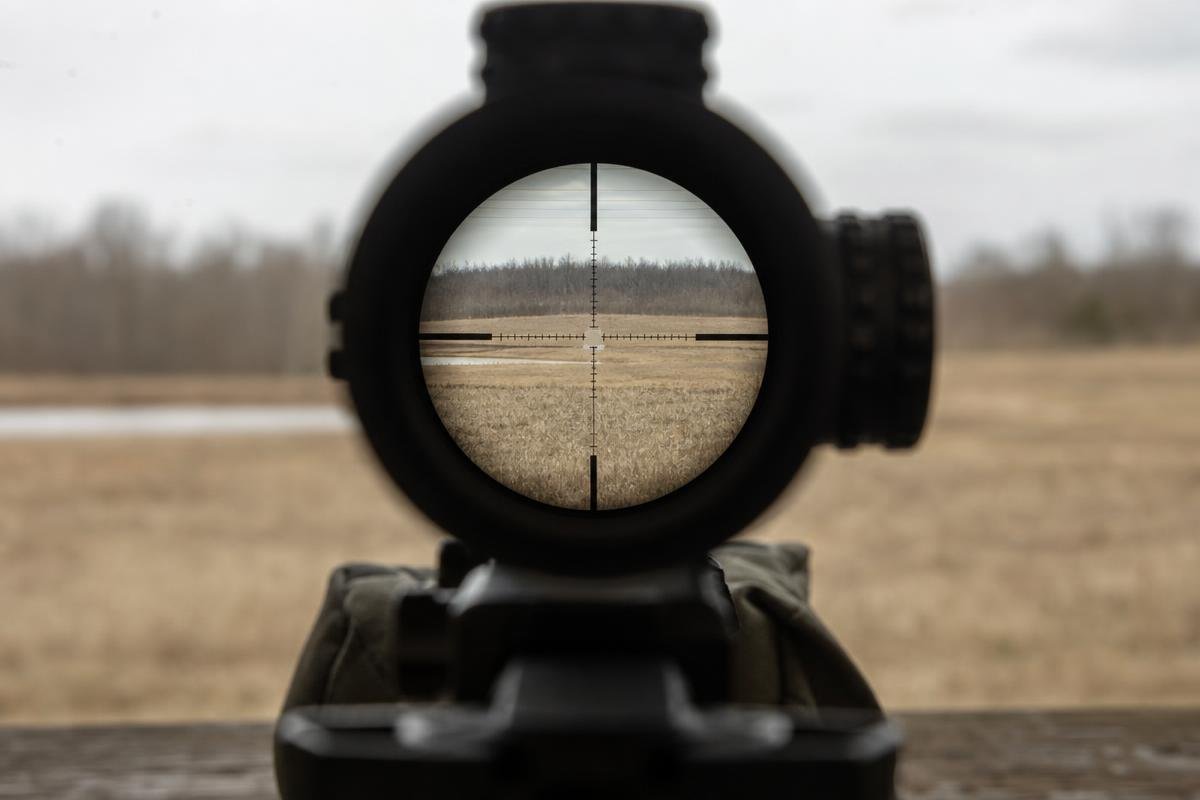
FFP vs SFP is a key choice when selecting an LPVO for your AR-15 build. FFP reticle marks keep their angular values across magnification; SFP marks use one manufacturer-specified calibration power. At AR15Parts.com, we help you compare reticle visibility, holdover needs, and compatible rifle components. Need help choosing parts for your setup? Contact our team.
FFP vs SFP: Key Takeaways
- FFP reticles appear to grow and shrink with magnification, while their marked subtensions retain the same angular values at every power.
- SFP reticles stay visually consistent as magnification changes, but their labeled subtensions are valid only at the manufacturer-specified calibration power.
- Neither focal plane is inherently more accurate; choose based on how you use the reticle and adjust magnification.
- Confirm your actual holds at the range with your ammunition and zero, regardless of focal plane.
What Is the Difference Between First and Second Focal Plane?
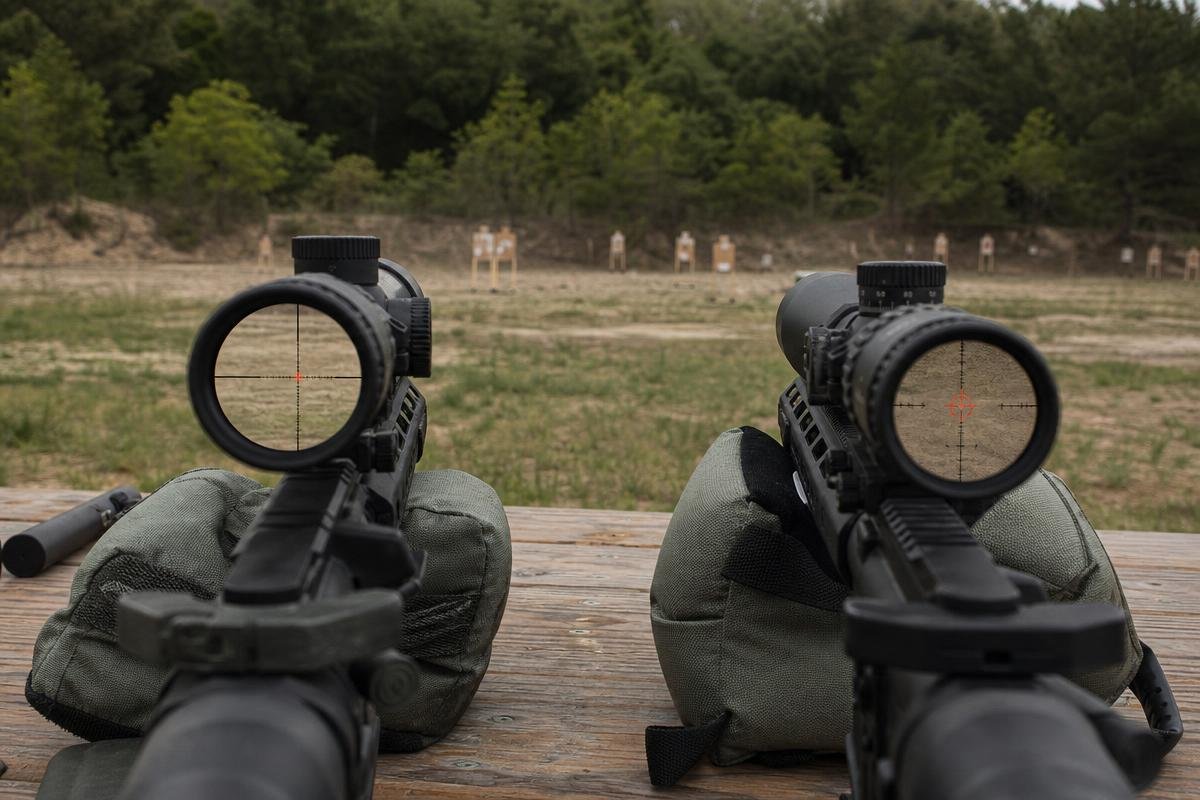
The difference is reticle scaling. An FFP reticle changes apparent size with magnification, while an SFP reticle remains nearly the same apparent size. Neither system is automatically more accurate, but they make holdovers and ranging work differently.
What Focal Plane Means
A first focal plane reticle sits ahead of the magnification assembly. The target image and reticle appear to enlarge together as you move from 1x toward the scope's maximum power.
A second focal plane scope places the reticle behind that assembly. The target gets larger as magnification increases, while the reticle appears close to the same size in your sight picture. The reticle itself does not physically grow or shrink in either plane scope.
This distinction matters on an AR-15 LPVO because changing magnification changes the relationship you see between the reticle marks and the target. The optic's lenses create that apparent change, not movement of the reticle inside the scope.
How FFP and SFP Reticles Appear Through the Scope
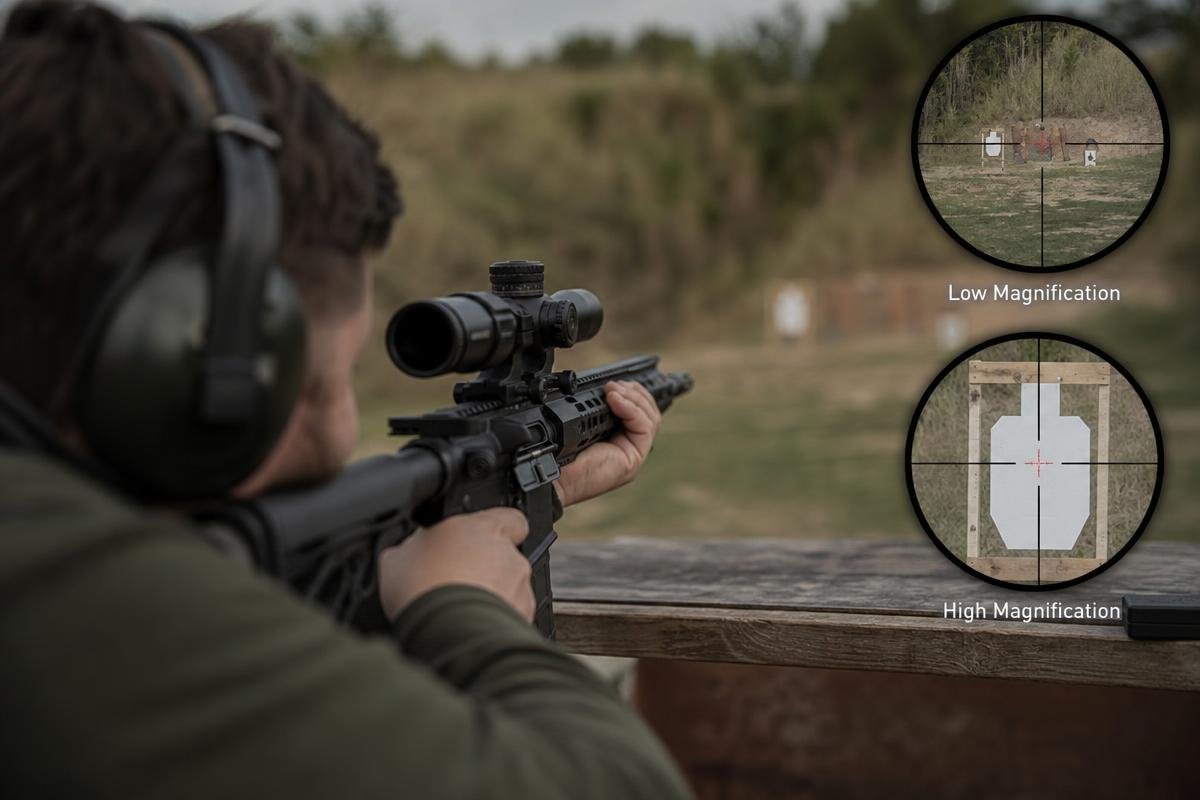
At 1x, an FFP reticle may look thin or relatively small, depending on line thickness and center illumination. At maximum power, it appears larger, while its hash marks and aiming references remain proportionate to the target image.
An SFP reticle stays visually familiar from low power through high power. Its center dot, crosshair, and hold marks look nearly unchanged, even as the target fills more of the view. That can be an advantage when a bold, quick center aiming point matters most.
Rifle role should guide the optic choice. A compact carbine and a distance-oriented setup can both begin with our complete AR-15 uppers, but the reticle should support the way the finished rifle will be used.
How Do FFP and SFP Reticles Affect Holds and Ranging?
FFP marks retain their stated mil or MOA value throughout the magnification range. SFP marks are only calibrated at the scope-specific power identified by the manufacturer. This is the practical difference when you need to hold for elevation or wind, or range a target.
Subtensions and Holdovers in Plain Terms
Subtension is the angular value represented by a reticle mark, usually measured in mils or MOA. A holdover means aiming above, below, or beside the target with those marks rather than dialing the elevation or windage turret.
On an FFP scope, every mil or MOA mark keeps the same angular relationship to the target at every power setting. A 1-mil hold remains 1 mil at 2x, 4x, or 6x. This lets you observe a miss, apply a correction, and fire again without first returning the scope to a particular magnification.
Are SFP Holdovers Accurate at Every Magnification?
Not at their labeled subtension values. SFP reticle subtensions are typically valid at the manufacturer-specified calibration power. Many SFP LPVOs are calibrated at maximum magnification, but that is not universal, so confirm the valid power in the manufacturer’s reticle documentation.
Changing magnification changes the effective angular value of every SFP hold mark on the target. A BDC reticle can add another variable because its marks may assume a specific cartridge, bullet weight, velocity, barrel length, zero distance, and calibration power. Verify those assumptions and confirm actual holds with your ammunition at the range before treating any BDC line as exact.
A 1-6x LPVO Example
On a 1-6x FFP LPVO, a 1-mil hold remains 1 mil at 2x, 4x, and 6x. The reticle appears smaller at low power, so fine references may be harder to read quickly, but their measurement does not change.
On a 1-6x SFP scope calibrated at 6x, that same mark is correct at 6x only. At lower settings, the mark represents a different angular value. Some reticle manuals include a usable conversion reference, while others do not, so the practical solution is to use the documented calibration power and verify your holds on paper or steel at the range.
If you are setting up an AR-15 and want to compare optic features with your intended use, contact AR15Parts.com for current product availability and manufacturer specifications.
FFP vs SFP for Common AR-15 Shooting Roles
Focal-plane choice should follow your shooting role, not a claim that one reticle style is always better. Consider whether you use reticle holds, how often you change power, and whether fast low-power visibility matters more than measuring with fine marks.
General-Purpose Carbines and Close-Range Use
Fast shots at close range demand a clear sight picture and a center aiming point you can find immediately. A bright illuminated dot, an uncluttered reticle, and true or near-true 1x performance often matter more than focal plane on a general-purpose carbine.
An SFP scope keeps its reticle visually consistent as you turn from 1x to 6x or 8x. That can make the center point easier to read at low power. An FFP LPVO can work equally well when its center feature remains visible at 1x, particularly with daylight-bright illumination, but that should be checked before buying.
Precision-Oriented AR Builds
Wind holds become more demanding when you change magnification and still need the reticle to measure accurately. An FFP AR-15 scope keeps marked wind and elevation references proportional throughout the zoom range.
That helps when you reduce power for a wider field of view, then need to hold for wind without returning to one calibration setting. A shooter building around a flatter cartridge may pair that optic with 6.5 Grendel complete uppers, suitable ammunition, and a barrel appropriate for the practical distance involved. FFP does not replace confirmed velocity data, a solid zero, or practice reading wind and holds.
Competition Stages and Changing Target Distances
Competition stages can force fast transitions between close targets and smaller targets at distance. Your choice should follow the stage design, time pressure, and whether you dial elevation or use reticle holds.
FFP can help shooters who hold for wind and elevation while changing power during a stage. An SFP scope can be the better fit when it is run at one known calibration setting or when a bold center point is the priority on close-range targets. Test both approaches using the same rifle, ammunition, and mount setup before committing.
For any rifle intended for practical use, build the optic plan around the complete system rather than reticle preference alone. Review compatible complete AR-15 rifles when comparing rifle configurations and optic needs. Need product information for your AR-15 optic setup? Call AR15Parts.com at (888) 706-0633.
What to Check Before Buying an FFP or SFP LPVO
Before choosing an LPVO, evaluate the reticle, turrets, illumination, mounting position, and the magnification settings you expect to use. A first focal plane scope can keep holds consistent through the zoom range, but only when the reticle and controls are suitable for your rifle and shooting plan.
Match Reticle Marks and Turret Adjustments
Your reticle and turrets should use the same unit. Buy a mil reticle with mil turrets, or an MOA reticle with MOA turrets. That lets you read a correction in the reticle and dial the same number on the turret.
A mil reticle paired with MOA turrets adds conversion work. The reverse does the same. That may be manageable on a bench, but it slows decisions during timed shooting or field use. If you are pairing an optic with one of our 6.5 Grendel complete uppers, make sure the reticle references are usable for the target sizes and ranges you intend to shoot.
Check Low-Power Visibility and Illumination
An LPVO must remain usable at the low end of its magnification range. With the rifle unloaded, cleared, and pointed in a safe direction, set the scope to its lowest magnification and evaluate whether the center aiming point is quick to find against both dark and bright backgrounds.
Read the manufacturer’s illumination description carefully. If a manufacturer describes the illumination as daylight-visible, verify that it remains easy to see under the expected outdoor lighting conditions. Many illuminated reticles are designed primarily for low-light aiming and will not appear dot-bright outdoors. This is especially important with FFP designs, since a fine reticle can become less prominent at low power.
Plan the Mount, Eye Relief, and Zero Check
Your mount should position the scope for proper eye relief and maintain that position securely. With the rifle unloaded, cleared, and pointed in a safe direction, check the eye-relief position from your normal shooting stance before tightening anything. Avoid placing the optic based only on how it looks on the receiver.
After mounting, confirm the reticle is level, check the eye box at low and high power, and confirm zero with your chosen ammunition. Recheck zero after mounting work, a hard impact, loose ring fasteners, or questionable turret adjustments. If you need help comparing an optic plan to a rifle build, contact AR15Parts.com at (888) 706-0633.
Matching Your Optic to Your Actual Range Use in Denison
For shooters in Denison and the wider Texoma area, an FFP or SFP choice should be based on usual target sizes, distances, and the magnification changes made during practice. The reticle has to remain useful at the power setting where the shot is actually taken.
Start With Your Typical Targets and Magnification Changes
A short-distance practice routine often favors a bold reticle that is quick to read at 1x. An SFP LPVO can fit that purpose well because its reticle keeps the same apparent size throughout its magnification range.
Smaller targets and frequent power changes call for a different approach. When you need to apply marked elevation or wind holds after changing magnification, FFP hash marks remain proportional and can reduce one mental step.
Match the Optic Plan to the Rifle Configuration
Your rifle setup affects what the optic needs to do. Barrel length, cartridge, ammunition, and recoil behavior shape practical distance and target expectations. A compact 5.56 build may place more value on rapid low-power sighting, while a longer setup used for smaller targets may benefit from consistent FFP holds.
Build choices work together. Bolt carrier group weight, buffer setup, muzzle device, and ammunition can affect how quickly you recover the reticle after recoil. Start with the rifle’s intended use, then compare compatible complete AR-15 uppers before settling on an optic plan.
We ship from our facility at 4000 Texoma Pkwy, Denison, TX 75020. For help with your build, contact us at (888) 706-0633 or review our complete AR-15 rifles.
Frequently Asked Questions
Is First Focal Plane Better Than Second Focal Plane?
No. First focal plane vs second focal plane depends on how you use hold marks while changing magnification. FFP keeps calibrated holds valid throughout the zoom range. An SFP scope can be simpler for a fixed-power setting or a bold reticle at low power.
Are FFP Reticles Too Small at Low Power?
Not always. Low-power visibility depends more on reticle design, line thickness, and illumination than focal plane alone. A daylight-bright center dot can make an FFP LPVO fast at 1x, while a fine unlit reticle may be harder to pick up.
At What Magnification Is an SFP Reticle Accurate?
An SFP reticle is accurate at its marked calibration magnification, often maximum power. Check the optic manual, then confirm that setting on paper at the range. Do not assume every second focal plane scope uses the same calibration point.
Should I Choose Mil or MOA?
Either works if your reticle and turrets match. Many mil-based turrets use 0.1-mil adjustment clicks, while MOA turrets commonly adjust in quarter-MOA clicks. Pick one system, read it consistently, and avoid mixing mil reticles with MOA turrets.
Can an FFP LPVO Work for Close-Range Shooting?
Yes. An FFP LPVO can work well at close range when it has a usable 1x setting and an illuminated aiming point. Test the LPVO from 1x through maximum magnification before relying on it for fast shooting.
Do I Need to Re-Zero After Changing Magnification?
No. Changing magnification should not move zero in a properly functioning scope. Check zero after mounting work, a hard impact, loose ring fasteners, or questionable turret adjustments.
If you are planning an AR-15 build around the way you shoot, call (888) 706-0633 or contact AR15Parts.com to discuss parts and complete AR-15 uppers.
Ready to Get Started with AR15Parts.com?
Call (888) 706-0633 to speak with our team directly. Our team can provide current product availability and manufacturer specifications. Whether you're just starting to plan or ready to move forward, we'll make the process simple and stress-free. Reach out today and let's talk about how we can help.