

Choosing between a free-float and a drop-in handguard is one of the most common decisions builders face, and the answer depends on how you actually use your rifle. Drop-in handguards are fast, affordable, and work fine for most builds. Free-float handguards remove barrel contact entirely, which improves accuracy potential when everything else in the rifle is doing its job. We stock both types and ship nationwide from Denison, TX, so you can get the right part without guesswork. Not sure which handguard fits your build? We can answer parts and compatibility questions before you order.
Key Takeaways
- Standard two-piece drop-in handguards are retained by the delta ring at the rear and the front handguard cap near the front sight base, making them relatively quick to install without specialized armorer’s tools.
- Free-float handguards mount only to the upper receiver, eliminating any pressure on the barrel for better accuracy potential.
- A free-float handguard can reduce pressure-induced point-of-impact shifts, but the measurable effect varies with the rifle, ammunition, support method, and shooter.
- Drop-in handguards cost less and install faster, while free-float setups give you more rail space and accessory mounting options.
- Your intended use, whether hunting, range work, or a duty-style build, should drive the choice more than price alone.
You're mid-build, upper receiver in hand, and the handguard decision is stalling everything. Drop-in or free-float? It sounds simple until you start reading forums and end up more confused than when you started. Compare how each type attaches, the possible accuracy difference, and the parts to check before buying, including the barrel nut, gas block, and handguard length.
This decision is not just about looks. It affects how your barrel behaves under pressure, how much weight you carry, and how much work you put in during installation. We walk through all of it, including a side-by-side breakdown of accuracy, cost, and installation difficulty, so you can make a decision and get back to building.
We stock handguards and complete AR-15 uppers for sale, shipping from our Denison, TX facility. Check product availability and compatibility before ordering.
What Is a Drop-In Handguard and How Does It Attach?
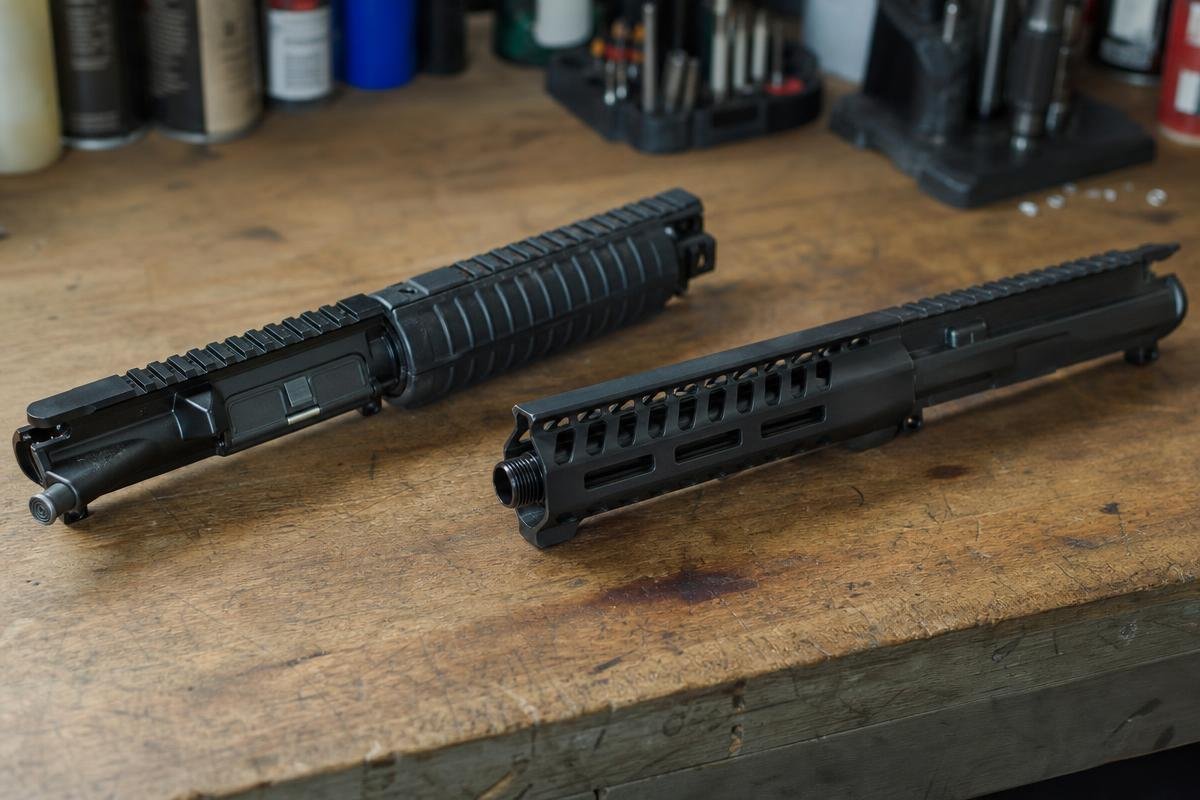
A drop-in AR-15 handguard installs without removing the barrel nut. That single fact is why so many first-time builders start here. No barrel nut wrench, no torque spec, no armorer's block required.
The attachment sequence is straightforward. Compress the delta ring rearward, seat the rear of the handguard beneath it, fit the front of the handguard into the front handguard cap, then release the ring. Spring tension holds the assembly in place. That retention system keeps the handguard seated without making it a free-float design.
Because the handguard presses against the barrel at both ends, it is not free-floating by definition. Barrel contact is exactly what separates these two handguard styles mechanically.
The Delta Ring and Cap System
The delta ring is the spring-loaded collar sitting just forward of the upper receiver. It compresses rearward to accept the handguard, then springs forward to lock the rear of the handguard in place. No tools needed for installation or removal. That simplicity makes drop-in units a practical choice for truck guns and budget carbines where fast swaps matter more than maximum accuracy.
The factory barrel nut stays in place throughout. If you are building on a standard mil-spec upper, the delta ring assembly is already there. Nothing about the existing configuration needs to change.
Drop-In Handguard Designs and Accessory Interfaces
Classic two-piece drop-ins split at the top and bottom, matching the standard mil-spec carbine profile. They are the lightest and least expensive option, and they are ideal when you just want a plain, reliable forend and plan to run iron sights or a single top-rail optic. Drop-in systems vary by manufacturer, and models with M-LOK or other accessory slots can provide additional mounting options without converting the rifle to a free-float setup.
Choose a drop-in design with the appropriate accessory interface when you plan to mount a light, laser, or vertical grip. If you want to compare those slot systems before choosing, review the manufacturer’s specifications for each handguard.
Neither design free-floats the barrel. If that accuracy difference matters for your build, the section below covers the real-world MOA data. For questions about which configuration fits your upper, call us at (888) 706-0633 or browse our complete AR-15 uppers for sale to see what ships ready to run.
What Is a Free-Float Handguard and How Does It Work?
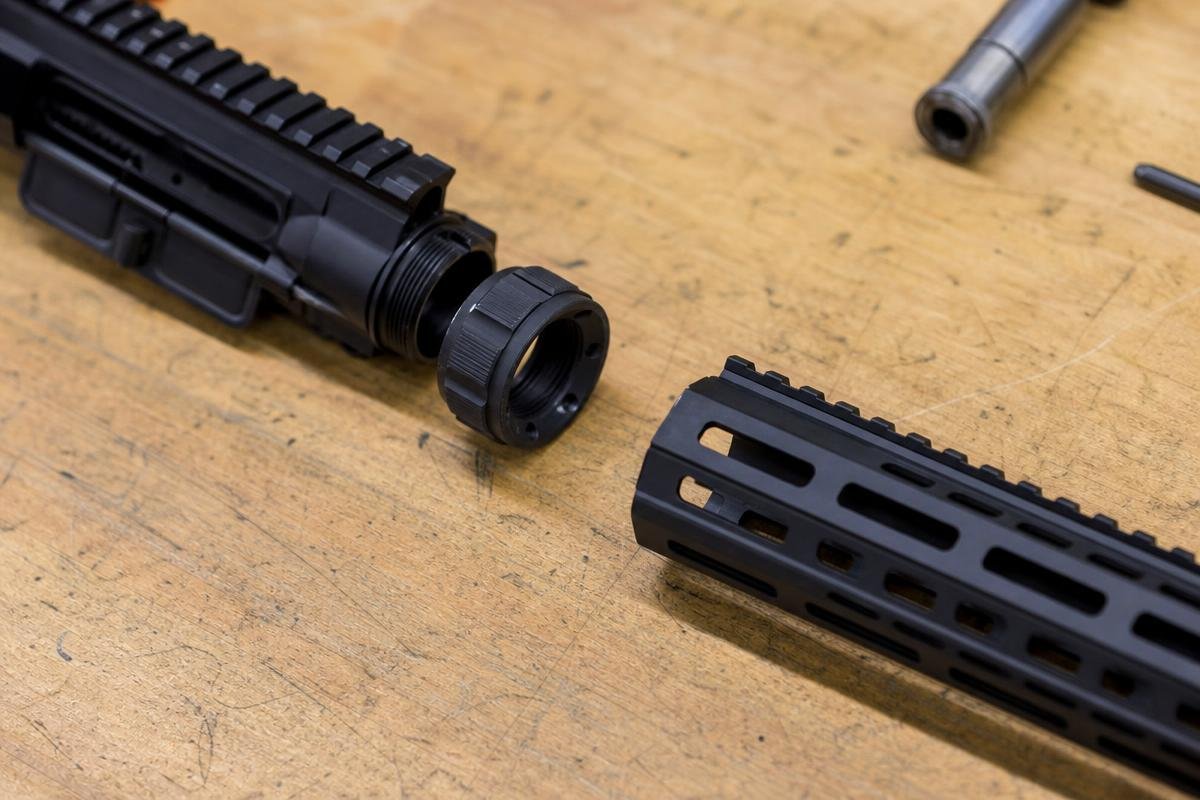
A free-float handguard mounts to a dedicated barrel nut secured to the upper receiver. The tube extends forward over the barrel without making contact at any point along its length. That zero-contact geometry is the core mechanical difference between the two designs, and it is why a free-float setup may improve consistency when pressure is applied to the handguard.
Because the handguard does not contact the barrel, pressure on the handguard is less likely to affect barrel movement. For precision-oriented builds, that isolation can help limit pressure-induced point-of-impact shifts when using a sling or support.
Barrel Nut Mounting and Zero Barrel Contact
Installation starts by removing the delta ring assembly completely. The factory barrel nut comes off, and the handguard's proprietary or mil-spec compatible barrel nut goes on in its place. You need an armorer's wrench and a torque wrench. Torque specs vary by manufacturer, typically 30 to 80 ft-lbs, so verify the spec sheet before you start. Skipping that step risks a loose nut that shifts zero under recoil.
Once the barrel nut is torqued and timed, the handguard slides over it and locks in place. The barrel floats free inside the tube. No delta ring, no cap, no spring tension against the barrel profile.
Handguard Length and Gas System Compatibility
Choose free-float handguard length based on barrel length, desired gas-block coverage, and clearance for the specific gas block and muzzle device.
Standard A-frame or front sight base style gas blocks will not clear the inner diameter of most free-float tubes. A low-profile gas block is required in most configurations. If you are planning a build and want to confirm compatibility before ordering, you can browse complete AR-15 uppers for sale that ship already configured with the correct gas block and handguard pairing, or contact AR15Parts.com at (888) 706-0633 to talk through your specific setup.
Already know which way you're going? Shop free-float rails and drop-in options ready to ship from Denison.
The Real Accuracy Difference Between Free Float and Drop In
This is the question most builders actually care about. The short answer: a free-float handguard may reduce pressure-induced point-of-impact shifts compared with a drop-in design, with the measurable difference varying by rifle, ammunition, support method, and shooter. Any measurable difference depends on barrel quality, ammunition, support method, and consistent technique. On a mid-tier barrel firing bulk 55 grain ammo, you may never see the difference. Whether that gain matters depends entirely on what you are doing with the rifle.
How Barrel Contact Affects Point of Impact
A drop-in handguard contacts the barrel at the gas block or front sight base. Any lateral force on that handguard, whether from a sling, a bipod leg, or your support hand grip, transfers directly to the barrel and shifts your point of impact. The barrel is no longer vibrating freely. It is responding to outside pressure on every shot cycle.
A free-float handguard mounts to the barrel nut, and the handguard itself does not contact the barrel. The barrel can vibrate more consistently from shot to shot. That consistency is where the accuracy gain comes from.
For close-range use, the practical effect may be small, while pressure-induced point-of-impact shifts can become more noticeable as distance increases.
Accuracy Differences in Practice
An angular point-of-impact shift becomes a larger linear difference as distance increases. The table below compares the two handguard types across practical build considerations without assuming a fixed accuracy gain.
| Spec | Drop-In | Free-Float |
|---|---|---|
| Barrel Contact | Yes, at gas block or FSB | None past the barrel nut |
| Accuracy Potential | Adequate for CQB and general range use | Potentially more consistent when external pressure is applied to the handguard |
| Installation Difficulty | Low, no special tools | Moderate, requires barrel nut swap |
| Tools Required | None or basic hand tools | Armorer’s wrench, torque wrench |
| Average Cost Range | Pricing varies | Pricing varies |
| Typical Weight | Lighter, simpler construction | Heavier, longer rail body |
| Accessory Mounting | Limited rail space | Full-length M-LOK or Picatinny |
| Barrel Nut Replacement | No | Yes |
For home defense, CQB, or general range use, a quality drop-in handguard is not holding you back. For precision shooting or competition, a free-float handguard is generally preferable when minimizing pressure-induced point-of-impact shifts is a priority. If you are building a precision upper and want guidance on configurations, browse our complete AR-15 uppers for sale or contact AR15Parts.com at (888) 706-0633 with your build specs.
Cost and Installation: What Each Type Actually Requires
Drop-In Handguard Cost and Tool Requirements
A drop-in AR-15 handguard setup is the lower-cost path, and the installation rarely takes more than ten minutes. Pricing varies by material, accessory interface, design, and manufacturer. Replacing a standard drop-in handguard generally requires no specialized armorer’s tools, although a delta-ring tool may make removal easier. Follow the handguard manufacturer’s instructions.
That simplicity is the real selling point for first-time builders. You remove the old handguard, compress the delta ring, seat the new one, and you are done. The barrel nut never moves.
Free-Float Handguard Cost and Installation Steps
A free-float installation costs more in both parts and tools. Pricing varies by manufacturer, material, design, and the tools required. First-time installers may need an armorer’s wrench, a calibrated torque wrench, and a vise block that match the manufacturer’s instructions.
The installation sequence runs like this:
- Remove the delta ring assembly and the existing barrel nut.
- Install the new barrel nut and torque it to the manufacturer's specification, typically 30 to 80 ft-lbs depending on the design.
- Align the gas tube port with the barrel nut's gas tube channel.
- Slide the handguard over the barrel and thread or clamp it to the barrel nut.
- Verify there is zero barrel contact along the full length of the handguard.
If you want a free-float setup without buying the tooling, the cleaner option is a complete AR-15 upper that ships with the rail already installed, headspaced, and function-checked. That eliminates the tool cost entirely and gets you on the range faster. Ready to build it out? Browse drop-in options and free-float rails, or call us at (888) 706-0633 to ask about parts compatibility.
Which Handguard Type Is Right for Your Build?
The right choice comes down to one thing: what you are actually doing with the rifle. Both designs work. Neither is wrong in the right context. The question is whether your use case demands barrel isolation or not.
When a Drop-In Handguard Makes Sense
If the rifle is a truck gun, a home-defense carbine, or a training rifle, a drop-in handguard may be a suitable option. The practical difference varies at every distance based on the rifle, ammunition, support method, and shooter. You keep the factory barrel nut, skip the armorer's tools, and spend the savings on ammunition or optics.
For a hard-use carbine, consider a drop-in handguard if your upper has a compatible delta ring and front handguard cap and you value a simpler swap. Check the manufacturer’s fitment specifications before ordering.
When a Free-Float Handguard Is Worth the Investment
If you are building a precision deer rifle, a designated marksman rifle, or a competition gun used consistently past 200 yards, a free-float handguard is generally preferable when reducing pressure-induced point-of-impact shifts is a priority. Pressure applied through a drop-in handguard can affect point of impact because the handguard interfaces with barrel-mounted components. A free-float design reduces this source of pressure-induced shift.
If you have already invested in a match-grade barrel, a quality bolt carrier group, and a precision trigger, running a drop-in handguard is the weak link in that system. Those components are working against each other. Pair the free-float rail with the rest of your precision build, and check our complete AR-15 uppers for sale if you want a turnkey starting point. If you have questions about finishing out the full rifle, contact AR15Parts.com at (888) 706-0633 for parts and compatibility advice.
AR-15 Handguards Shipped Nationwide
We stock and ship free-float and drop-in handguard options from our facility at 4000 Texoma Pkwy, Denison, TX 75020. Builders across Texas, Oklahoma, and the rest of the country can order and have parts moving quickly. Availability and handling times vary by product.
For your build, choose based on gas block clearance, accessory needs, and how you support the rifle. A free-float rail suits builds where barrel isolation is a priority; a compatible drop-in handguard can retain a standard delta-ring setup.
If you are not sure which direction to go before you order, call us at (888) 706-0633. You can also contact AR15Parts.com online and describe your build. We can help compare handguard specifications with your barrel length and gas system. No guesswork, no upsell pressure.
We also carry complete AR-15 uppers for sale if you want a turnkey unit already built around the right handguard configuration for your application.
Frequently Asked Questions
Does a free-float handguard actually improve accuracy at my shooting distance?
At 100 yards, the measurable difference can be small or hard to isolate from ammunition and shooter variability. The linear effect of an angular point-of-impact shift becomes more visible as distance increases, but the practical difference depends on the complete setup. For a carbine used mainly at shorter shooting distances, a quality drop-in handguard may be sufficient. At longer distances, factor potential point-of-impact shifts into your build.
Will my existing gas block work with a free-float handguard?
Not always. Most free-float handguards require a low-profile gas block because the handguard slides over the barrel and gas block. Check the inner diameter spec of the handguard against the height of your current gas block before you order. A standard A-frame front sight base will not clear most free-float tubes. Confirm clearance before ordering a rail for an existing upper.
Do I need an armorer's wrench to install a free-float handguard?
Do not substitute improvised tools, because they can damage the barrel nut or leave torque unverified. Use the manufacturer-specified armorer’s wrench and a calibrated torque wrench rather than improvised tools.
Will any drop-in handguard fit my AR-15?
Most drop-in handguards are built for standard mil-spec delta ring assemblies. Verify your upper uses a standard delta ring before ordering. Piston-driven uppers and some non-standard configurations use different attachment systems and may not accept a standard drop-in unit.
What handguard length fits a 16-inch barrel?
A 16-inch barrel may use a carbine- or mid-length gas system. A 15-inch free-float handguard is a common pairing and clears the gas block when using a low-profile unit. For a drop-in setup, match the handguard to the rifle’s existing gas-system length and front handguard-cap position. If you are unsure about gas port position on your specific barrel, our AR-15 barrels page lists gas system length by barrel configuration.
Is a free-float handguard always lighter than a drop-in?
No. A basic aluminum free-float tube can weigh less than a polymer drop-in with heat shields. Premium free-float designs with full-length Picatinny rails add real weight. Compare published weight specs before you decide. Do not assume free-float means lighter.
You now have the mechanical facts, the cost breakdown, and the use-case framework to make this decision with confidence. If you are ready to order, we carry handguards and complete AR-15 uppers that ship from Denison, TX to builders across the country. If you have parts compatibility questions before you buy, call us at (888) 706-0633. We can help you compare handguard compatibility and choose parts for your build.
Ready to Get Started with AR15Parts.com?
Call (888) 706-0633 to ask our team about handguard options and parts compatibility. We can help you compare available parts before you order. You can also contact our team online with product questions.