
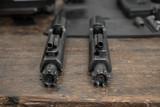
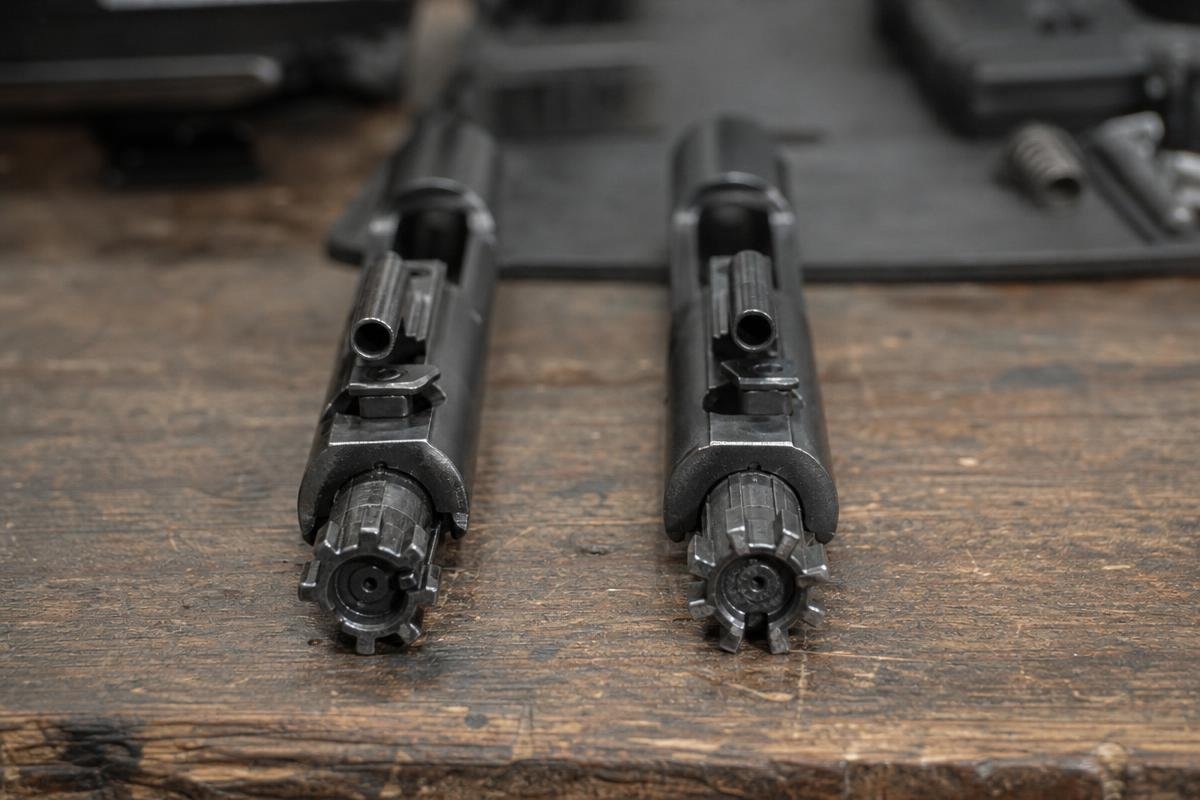
A full auto BCG and a semi-auto BCG differ mainly in the rear underside profile of the carrier. If you are choosing parts for an AR-15, that difference matters for carrier mass and compatibility, but a full-auto profile carrier does not make a semi-auto rifle fire automatically. We ship from our Denison, TX facility, and our team can help you compare available BCG options before you order. Have a question? Call us at (888) 706-0633.
Key Takeaways
- The real difference between full auto and semi-auto BCGs comes down to one small dimension: the rear underside profile of the carrier and the resulting carrier mass.
- A full-auto BCG is legal in any semi-automatic AR-15 and is the more common choice for standard builds.
- Semi-auto BCGs have a shorter tail that physically cannot trip an auto sear, making them one compatible option for semi-auto lowers.
- Carrier mass affects felt recoil and gas system timing, so BCG selection is relevant beyond just legal configuration.
- Neither BCG type converts a semi-automatic rifle to full-auto on its own; the fire control group and lower receiver determine that.
Full Auto BCG vs. Semi-Auto: What Changes in the Carrier?
The distinction between the two carrier profiles lives in one place: the carrier body itself. Not the bolt. Not the firing pin. Not the cam pin. The carrier body is where the geometry changes, and that geometry is the only thing that separates these two AR-15 bolt carrier group types.
The BCG assembly has five components: the bolt, cam pin, firing pin, firing pin retaining pin, and the carrier. If you want the full breakdown of how each piece functions together, our AR uppers and BCG selection pages cover the complete component anatomy. For the full-auto versus semi-auto distinction, keep your eyes on the carrier tail.
The Full-Auto Lug
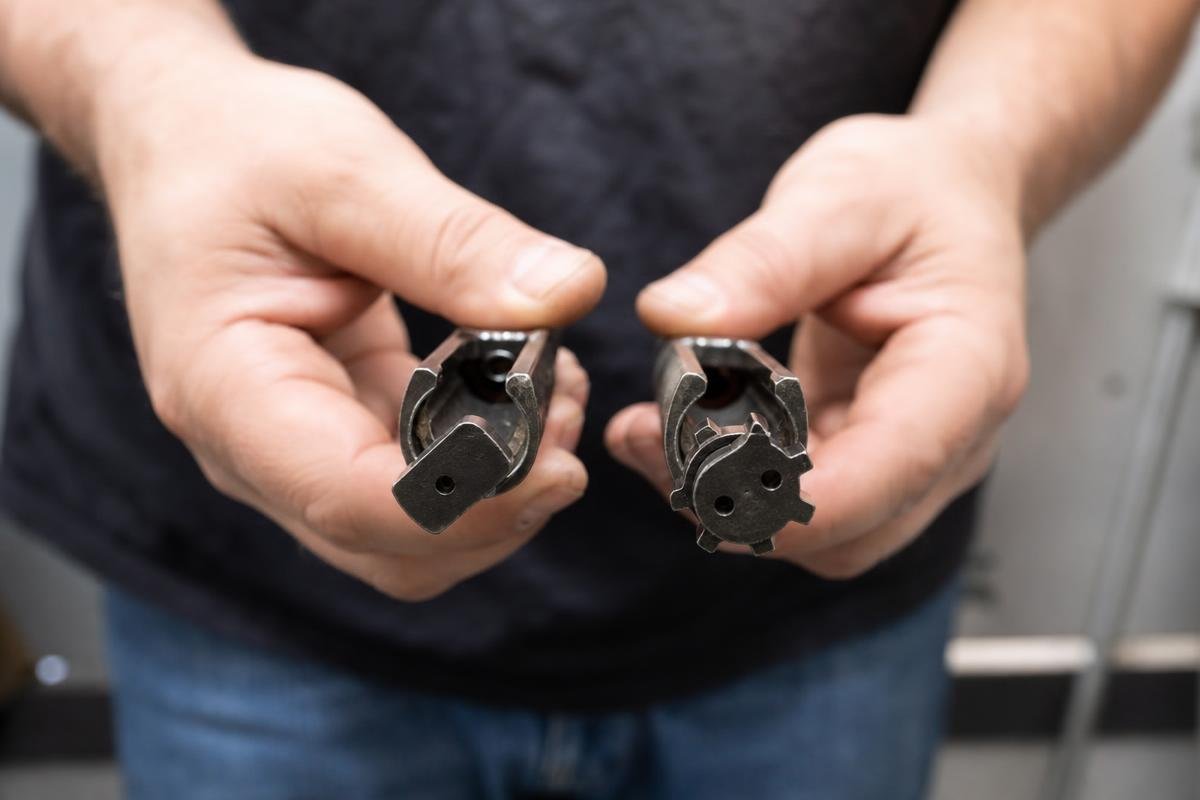
Flip a full-auto BCG over and look at the underside of the carrier tail, the rearmost section of the carrier body. You will see a small machined shelf of metal protruding from that surface. That is the auto sear trip lug. It is roughly 0.2 inches of additional material compared to a semi-auto carrier.
In a registered, select-fire weapon, that lug physically contacts the auto sear as the carrier cycles rearward. That contact trips the auto sear, which holds the hammer back and releases it again the moment the bolt goes into battery. That mechanical contact is what allows continuous fire. No contact, no automatic fire. It is that simple.
If you pick up a mil-spec BCG at a vendor table at a gun show in Sherman and the label reads "full-auto," that lug is why. It is standard mil-spec geometry. It is not a red flag. It is just how military-spec carriers are machined.
How the Semi-Auto BCG Differs in Geometry
A semi-auto carrier tail is cut shorter at the rear underside. The auto sear trip lug is absent. There is no shelf of metal to contact an auto sear because civilian fire control groups do not have one to contact. The carrier cycles, the hammer resets, and you get one round per trigger pull.
This is purely a geometry difference. No electronics. No trigger wiring. No internal mechanism beyond the presence or absence of that rear lug. The AR-15 carrier types documented in most mil-spec references come down to exactly this one machined feature.
One question comes up often: if you machine off the lug on a full-auto BCG, does it become a semi-auto carrier? Do not modify the carrier or any fire-control component. Use parts in their manufactured configuration and obtain qualified legal and technical guidance before considering any regulated modification.
Why a Civilian AR-15 Cannot Fire Automatically, Even with a Full-Auto BCG
This question comes up constantly. Install a full-auto BCG in a standard semi-auto rifle, and it still fires one round per trigger pull. That is exactly how it should work. The BCG type does not control rate of fire. The fire control group in your lower receiver does.
The Fire Control Group Is the Real Gatekeeper
Your lower receiver houses the components that actually govern how your rifle fires: the trigger, hammer, disconnector, and selector switch. In a standard civilian AR-15, there is no auto sear. Without one, the full-auto lug on the carrier contacts nothing. It is present, but it does nothing. The rifle resets after each trigger pull, same as any other semi-auto build.
Installing a full-auto BCG does not add an auto sear. It does not modify your trigger group. The bolt carrier groups we stock are part of the upper assembly ecosystem, and swapping one in changes nothing about how your lower's fire control operates. No BCG swap, trigger swap, or parts combination legally converts a semi-auto lower to full-auto without NFA compliance. Attempting that conversion is a federal felony. We state that plainly, not to alarm anyone, but because it is the fact.
To answer the direct question: no, a full-auto lug sitting inert in your semi-auto rifle creates no legal risk. The lug alone does nothing. You are not in violation of any law simply by running a full-auto BCG in a standard civilian build.
What the Hughes Amendment Actually Means for Your Build
The Firearm Owners Protection Act of 1986, specifically the Hughes Amendment, banned civilian transfer of machine guns manufactured after May 19, 1986. Pre-1986 registered machine guns are still legal to own with proper NFA paperwork: a Form 4, a $200 tax stamp, and ATF approval. That process applies to the machine gun itself, not to a BCG. As of January 1, 2026, the NFA tax is $0 for suppressors, short-barreled rifles, short-barreled shotguns, and any other weapons (AOWs), although registration and approval still apply. Machine guns remain subject to the $200 tax.
A full-auto BCG purchased today is a legal, unregulated component. It is not a machine gun. It does not require NFA paperwork on its own. Texas law can change, so verify current state and federal requirements before purchasing or configuring a firearm. That leaves North Texas builders in a permissive environment at the state level, while federal law applies uniformly regardless of where you live.
One note for buyers along the Red River: if you transport any NFA-regulated item across the Texas-Oklahoma line, both states' rules apply. That is a separate conversation from BCG selection, but it is worth knowing if you live in Durant or Ardmore and own a registered NFA item.
Ready to order the right BCG for your build? Browse our bolt carrier groups and complete uppers. We build complete uppers to order, assemble them in-house, and headspace and function-check them before shipping.
Does BCG Type Affect Reliability or Performance in a Semi-Auto Build?
Yes, but the degree depends on how your rifle is configured. In a standard semi-auto carbine running a carbine-length gas system, the two carrier profiles differ so little that most shooters will never notice it at the range. Where the distinction becomes genuinely relevant is in suppressed builds and adjustable-gas setups. For a suppressed 300 Blackout build, carrier mass is one factor to consider alongside the gas and buffer setup.
Mass, Dwell Time, and the Gas Curve
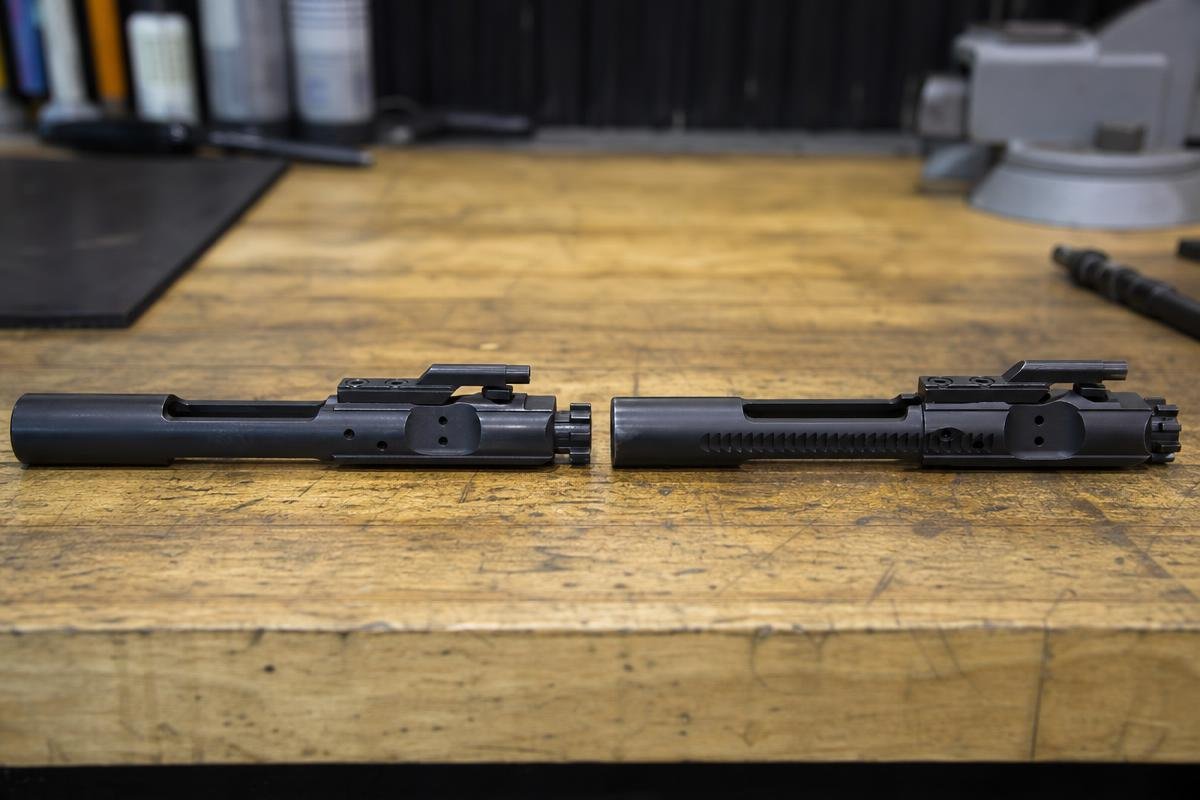
A full-auto BCG carries slightly more mass than a semi-auto carrier. The difference is typically measured in fractions of an ounce. Carrier mass can affect bolt-unlock timing and carrier velocity, which may influence felt impulse and cycling behavior.
On a standard 16-inch barrel with a carbine-length gas system, that mass difference is negligible. You are unlikely to feel it or measure it in a standard build. The picture changes on a suppressed 300 Blackout or 5.56 setup. Suppressors increase backpressure, which drives more gas into the system and can cause over-gassing. A heavier carrier requires slightly more gas pressure to cycle fully, which gives you a modest buffer against the pressure spike a suppressor introduces.
If you are tuning a suppressed build or running an adjustable gas block, the added mass of a full-auto carrier becomes a real variable to account for. For more on how gas system length interacts with these dynamics, see our guide on choosing the right gas system length for your AR-15.
Carrier Tilt and Wear Patterns Over Time
Full-auto carriers have a longer bearing surface at the rear of the carrier body. That extended surface contacts the inside of the lower receiver extension more evenly during rearward travel. In a carbine-length build, this may distribute rear bearing contact more evenly, although the effect depends on the complete operating system. Carrier tilt is what happens when the rear of the carrier contacts the buffer tube at an angle rather than straight back, and it accelerates wear on the lower receiver extension over time.
Will switching to a full-auto carrier eliminate tilt entirely? No. But the longer bearing surface distributes contact load more evenly, which some builders argue extends the service life of the lower extension in high-round-count carbines. For a rifle that sees a few hundred rounds a year, the wear difference is minimal.
For a rifle running thousands of rounds annually, the full-auto carrier's geometry is a reasonable consideration. If you are building a suppressor-ready rifle and want to pair the right carrier with a complete upper, browse our 300 Blackout complete uppers or the complete AR-15 uppers catalog to match components before you build. Have questions about which BCG fits your build? Call us at (888) 706-0633 for product guidance from our team.
Which BCG Should You Run in Your Civilian AR-15 Build?
The short answer for most builders: run a full-auto profile BCG. It is the mil-spec standard, it is what most manufacturers produce by default, and it works in any semi-auto AR-15 without modification. The semi-auto profile is not wrong, but it is the less common option and offers no functional advantage in a civilian build.
Standard Carbine and Rifle Builds
If you are building a 16-inch or 20-inch AR-15 in 5.56 NATO, .223 Wylde, or 300 Blackout with a carbine or mid-length gas system, either carrier profile runs reliably. The full-auto BCG is the default recommendation. It is mil-spec, widely available, and commonly used in civilian builds. There is little reason to seek a semi-auto profile carrier when a suitable full-auto BCG is available.
Whether a full-auto BCG is legal for civilian use comes up often. Yes, the carrier is legal for any civilian to own. The BCG profile alone does not make a rifle fire automatically. That requires a registered auto sear and a modified fire control group, neither of which is present in a standard semi-auto bolt carrier group build.
Suppressed and Adjustable-Gas Builds
A suppressor increases backpressure in the gas system. That extra pressure drives the carrier rearward faster and harder than in an unsuppressed setup. The additional mass of a full-auto BCG helps buffer that energy, which makes cycling more consistent and reduces felt bolt velocity. If you are running a suppressed setup, a full-auto-profile carrier may be preferable in some suppressed configurations, depending on the gas and buffer setup.
Pair it with an adjustable gas block so you can tune the gas curve for both suppressed and unsuppressed use. Hunters running suppressed 300 BLK setups for hog and deer season see real benefit from this combination. A 300 Blackout upper built around a full-auto BCG and an adjustable gas block is a practical, reliable suppressor-ready platform. If you are considering a piston system for a suppressed build, verify upper compatibility and manufacturer guidance before finalizing your parts list.
Coatings and Materials: What Actually Matters Alongside BCG Type
Once you settle on a full-auto profile, the more consequential decision is coating. Phosphate, also called parkerized, is the mil-spec standard and holds lubrication well. Nickel boron is self-lubricating and significantly easier to clean after high-volume sessions. DLC, diamond-like carbon, offers the lowest friction coefficient of any common coating and holds up well against corrosion. Chrome-lined carriers add corrosion resistance and suit high-volume shooters who run the rifle hard in wet or humid conditions, which matters through the muggy North Texas summers.
The carrier options break down further, including a side-by-side coating comparison, in our AR-15 BCG coatings guide. Profile gets you in the right category. Coating determines how the carrier performs over time in your specific conditions.
What Denison and North Texas Shooters Should Know Before Buying a BCG
Texas Law and the AR-15 Platform
Verify current Texas and federal requirements before purchasing or configuring a semi-automatic rifle. A full auto BCG in a civilian-legal semi-auto AR-15 requires zero special paperwork. You can buy one, install it, and head to the range without any additional licensing or registration.
NFA items are a different matter. Suppressors and registered machineguns remain subject to federal application and approval requirements. Current federal tax treatment differs by NFA item, so verify the current ATF requirements before proceeding. If you are running a suppressor-ready build for deer season or hog hunting, the BCG itself is not the regulated part. The suppressor is. Keep that distinction clear.
Shooters coming down from the Oklahoma side should verify NFA compliance before transporting any regulated items across the state line. The choice between full-auto and semi-auto carrier profiles carries no legal weight for that transport question. What matters is whether your build includes any federally registered NFA item.
Finding the Right BCG for Your Build from Denison
We ship nationwide from 4000 Texoma Parkway, Denison, TX 75020, right on the US-75 corridor. Builders in Sherman, Pottsboro, and across Grayson County can order BCGs for direct delivery without leaving the house. If you want a turnkey assembly with a BCG already headspaced and function-checked, browse our complete AR-15 uppers and drop one onto your lower.
BCG selection is a practical question here, not just an academic one. For a hunting or range build, pick the BCG that fits your gas system, barrel length, and how you actually shoot. We can help you sort that out.
Frequently Asked Questions
Is a full-auto BCG legal to own in a semi-auto AR-15?
Yes. A full-auto profile BCG is a standard mil-spec component sold openly by licensed dealers. No NFA paperwork is required for the BCG itself. The regulated items are the auto sear and registered machine gun, not the carrier group.
Will a full-auto BCG make my AR-15 fire automatically?
No. Without an auto sear in the lower receiver, the full-auto lug has no surface to contact. Your rifle fires one round per trigger pull regardless of which BCG profile you install.
What is the actual weight difference between a full-auto and semi-auto BCG?
Typically 0.2 to 0.5 ounces depending on manufacturer and material. Most shooters will never notice it. The difference only matters in precision or competition builds where every ounce is tracked.
Which BCG profile do most AR-15 builders use?
Full-auto profile is the industry standard. Most mil-spec BCGs ship with the full-auto profile even when sold for civilian semi-auto rifles. Wider availability and a longer field track record make it the default choice.
Does BCG type matter for a suppressed 300 Blackout build?
Yes. Additional carrier mass helps buffer the increased backpressure from a suppressor, especially with supersonic loads. Pair a full-auto profile BCG with an adjustable gas block. See our 300 Blackout complete uppers for suppressor-ready configurations.
Where can I buy a full-auto profile BCG for my AR-15 build?
We carry bolt carrier groups. Our complete uppers are built to order, assembled in-house, headspaced and function-checked before shipping. For a deeper look at coatings and carrier types before you order, read our AR-15 BCG guide.
Ready to order? AR15Parts.com ships bolt carrier groups and complete uppers nationwide from 4000 Texoma Parkway, Denison, TX 75020. Every complete upper is built to order, assembled in-house, headspaced and function-checked before shipping. Browse our complete AR-15 uppers, or call us at (888) 706-0633 to talk through your build before you order.
Ready to Get Started with AR15Parts.com?
Call (888) 706-0633 to order the right BCG for your build or speak with our team directly. We're ready to answer your questions, walk you through your options, and match the carrier to your gas system and barrel. Whether you're just starting to plan or ready to buy, we'll make the process simple and stress-free. Order your bolt carrier group today and let's build it right the first time.