
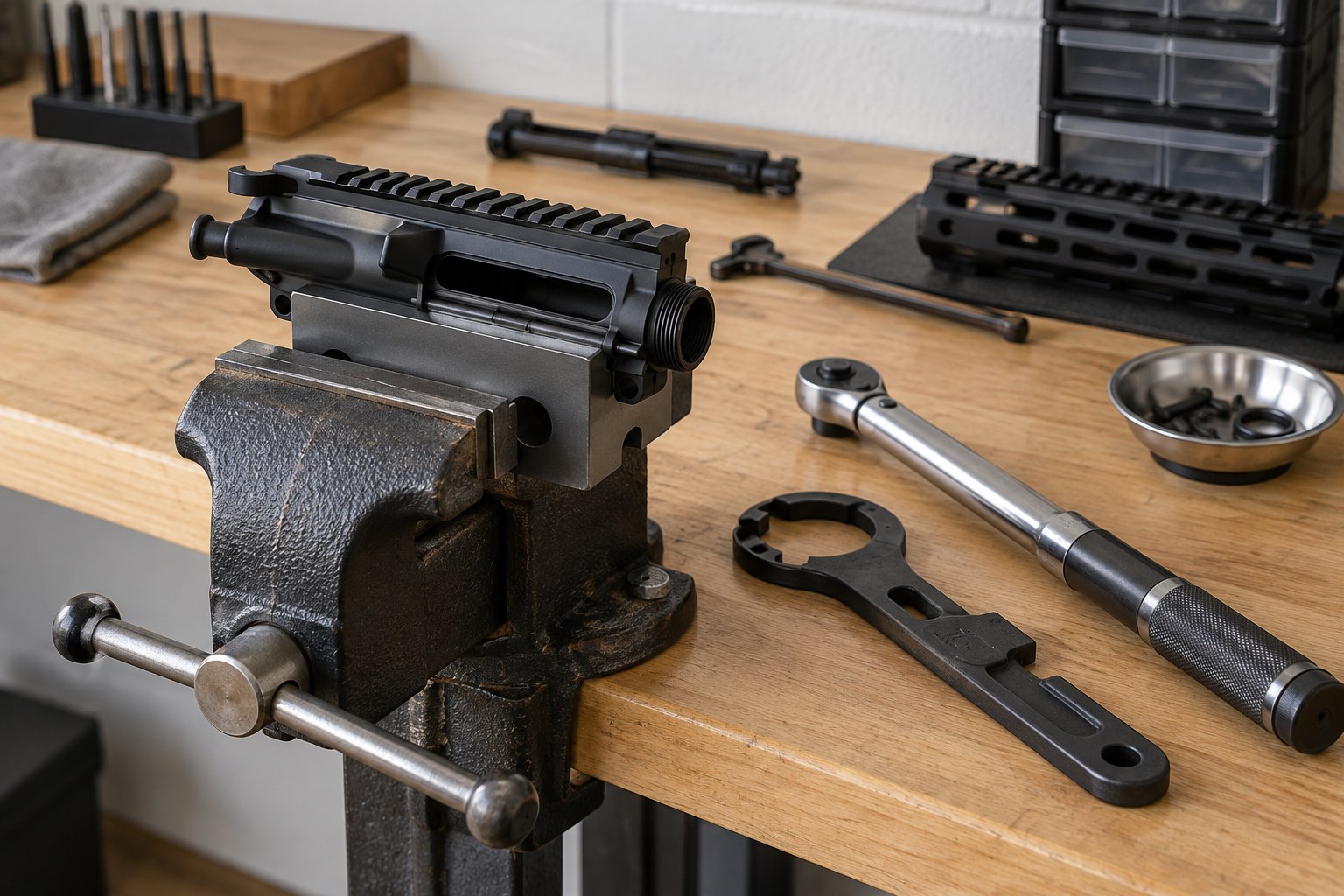
Getting your AR-15 barrel nut torque correct is one of the simplest ways to protect a new barrel and keep a rifle shooting the way it should. Too little torque leaves the nut free to work loose under recoil, and an inconsistent approach can throw off gas tube alignment on a standard-style nut before you ever fire a shot. AR15Parts.com ships barrels and upper parts from its Texoma-area facility in Denison. Confirming the right spec before you clamp anything in a vise protects a barrel, a thread, and a range day. Have questions about your specific barrel and nut before you start?
Key Takeaways
- Correct AR-15 barrel nut torque keeps the barrel seated tight against the upper receiver, supports gas tube alignment on a standard-style barrel nut, and helps keep group sizes consistent from one range session to the next.
- A commonly cited Army technical manual procedure for a standard mil-spec barrel nut calls for torquing to 30 ft-lb, loosening and repeating that step, then tightening further only as needed and never past 80 ft-lb to line up the gas tube hole.
- Proprietary free-float handguard nuts, including the barrel nut used with Aero Precision handguards, often carry their own published torque range, so always follow that manufacturer's spec instead of a generic mil-spec number.
- A torque wrench, a matching armorer's wrench, and an upper receiver vise block or reaction rod are the core tools for the job, along with anti-seize or grease exactly as the component manufacturer specifies.
- Clamping the bare receiver instead of using a proper vise block, or adding a crowfoot wrench without correcting the setting for its length, are two of the most common ways a torque reading ends up wrong.
- A qualified gunsmith should take over whenever the gas tube hole will not align inside the allowed torque range, a barrel nut will not turn smoothly, or headspace has not been verified.
Why Barrel Nut Torque Matters on Every AR-15 Build
The barrel nut is the large threaded collar that clamps the barrel extension against the face of the upper receiver. Correct torque keeps that joint tight enough that the barrel cannot shift or loosen under the pressure and vibration of firing, while avoiding so much force that threads gall or the nut itself cracks.
Barrel Seating Against the Receiver Face
The barrel extension has to sit flush and square against the front of the upper receiver for the action to lock up correctly. Under-torquing the barrel nut can leave a small gap that lets the barrel move with every shot, which is hard on threads and can affect how consistently the rifle cycles.
Gas Tube Alignment on a Standard Barrel Nut
A standard round barrel nut has a series of notches cut into its face. The gas tube hole in the upper receiver has to line up with one of those notches so the gas tube can pass through cleanly. Because the notches are spaced at fixed intervals, the nut sometimes needs to be tightened past its minimum torque value to reach the next notch, which is exactly why a torque range exists instead of a single fixed number.
Consistency From One Range Trip to the Next
A barrel nut that is torqued differently every time it is installed can change how the barrel sits and how the upper and lower assemblies interact under recoil. Following the same verified procedure and the same spec every time removes one more variable when you are chasing consistent groups. If you would rather start from an upper that is already headspaced and function-checked, complete AR-15 uppers from AR15Parts.com are assembled in-house before they ship.
What Is the Correct AR-15 Barrel Nut Torque for a Standard Nut?
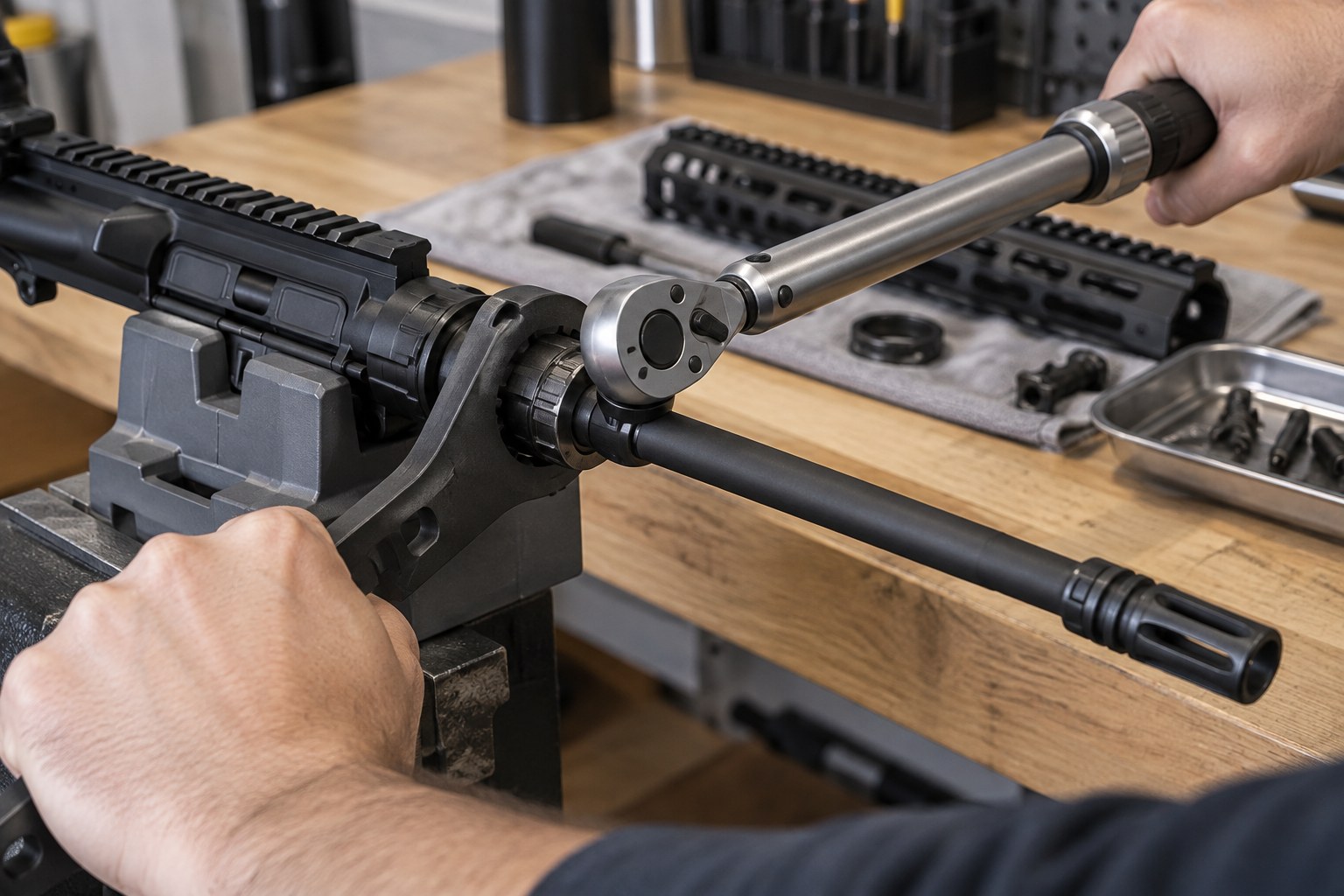
There is no single universal number for AR-15 barrel nut torque. A commonly cited Army technical manual procedure gives a starting point for standard mil-spec barrel nuts, and it is worth understanding the range as well as the reasoning behind it.
The Commonly Cited Army Technical Manual Procedure
The Army technical manual for the M16 rifle and M4 carbine describes torquing the barrel nut assembly to 30 ft-lb using a combination wrench and torque wrench together, then loosening the nut and repeating that torque step, since the repeated cycle helps the threads seat and reduces the chance of the nut backing off later. The same manual includes a caution against torquing the barrel nut past 80 ft-lb while indexing it to the next notch for gas tube clearance, and it specifically notes that the nut should never be loosened to try to fix alignment, only tightened further within that limit.
| Barrel Nut Type | Commonly Cited Torque Guidance | Source |
|---|---|---|
| Standard mil-spec round barrel nut | Torque to 30 ft-lb, loosen and repeat the torque step, then continue tightening only as needed, never past 80 ft-lb, to align the gas tube hole | Army Technical Manual TM 9-1005-319-23&P |
| Aero Precision BAR barrel nut (used with Aero Precision free-float handguards) | 30 to 45 ft-lb recommended; do not exceed 45 ft-lb | Aero Precision BAR Barrel Nut Installation Instructions |
| Any other proprietary free-float barrel nut | Follow the torque figure published by that specific manufacturer, since it can fall outside the mil-spec range | Manufacturer's own installation instructions |
Why the Range Runs From 30 Up to 80 ft-lb
That wide range confuses a lot of first-time builders, but it makes sense once you consider the notches on the barrel nut face. The 30 ft-lb figure is the minimum torque called for, and 80 ft-lb is a ceiling, not a target. Tighten only as far past 30 ft-lb as needed to land on the next notch that lines up the gas tube hole, then stop.
Grease or Anti-Seize on the Threads
The same technical manual calls for a light coat of molybdenum disulfide grease on the barrel nut threads before installation, which reduces friction so the torque wrench reading reflects real clamping force instead of thread drag. Aftermarket manufacturers frequently specify their own anti-seize or grease, so always follow the instructions packaged with the barrel nut or handguard you are installing rather than assuming one product works for every setup. For a broader look at torque values across the rest of the upper, our AR Upper Hub guide to AR-15 upper torque specs is a useful companion reference.
Proprietary Free-Float Handguard Nuts Have Their Own Torque Specs
Plenty of free-float handguards use a barrel nut that looks similar to a standard mil-spec nut but is not interchangeable with it, and the torque spec that comes with it is not always the same 30 to 80 ft-lb range either.
Why Aftermarket Barrel Nuts Differ From the Mil-Spec Number
An Aero Precision BAR barrel nut, for example, is machined to mount that brand's free-float handguards to a standard threaded upper receiver, and Aero Precision publishes a recommended torque of 30 to 45 ft-lb for that specific nut, warning that torquing it past 45 ft-lb can damage the nut. That is a narrower, lower ceiling than the mil-spec range, which is exactly the point: a proprietary nut is its own part with its own tolerances, so its torque spec has to be treated as its own number, not an assumption borrowed from a different design.
Where to Find the Torque Spec for Your Handguard
Before you touch a torque wrench, check the installation instructions that came with the handguard or barrel nut, or look up the product page from the manufacturer directly. If you cannot locate a spec for the exact part in hand, contact the manufacturer rather than guessing, and if you are still unsure which style of nut you are working with, our AR Upper Hub guide comparing free-float and drop-in handguards is a useful starting point for identifying the hardware on your upper.
Tools You Need to Get AR-15 Barrel Nut Torque Right
The right tools make the difference between a torque reading you can trust and a guess. None of this requires a full gunsmithing setup, but skipping any one of these pieces makes it much harder to get a repeatable result.
Torque Wrench and Armorer's Wrench
A 1/2 inch drive torque wrench, either a click-style or a beam-style unit, lets you dial in a specific foot-pound value and feel or hear when you reach it. It has to be paired with an armorer's wrench sized to fit the notches or slip ring on your specific barrel nut so the torque transfers evenly instead of slipping or digging into one side of the nut.
Upper Receiver Vise Block or Reaction Rod
An upper receiver vise block or a reaction rod holds the upper steady in a bench vise. A clamshell-style vise block clamps the receiver evenly along its length instead of at a pinch point, while a reaction rod locks into the barrel extension lugs so the twisting force of the barrel nut goes into the extension rather than the thin aluminum of the receiver.
Anti-Seize or Grease Per the Manufacturer
Keep whatever anti-seize or grease the barrel or barrel nut manufacturer specifies on hand, along with a clean rag, so threads are lubricated consistently every time. A dry thread and a greased thread do not produce the same clamping force at the same torque wrench reading.
| Tool | Purpose |
|---|---|
| Torque wrench, 1/2 inch drive | Delivers a measured, repeatable torque reading in foot-pounds |
| Armorer's wrench sized for the barrel nut | Engages the barrel nut notches or slip ring so torque transfers evenly |
| Upper receiver vise block or reaction rod | Holds the upper receiver and barrel extension without clamping the receiver walls directly |
| Anti-seize or grease per the component manufacturer | Reduces thread friction so the torque wrench reading reflects actual clamping force |
Common Barrel Nut Torque Mistakes to Avoid
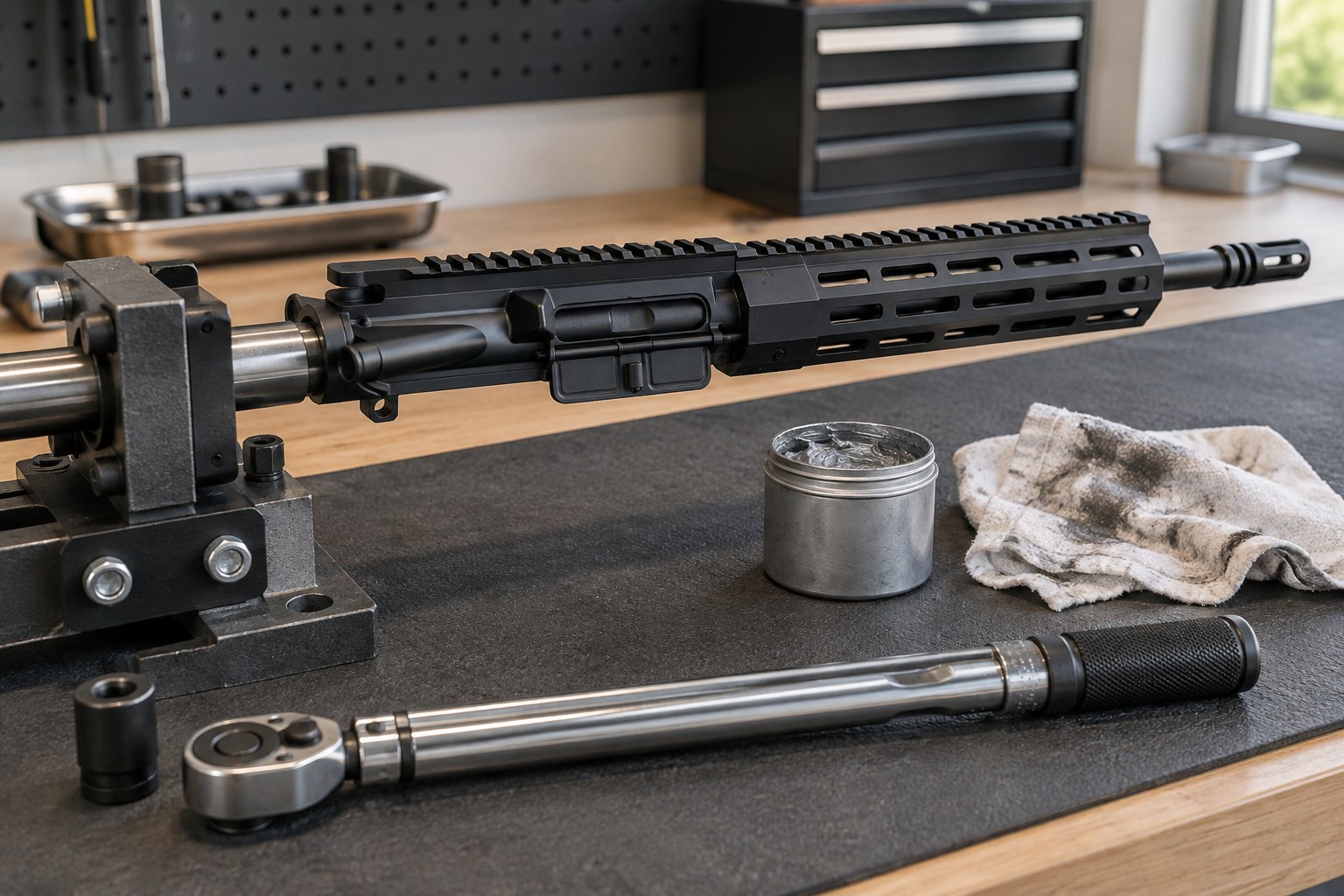
Most barrel nut torque problems trace back to a handful of repeatable mistakes rather than a bad part. Watching for these before you start saves time and protects the upper receiver.
Clamping the Bare Receiver Instead of a Vise Block
Putting a bare upper receiver directly into a bench vise, even with padded jaws, risks crushing or distorting the thin receiver walls when real torque is applied. A clamshell vise block spreads that load evenly around the receiver, and a reaction rod takes it through the barrel extension, which is the part actually designed to handle it.
Adding a Crowfoot Wrench Without Adjusting the Setting
Some builders attach a crowfoot wrench or other extension to their torque wrench to reach the barrel nut at an angle. Doing that changes the effective length of the wrench, so the dial setting and the true torque delivered to the barrel nut are no longer the same number, and the difference grows or shrinks with the extension's length and angle. If you use one, follow the extension manufacturer's guidance for correcting the setting instead of dialing in the barrel nut's target torque directly.
Skipping the Loosen and Retorque Step
It can be tempting to torque a barrel nut once and move on, but the loosen-and-repeat step described in the commonly cited technical manual procedure exists to help the threads seat evenly. Skipping it does not always cause an immediate problem, but it removes one of the built-in checks that a barrel nut is threading on straight and consistently.
When Should AR-15 Barrel Nut Torque Work Go to a Gunsmith?
Most barrel nut installations on a standard AR-15 upper are within reach of a careful builder who has the right tools, but some situations call for a qualified gunsmith instead of another attempt with a torque wrench.
Alignment Will Not Cooperate Inside the Allowed Range
If the gas tube hole will not line up with a notch before you reach the maximum torque a barrel nut or barrel manufacturer allows, stop and have a gunsmith look at the barrel extension, receiver threads, and barrel nut fit rather than forcing the nut further or loosening it to try again.
Headspace Has Not Been Checked
Barrel nut torque and headspace are two different checks, and a correctly torqued nut does not confirm headspace on its own. A qualified gunsmith should verify headspace with the proper gauges any time a barrel is newly installed or swapped, and any time something about chambering or extraction feels different than before.
Threads, Nut, or Receiver Show Damage
Galled threads, a barrel nut that will not turn smoothly, or visible damage to the receiver threads are signs to stop and get a qualified opinion rather than continuing to apply torque. Working past visible damage risks turning a repairable part into one that needs full replacement. If a gunsmith determines the barrel itself needs to be replaced, you can browse current barrel options by caliber once you know what fits your upper. Always keep the firearm unloaded and follow the firearm manufacturer's instructions any time you are working on the upper receiver, and never modify or drill a gas port to try to solve a fit or alignment problem.
If your build uses a standard threaded upper and you are shopping for a free-float rail to pair with it, browse current handguard options and confirm the torque spec listed for that specific product before you start.
AR-15 Barrel Nut Torque Help for Denison and Texoma Builders
North Texas humidity around Lake Texoma can swing widely between seasons, and builders who store an upper for months between range trips sometimes find a little surface corrosion on exposed threads that is worth cleaning up before any torque work begins. Whether you are prepping a rifle for deer and hog season or just getting a new build ready for a range day, starting with clean, properly lubricated threads makes the whole barrel nut process more predictable.
Our team is glad to help you confirm which torque spec applies to the specific barrel nut and handguard combination you are running.
Reach AR15Parts.com at 4000 Texoma Parkway, Denison, TX 75020 or by phone at (888) 706-0633 if you want a second opinion before you tighten anything down.
Frequently Asked Questions
What Is a Safe AR-15 Barrel Nut Torque Range for a Standard Nut?
A commonly cited Army technical manual procedure for a standard mil-spec barrel nut calls for an initial torque of 30 ft-lb, followed by loosening and repeating that step, then tightening further only as needed to align the gas tube hole and never past 80 ft-lb. Always confirm the spec for your specific barrel nut before starting.
Do Free-Float Handguard Barrel Nuts Use the Same Torque Spec as Mil-Spec?
Not always. Proprietary free-float barrel nuts, including the Aero Precision BAR barrel nut, often carry a narrower published range than the standard mil-spec figure. Check the installation instructions for your specific handguard and barrel nut rather than assuming a mil-spec number applies.
Can I Torque a Barrel Nut Without a Vise Block?
You should not attempt it without one. A reaction rod transfers torque through the barrel extension and a clamshell vise block spreads the clamping force evenly around the receiver, while clamping the bare receiver directly in a bench vise risks distorting it under real torque.
Why Will My Barrel Nut Not Align at the Correct Torque?
Alignment problems usually mean the barrel nut needs to be tightened further within its allowed maximum to reach the next notch, since the gas tube hole only lines up at fixed intervals on a standard nut. If it will not align before you reach the manufacturer's maximum torque figure, stop and have a qualified gunsmith check the fit rather than exceeding that limit.
What Grease or Anti-Seize Should I Use on Barrel Nut Threads?
Use whatever the barrel, barrel nut, or handguard manufacturer specifies, since thread lubrication affects how much actual clamping force a given torque wrench reading produces. A commonly cited technical manual procedure calls for molybdenum disulfide grease on standard mil-spec threads, while some aftermarket manufacturers specify their own anti-seize product.
When Should a Gunsmith Check My Barrel Nut Torque?
Call a qualified gunsmith if the gas tube hole will not align within the allowed torque range, the nut will not turn smoothly, the receiver or barrel extension threads show damage, or headspace has not been verified after a barrel change. Those situations are worth a second set of eyes before you continue.
Ready to Get Started with AR15Parts.com?
Getting your AR-15 barrel nut torque set correctly the first time protects your barrel, your upper receiver, and your range day. Reach the AR15Parts.com team at (888) 706-0633 or [email protected], Monday through Friday from 8:00 AM to 4:00 PM Central, with questions about your barrel nut, handguard, or torque spec before you start.