
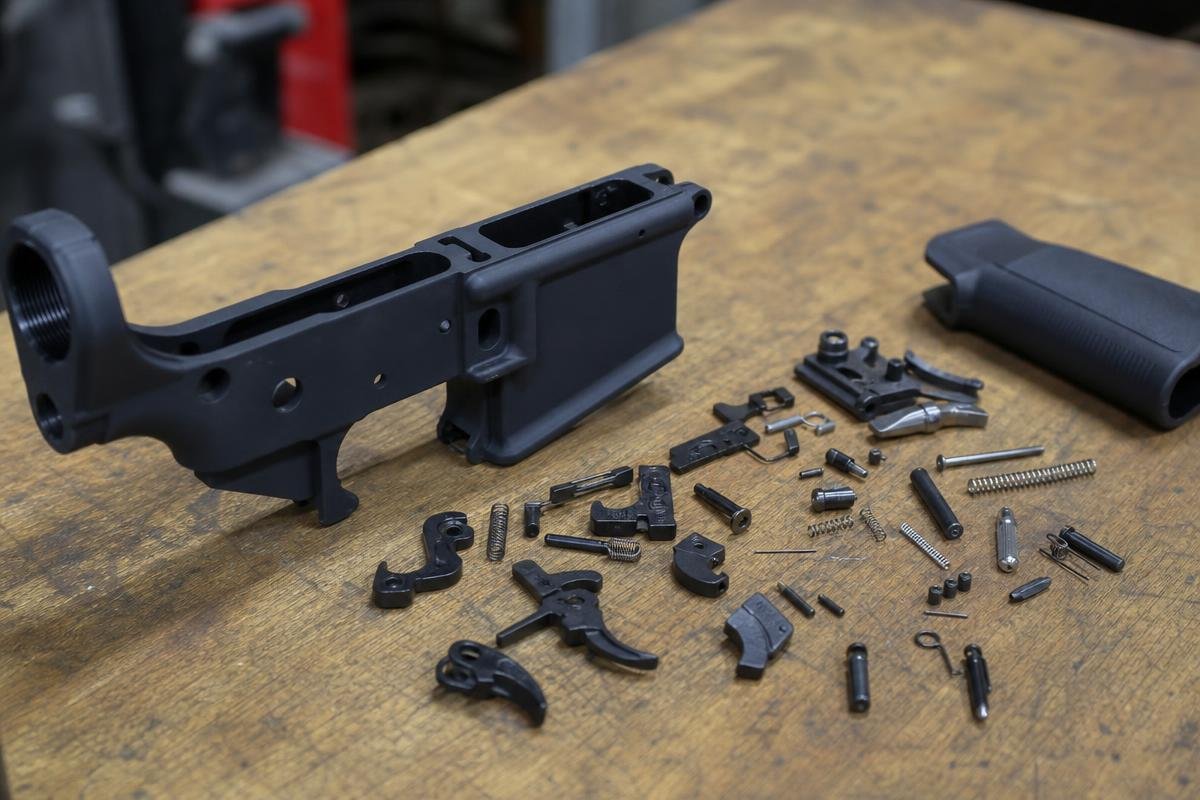
Lower parts kit installation starts with understanding what's included and checking compatibility before you begin. Get the right kit with quality components and your lower functions reliably from the first round. Get the wrong one and you're chasing trigger slap, stiff selectors, and pins that don't seat. We stock a full range of lower parts kits at AR15Parts.com, shipping parts nationwide from 4000 Texoma Pkwy, Denison, TX 75020. Below, we cover standard kit contents, component quality, and what to check before ordering.
Not sure which LPK fits your build? Call us at (888) 706-0633 for help choosing a compatible kit.
Key Takeaways
- A standard AR-15 lower parts kit includes 32 core parts, or 34 if a castle nut and end plate are included covering the trigger group, bolt catch, magazine catch, and safety selector.
- Component quality varies significantly between kits, and mil-spec dimensions matter for reliable function and drop-in compatibility.
- Installation order affects how easily the build goes together, especially for the trigger group and receiver extension assembly.
- Texas generally does not require a permit or registration for a personal AR-15 build from parts. Check the federal, state, and local requirements that apply to your build.
Lower Parts Kit Installation: What's Included in the Kit?
An AR-15 lower parts kit is the collection of small components that turns a stripped lower receiver into a functioning firearm. Every mechanical action, firing, resetting, ejecting a spent case, locking the bolt back on an empty magazine, depends entirely on these parts working together correctly. The kit is the mechanical heart of the lower, and missing even one piece means the rifle does not function.
The core parts list below contains 32 items. Kits that also include a castle nut and end plate contain 34. Check the manufacturer's contents list before ordering.
The Full Parts List
Here is the complete inventory you should expect in a standard kit:
- Trigger
- Trigger spring
- Hammer
- Hammer spring
- Disconnector
- Disconnector spring
- Trigger pin
- Hammer pin
- Safety selector
- Safety detent
- Safety detent spring
- Pistol grip
- Pistol grip screw
- Pistol grip lock washer
- Bolt catch
- Bolt catch plunger
- Bolt catch spring
- Bolt catch roll pin
- Magazine catch
- Magazine catch button
- Magazine catch spring
- Trigger guard
- Trigger guard roll pin
- Trigger guard detent
- Front pivot pin
- Front pivot pin detent
- Front pivot pin detent spring
- Rear takedown pin
- Rear takedown pin detent
- Rear takedown pin detent spring
- Buffer retainer
- Buffer retainer spring
That is 32 parts at the core. Kits that add a castle nut and end plate bring the total to 34. Check the manufacturer's parts list before you order.
What the Kit Does Not Include
The LPK does not include the lower receiver itself. As a regulated firearm, a lower receiver ships separately to the buyer's FFL for transfer. The kit also does not include the stock or pistol brace, the buffer tube (receiver extension), the buffer, or the buffer spring. Those are sold as a separate buffer kit or stock assembly. If you are pairing your kit with a 5.56 NATO complete upper receiver or a 300 Blackout complete upper for a suppressed build, budget for the buffer and stock components as a separate line item. Before assembling or configuring a rifle, confirm the current federal, state, and local requirements that apply to your specific build.
How to Install an AR-15 Lower Parts Kit: Step-By-Step Assembly Order
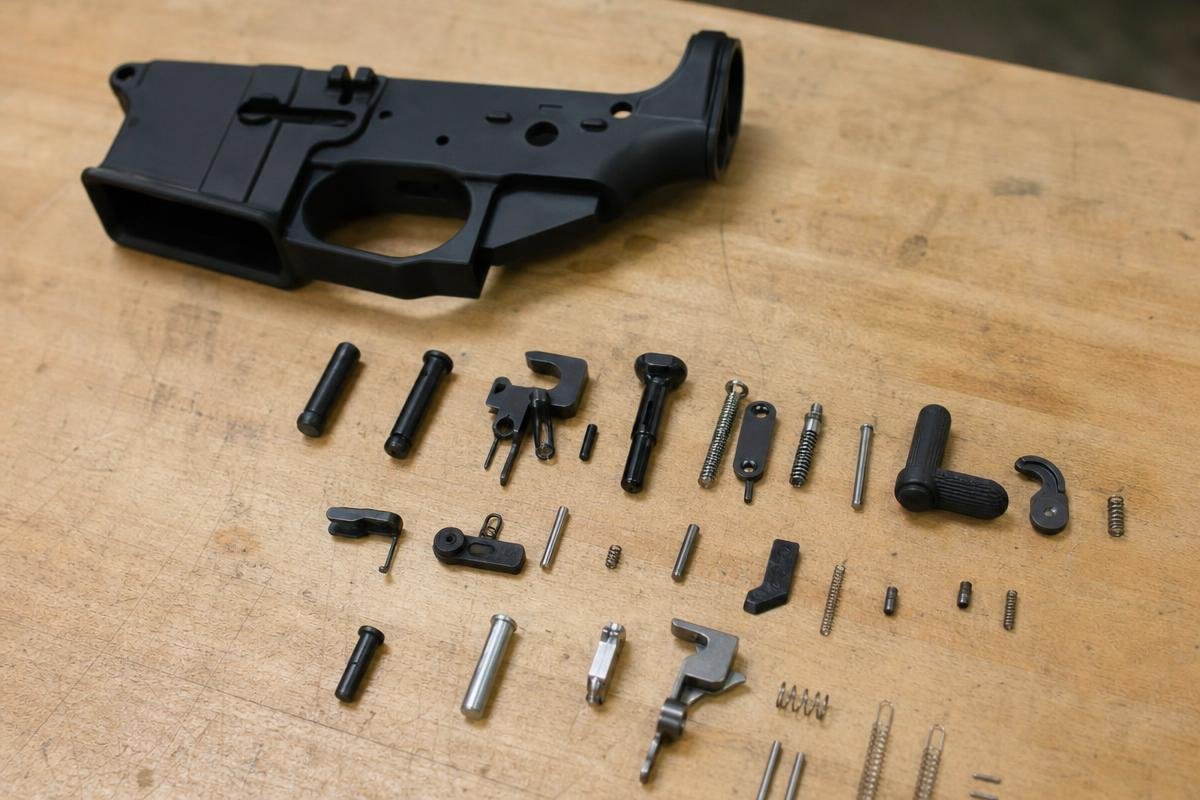
Assembly order matters. Install sub-assemblies out of sequence and you will be pressing pins back out and starting over. Follow this order and each part seats cleanly without blocking the next.
Magazine Catch
Insert the magazine catch body from the left side of the lower receiver. Thread the magazine release button in from the right. Compress the button inward, then rotate the catch clockwise until it sits flush with the receiver wall. Do not overtighten. Stripping those threads means a new lower.
Bolt Catch
Start the roll pin in the receiver lug with a punch before you seat anything else. Drop in the plunger spring, then the plunger, then position the bolt catch over both. Drive the roll pin fully with a roll pin punch. The two most common mistakes here are losing the plunger spring before the catch is seated and driving the pin without the bolt catch aligned. Both cost you time.
Trigger Guard
This is the step most likely to crack your lower. The rear trigger guard pin is a roll pin driven into thin receiver ears. Use a lower vise block or place a hardwood dowel behind the ears before you swing a hammer. Without support, the ears snap. A cracked lower is a parts order back to the shop. Do not skip the support block.
Trigger Group
This is the core of your AR-15 lower receiver assembly. Seat the disconnector spring in the pocket on the disconnector first. Install the trigger with its spring into the lower, then pin it. Set the disconnector on top of the trigger. Install the hammer last, with the spring legs straddling the trigger pin. Verify the hammer falls freely and the disconnector resets before moving to the next step. These are your trigger group components working together, and a missed reset here shows up as a malfunction downrange.
Not sure which trigger group or replacement part fits your lower? Call our team in Denison at (888) 706-0633 and we will match the right component to your build before you buy.
Safety Selector and Pistol Grip
Drop the safety detent and its spring into the detent hole in the lower before the grip threads on. The grip captures the spring as it seats. This is the most common mistake in LPK installation: the detent spring falls into the receiver cavity before the grip is tight. Work slowly. Keep a finger over the hole until the grip is snug.
Receiver Extension and Rear Takedown Pin
Install the buffer retainer and its spring into the lower before threading on the receiver extension tube. The tube captures the retainer as it tightens. Note the diameter before you order: mil-spec tubes have an outer diameter of approximately 1.148 inches, while commercial tubes measure roughly 1.168 to 1.170 inches in outer diameter. Mix the two and the stock either will not slide on or fits loose and unsafe, so match the tube and stock to the same spec. Once the tube is torqued and staked, seat the rear takedown pin and its detent and spring. Your lower is now ready to pair with a 5.56 NATO complete upper receiver or any other caliber upper.
Standard vs. Upgraded AR-15 Lower Parts Kits: What Changes and Why
What a Mil-Spec LPK Gets Right
A standard mil-spec kit is not a compromise. It is a proven baseline. Chrome-silicon springs, phosphate-finished components, and a trigger pull in the 6 to 8 pound range are what the military spec was built around. For defensive builds, general-use rifles, and suppressed pistol-caliber configurations, that spec handles the job without modification. Most builders running 300 Blackout complete uppers for suppressed builds leave the trigger stock and direct their budget toward the suppressor or upper assembly instead.
Where Builders Typically Upgrade First
The trigger and hammer set is the most common first upgrade. A quality aftermarket set brings pull weight down to 3.5 to 5 pounds and sharpens reset, which matters most for precision work at distance. For precision shooting, some builders prioritize a more consistent trigger pull.
Anti-walk trigger and hammer pins are a close second. They prevent lateral pin migration under sustained fire. An ambidextrous safety selector adds left-hand access without changing any other trigger group component. The pistol grip is the lowest-stakes swap. Changing it adjusts wrist angle and reach, not mechanical function. Compare grip options before you buy.
Drop-In Trigger Groups vs. Standard Trigger Assemblies
A drop-in cassette replaces the trigger, hammer, disconnector, and pins as one self-contained unit. It installs in minutes with no fitting. No other LPK component changes. That makes it the right call for precision and competition builds where a consistent, repeatable pull is the priority.
A standard trigger assembly costs less upfront and allows individual component replacement over time. If one part wears, you replace that part, not the whole unit. Both approaches are valid. The choice depends on your budget, your intended use, and how much you want to tune the rifle later.
What to Look for When Choosing an AR-15 Lower Parts Kit
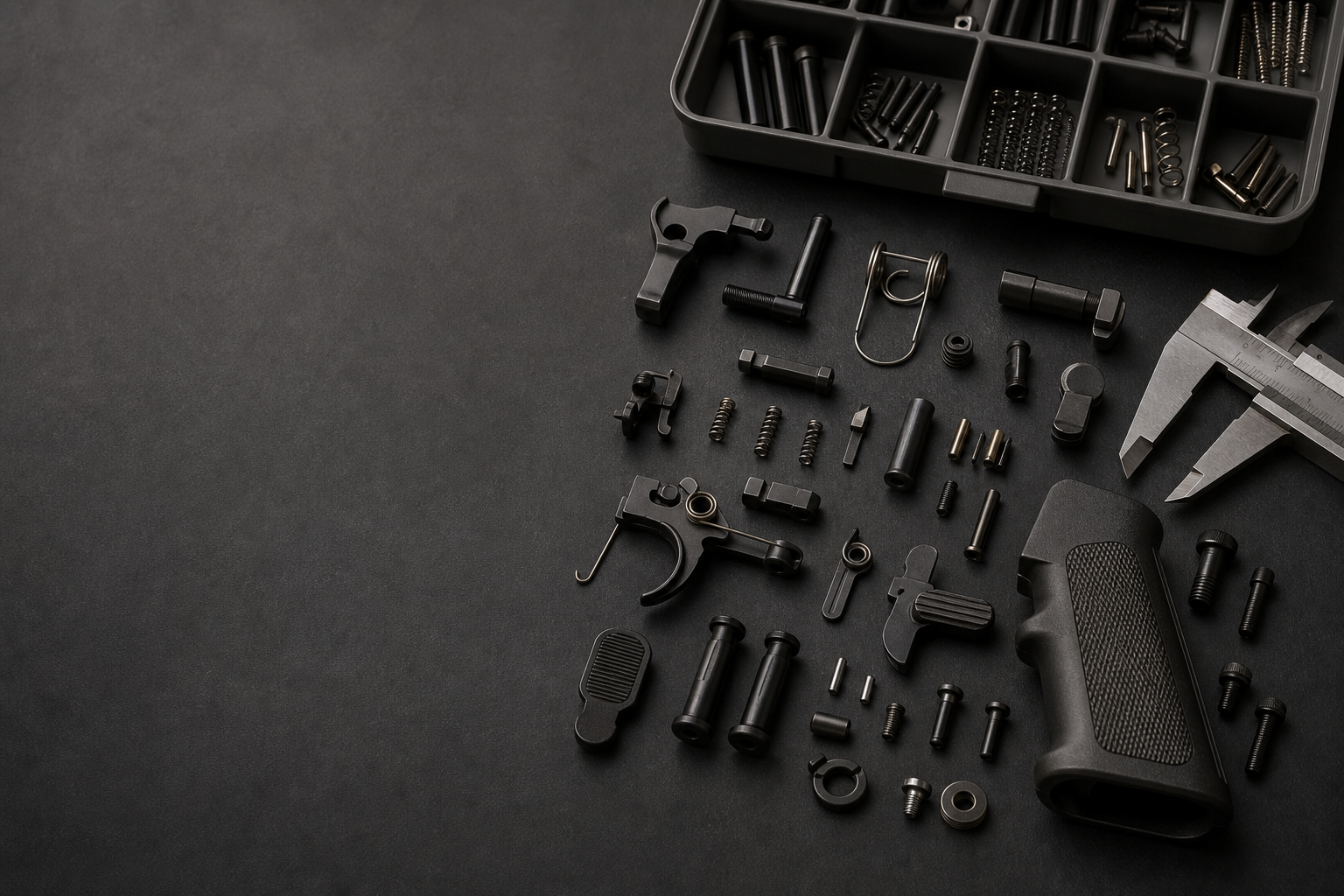
Not every kit is built to the same standard. Budget kits cut corners on material spec, spring quality, and part count. Knowing what to check before you buy saves you from a mid-build parts shortage or a component that fails under stress.
Material and Finish Standards
Pins, detents, and small structural parts should be tool steel or 8620 steel. Pot metal and zinc alloy substitutes are common in low-cost kits and they crack or deform under normal cycling pressure. For finish, look for phosphate (parkerized) or nitride treatment. Both resist corrosion better than bare steel and hold up through extended use. Bare or lightly plated parts will show rust in humid storage conditions, which matters here where summer humidity off the Red River and sharp winter temperature swings are hard on unprotected steel.
Spring Quality and Coil Spec
Chrome-silicon springs maintain tension across more compression cycles than standard music wire springs. A quality kit will specify the spring material. If the listing says nothing about spring wire, assume music wire. Music wire springs can take a set, meaning they lose tension after sitting compressed in storage for months. That affects trigger reset feel and detent retention. Check the spec sheet before you order.
Included vs. Missing Components
Count every part before assembly starts. Budget kits commonly omit the pistol grip screw and lock washer, the buffer retainer and spring, or the trigger guard roll pin. Cross-reference against the 32 core parts listed above. A missing pistol grip screw is a minor inconvenience if you catch it at the workbench. It stops the build entirely if you find out mid-assembly.
We stock complete lower parts kits so you don't have to piece together individual components. If you are pairing your kit with a 5.56 NATO complete upper receiver or a 300 Blackout complete upper for a suppressed build, verify the LPK is complete before the upper arrives. Questions about which AR-15 lower parts kit fits your build? Call us at (888) 706-0633 and we will walk you through it.
Tools You Need Before You Start the Assembly
Starting an LPK installation without the right tools is how lowers get cracked. A marred or cracked lower is a serialized part. That means starting the entire build over. Get the tools first.
Essential Tools
These are not optional. You need every item on this list before the first pin goes in.
- Lower vise block holds the lower receiver secure during assembly without crushing the aluminum
- Armorer's wrench required for the castle nut and receiver extension; nothing else fits correctly
- Roll pin punch set1/8-inch and 3/32-inch; standard punches will walk off the pin and mar the receiver
- Brass or nylon-faced hammersteel faces damage anodizing on contact
- Needle-nose pliers for seating detent springs without losing them
- Punch block or hardwood blockbacks the receiver ears during trigger guard pin installation; skipping this step is the single most common cause of a cracked lower
Helpful but Optional Tools
A bench vise is useful but not required if you have a solid lower vise block and a stable work surface. If you are working without a full armorer's bench, a dense hardwood block substitutes for a commercial punch block just fine. The tool matters more than the brand.
- Trigger pull gauge verifies pull weight after assembly
- Lower receiver action block adds more secure holding than a standard vise block
- Anti-rotation trigger pin tool speeds up pin alignment on mil-spec trigger groups
Once the lower is assembled, it pairs directly with any 5.56 NATO complete upper receivers or 300 Blackout complete uppers for suppressed builds we stock.
Ordering Lower Parts Kits From Our Denison, TX Facility
For current product availability or compatibility questions, contact AR15Parts at (888) 706-0633 before ordering.
Texas Compliance and Legal Considerations
The state imposes no restrictions on lower parts kit purchases or personal lower receiver assembly beyond what federal law already requires. There is no waiting period, no permit, and no registration requirement for a rifle you build for your own use, provided you are not building it for sale. That applies whether you are in Sherman, Durant, Gainesville, or anywhere else in the surrounding area. Builders who work the regional gun show circuit should still keep the sale distinction in mind, since assembling for resale crosses into manufacturing.
Two categories require extra attention regardless of state law. Suppressors and short-barreled rifles both require ATF Form 4/1 registration and approval before you build or possess them. As of January 1, 2026, the federal transfer tax on these items was reduced to $0, though registration and approval are still mandatory. Verify current federal and state law before starting any build that falls outside a standard rifle configuration.
Completing Your Build: Pairing the Lower With the Right Upper
Once your lower is assembled, the next step is selecting a matching upper. We carry complete AR-15 uppers in multiple calibers, so you are not limited to one configuration. The right choice depends on what you plan to do with the rifle.
For general-purpose use, a 5.56 NATO upper is the most practical starting point. It feeds reliably, ammunition is widely available, and the platform is well-understood. If you are running a suppressed build, 300 Blackout complete uppers are purpose-built for that role, cycling reliably with both subsonic and supersonic loads. For longer-range work past 400 yards, 6.5 Grendel complete uppers give you a meaningful ballistic advantage over 5.56 without changing the lower or magazine well.
Frequently Asked Questions
How many parts are in a standard AR-15 lower parts kit?
A standard kit has 32 core parts. Some kits also include a castle nut and end plate, bringing the total to 34. Count your parts before you start. Missing one small detent or spring will stop the build cold.
Can I install an LPK with basic hand tools?
Yes, but you need the right basics. A roll pin punch set, a hammer, and a lower vise block are the minimum. The trigger guard roll pin step puts the most stress on the receiver. Without proper support there, you risk cracking the lower ear.
Does the buffer tube diameter matter when installing an LPK?
Buffer tube diameter affects stock compatibility, not the lower parts kit installation itself. Mil-spec tubes measure 1.148 inches; commercial tubes measure 1.168 inches. The LPK goes in the same way regardless of which tube you run.
Do I need an FFL to buy an AR-15 lower parts kit?
No FFL is required. The parts kit contains no serialized components. The lower receiver is the regulated part. Parts kits ship direct to your door.
How long does it take to install an LPK?
A first-time builder should plan for two to four hours. An experienced builder can finish in under an hour. Most of that time goes to the trigger group and safety selector detent work.
What is the most common mistake during LPK installation?
Losing a detent spring inside the lower. It happens most often during safety selector or takedown pin installation. Work over a parts mat. Seat the safety detent spring and install the pistol grip immediately after, before that spring has a chance to launch across the room.
Does AR15Parts.com ship lower parts kits nationwide?
Yes. We ship from 4000 Texoma Pkwy, Denison, TX 75020, with availability subject to destination and applicable law. Call us at (888) 706-0633 with any compatibility questions before you order.
Ready to Get Started with AR15Parts.com?
Ready to start your build? We stock complete lower parts kits with product details to help you check compatibility. Once your lower is done, pair it with one of our complete AR-15 uppers in multiple calibers, including 5.56 NATO complete upper receivers for general-use builds. Call (888) 706-0633 or browse current inventory at ar15parts.com. If you have a question about a specific part or compatibility, call before you order. We would rather answer a question now than help you troubleshoot a misfeed later.