
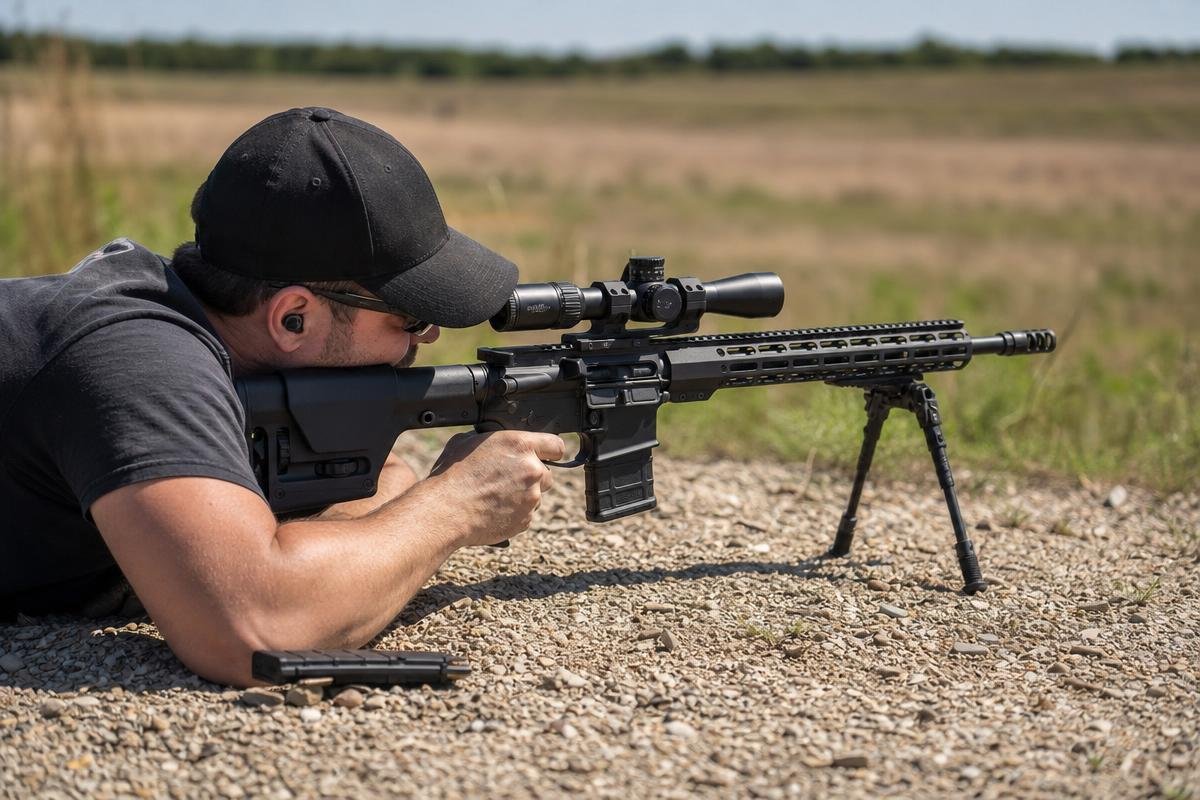
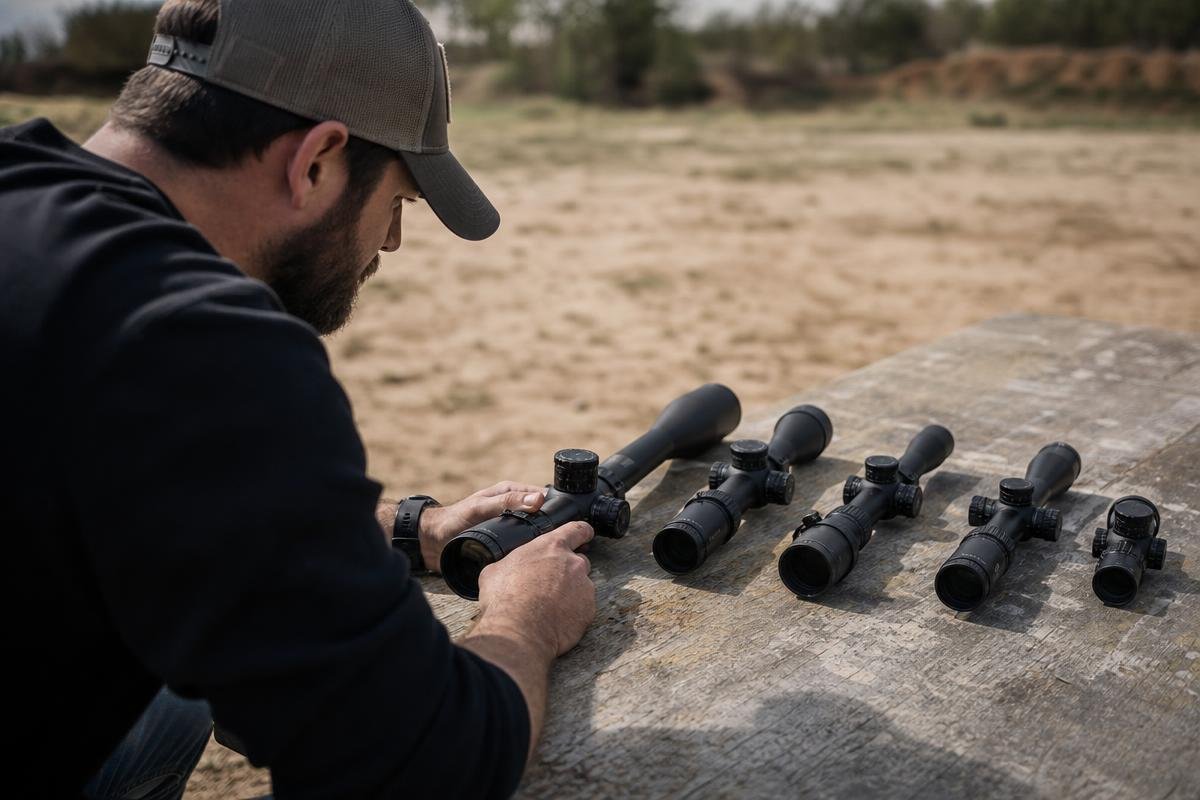
LPVO magnification choices from 1-4x to 1-10x affect field of view, weight, and how well an optic fits your upper. We compare the four power ranges, reticle options, and mounting considerations so you can choose parts suited to your rifle's cartridge and intended use.
We build complete uppers to order and ship them from our Denison, TX facility. Each complete upper is assembled in-house, headspaced, and function-checked before shipping. Need help matching an optic to an upper and mount? Call us at (888) 706-0633 before you order.
Key Takeaways
- Choosing LPVO magnification starts with your maximum engagement distance and intended use.
- 1-6x covers most carbine roles; 1-8x and 1-10x add reach for open-terrain hunting and longer range work.
- First focal plane reticles keep subtensions accurate at every power setting; second focal plane reticles are calibrated at max magnification only.
- Caliber matters: a suppressed 300 Blackout build and a 6.5 Grendel hunting rifle need different magnification ceilings.
- Reticles with wind-hold subtensions are a practical tool, not a premium upgrade, for shooters accounting for wind at longer distances.
How LPVO Magnification Works on an AR-15
What Is an LPVO?
A low power variable optic is a riflescope with a true lower magnification bound of 1x and an upper bound that runs from 4x to 10x depending on the model. The 1x setting is not cosmetic. A true 1x setting supports both-eyes-open aiming when eye relief and alignment are right. Budget variables often advertise 1x but deliver 1.1x or 1.2x at the low end.
That extra magnification can make the both-eyes-open sight picture less natural. If you are shopping for the best LPVO for an AR-15, confirm the manufacturer specifies true 1x, not an approximation.
How Does an LPVO Compare to a Red Dot?
A fixed 4x scope locks you to one distance. It works at 300 yards and fights you at 25. A red dot prioritizes close-range speed but generally offers less precision and target resolution at longer distances unless paired with a magnifier. A variable optic replaces both. The tradeoff is real: LPVOs add weight and cost compared to either alternative. A quality 1-6x or 1-8x unit with a mount will run heavier than a red dot and magnifier combined in many configurations. That weight is the price of the capability.
The Versatility Case: One Optic, Two Jobs
Consider a shooter running a 5.56 NATO carbine upper with a 16-inch barrel. In a single range session, that shooter engages steel at 25 yards and paper at 400 yards. With the scope dialed to 1x, the close target gets a both-eyes-open, fast-acquisition sight picture. Dialed to 6x or 8x, the 400-yard target becomes readable without a separate optic or a magnifier swap. No backup magnifier needed. That single-optic argument is the most common reason AR-15 shooters make the switch, and it holds up across most practical shooting scenarios.
LPVO Magnification by Tier: Which Range Fits Your Build?
| Magnification Tier | Typical Use | Example Barrel Length | Compatible Chambering or Cartridge | Weight Penalty |
|---|---|---|---|---|
| 1-4x | Close to mid-range | 10.5 or 14.5 inches | 5.56 NATO, 300 Blackout | Model-dependent |
| 1-6x | Close to medium range | 16 inches | 5.56 NATO or .223 Remington in a .223 Wylde chamber, 300 Blackout | Model-dependent |
| 1-8x | Medium to extended range | 18 or 20 inches | 6.5 Grendel, 6mm ARC | Model-dependent |
| 1-10x | Extended range | 20 or 24 inches | 6.5 Creedmoor or .243 Winchester, on a compatible large-frame AR-10 platform | Model-dependent |
1-4x: Short-Range and Mixed-Distance Carbines
A 1-4x suits shooters whose primary engagement zone stays inside 200 yards. At 4x, you get more detail on mid-range targets without committing to a higher-power optic. This tier works well on 10.5-inch or 14.5-inch uppers used for home defense, patrol, or competition stages that mix close and medium distances. If your range rarely exceeds 200 yards, you do not need more magnification than this.
1-6x: The General-Purpose Standard
A 1-6x balances close-range speed with enough magnification for mid-range targets. It pairs naturally with a 16-inch carbine chambered in 5.56, .223 Wylde, or 300 Blackout. For most shooters, this is the right tier to start with. A 1-6x can cover a broad range of lawful range and field uses without the added bulk of higher-power options.
Not sure which caliber upper pairs with your magnification choice? Browse our complete uppers or call to talk through your build before you order.
1-8x: Extended-Range Precision and Hunting Builds
A 1-8x adds real capability past 400 yards without the cost and weight jump of a 1-10x. It suits precision practice and lawful hunting when the cartridge and conditions support the distance. This tier pairs well with 18-inch or 20-inch barrels and flatter-shooting cartridges. Our 6.5 Grendel uppers are a natural match here, retaining enough velocity at 600 yards to make the extra magnification useful.
1-10x: Long-Range Single-Optic Builds
A 1-10x is the right call only if you are regularly engaging targets past 600 yards and want one optic to cover the full range. At 10x, field of view narrows considerably, which slows target transitions at close distance. This tier requires a quality mount to hold zero under recoil. For 6.5 Creedmoor or .243 Winchester, use a compatible large-frame AR-10 platform rather than an AR-15 lower. If you are not shooting past 500 yards consistently, a 1-8x gives you nearly the same reach with less weight and a wider field of view. Talk to us about a purpose-built precision upper if your distances genuinely justify this tier.
SFP vs FFP Reticles: Which Fits Your Magnification Range?
The focal plane debate is one of the most practical decisions you will make when selecting the best LPVO for your AR-15. It determines whether your holdover marks are accurate at every power setting or only at one.
Second Focal Plane (SFP): Clean at 1x, Accurate at the Specified Calibration Power
On an SFP scope, the reticle stays the same apparent size regardless of where you set the magnification ring. The subtensions, those mil or MOA hash marks for holdovers and ranging, are calibrated at the manufacturer-specified power, often maximum magnification. At magnifications other than the manufacturer-specified calibration power, the subtension values require the applicable conversion. At the specified calibration power, they work as designed.
The practical upside is a clean, uncluttered reticle at 1x. For fast close-range target acquisition, that matters. Most entry-level and mid-tier LPVOs use SFP for exactly this reason, and the price point stays lower as a result.
First Focal Plane (FFP): Subtensions That Work at Every Magnification
On an FFP scope, the reticle scales with the image as magnification increases. Your mil or MOA subtensions remain accurate at 2x, 4x, 6x, or wherever you stop the ring. If you are dialing a wind call at 6x in windy conditions, the reticle math holds. FFP scopes cost more, and some designs produce a thick or visually busy reticle at 1x, which can slow down close-range work.
Which Focal Plane Is Right for Your Build?
For a general-purpose carbine running 5.56 NATO complete uppers at mixed distances, SFP is the practical choice. The 1x sight picture stays clean and the cost stays manageable. If your LPVO will spend most of its time near maximum magnification, the focal plane distinction matters very little in practice.
For a precision or hunting build, particularly a 6.5 Grendel complete upper used in exposed, windy conditions, FFP may be the better fit. Accurate subtensions at variable power are a real tool, not a premium-only feature, when sight lines stretch past 300 yards.
Mount Height, Eye Relief, and Tube Diameter: The Compatibility Details That Matter
Mount Height and Co-Witness Options
Skipping mount height research is the fastest way to end up with a scope you cannot shoot comfortably. AR-15 flat-top uppers use a Picatinny (MIL-STD-1913) rail, and most LPVOs mount on either a cantilever or a two-piece ring setup. LPVO mounts are offered in several optical-centerline heights. Select a height based on the rifle, stock, shooting position, and manufacturer specifications.
Check the manufacturer's listed optical-centerline height above the top rail before you buy. Do not assume iron-sight co-witness through an LPVO without model-specific confirmation.
Eye Relief and Eye Box: What the Spec Sheet Does Not Tell You
Eye relief is the distance from the rear lens to your eye where you get a full, clear image. Most LPVOs spec 3.5 to 4 inches. Eye box is the tolerance around that distance where the image stays usable. On a variable optic, eye box matters more than on a fixed-power scope because you are adjusting magnification in the field. A tight eye box punishes any inconsistency in cheek weld. Your stock selection directly affects how repeatable that weld is, so those two decisions are linked.
Tube Diameter: 30mm vs 34mm
Most LPVOs ship with either a 30mm or 34mm main tube. A 34mm tube gives more internal adjustment travel, which is useful if you are dialing for distance on a 6.5 Grendel complete upper for extended-range AR-15 builds. The critical point: 30mm and 34mm rings are not interchangeable. Ordering the wrong mount means your scope does not fit. Verify tube diameter before you buy a mount. Ring-cap screws and rail cross-bolts can require different torque values. Use a calibrated torque tool and follow the mount manufacturer's exact specification for each fastener.
Have questions about mounting hardware or need help matching a scope to your build? Call us at (888) 706-0633 for parts and compatibility advice.
LPVO Compatibility Checklist: Pairing Your Scope with the Right AR-15 Build
Picking the right magnification tier is only half the job. Your barrel length, gas system, upper receiver rail, and mount hardware all have to work together with that optic or you will fight the build every time you go to the range. Check rail fit, tube diameter, and mounting hardware before buying.
Barrel Length and Cartridge Pairings by Magnification Tier
Match your magnification ceiling to the cartridge and barrel length that actually justifies it. Running a 1-10x on a 10.5-inch 5.56 pistol does not make that platform a long-range rifle. The list below reflects what works in practice.
- 1-4x: 10.5 to 16-inch barrels, carbine or mid-length gas, 5.56 NATO, 300 Blackout uppers, 7.62x39. Best for close to 200-yard work.
- 1-6x: 14.5 to 18-inch barrels, mid-length or rifle-length gas, 5.56 / .223 Wylde / 300 BLK / 6.5 Grendel. The most versatile tier for general AR-15 use out to 400 yards.
- 1-8x: 18 to 20-inch barrels, rifle-length gas, 6.5 Grendel, 6mm ARC, .224 Valkyrie. Pair with 6.5 Grendel uppers for extended-range builds that stay on the AR-15 platform.
- 1-10x: 20 to 24-inch barrels, rifle-length gas, 6.5 Creedmoor or .243 Winchester, on a compatible large-frame AR-10 platform. These builds are purpose-built for precision work at 500 yards and beyond.
Upper Receiver Rail Tolerances and Zero Retention
Any mil-spec flat-top upper with a Picatinny rail machined to MIL-STD-1913 tolerances accepts a standard LPVO mount in 30mm or 34mm tube diameter. The problem shows up with budget uppers where the rail slots are cut loose or inconsistently spaced. When you remove and reinstall the optic on a non-spec rail, point-of-impact shift is common, sometimes several inches at 100 yards.
Mount fastener torque is not optional. Ring-cap screws and rail cross-bolts may require different torque values. Use a calibrated torque tool and follow the mount manufacturer's exact specification for each fastener.
Gas System Tuning and Optic Longevity
An over-gassed carbine produces a sharper, faster bolt carrier group cycle than the system was designed to handle. That spike in rearward impulse transmits through the upper receiver and into your scope mount on every shot. Excessive cycling can increase wear and felt recoil.
Ejection pattern can be one diagnostic clue, but ammunition, extractor condition, buffer setup, suppressor use, and other variables also affect it. Have cycling or pressure concerns evaluated by a qualified armorer.
Choosing an LPVO for Open Terrain and Longer Sight Lines
Wind and Sight Lines: What to Consider
Open terrain and variable winds can affect optic and reticle selection in open terrain. A 1-6x or 1-8x optic can provide more magnification headroom than a 1-4x for longer sight lines.
For shooters using AR-15 platform rifles in open terrain, a 1-6x or 1-8x LPVO can offer useful magnification for longer sight lines. A reticle with wind-hold subtensions may also help when conditions are windy.
How We Support Builders Nationwide
We ship from our facility at 4000 Texoma Pkwy, Denison, TX 75020. Our complete uppers are built to order, assembled in-house, headspaced, and function-checked before shipping. Confirm that the caliber, magazine, buffer system, and platform are compatible with the intended lower before installation. You can select a compatible upper and available optic from one source, subject to current inventory. Browse our AR-15 complete uppers or call us at (888) 706-0633 with questions about pairing a specific upper with your optic.
Frequently Asked Questions
What magnification is best for a general-purpose AR-15 used at 25 to 400 yards?
A 1-6x is the most practical choice for that range. At 6x, you get more target detail at distance than at 1x. At 1x the sight picture is fast enough for close work. It is the most common answer to "best LPVO for AR-15" for good reason.
Can a 1-6x LPVO reach out to 500 yards effectively?
Yes, with the right cartridge and a precise reticle. A suitable 5.56 NATO or .223 Remington load fired from a .223 Wylde chamber can support longer-range target use when verified for the specific rifle and conditions. If 500 yards is a regular distance for you, a 1-8x gives more margin and clearer resolution at distance.
Should I choose SFP or FFP for my AR-15 LPVO?
For most AR-15 shooters, SFP is the simpler and less expensive choice. The SFP vs FFP reticle AR-15 decision comes down to how you shoot. FFP holdovers are accurate at any magnification. SFP holdovers are accurate at the manufacturer-specified calibration power, often maximum magnification.
Will any AR-15 upper receiver work with a standard LPVO mount?
Any mil-spec flat-top upper with a Picatinny rail machined to MIL-STD-1913 tolerances accepts standard 30mm or 34mm LPVO mounts. The rail spec is what determines zero retention, not the upper brand. Browse our complete uppers to confirm rail spec before you order a mount.
How much should I expect to spend on a quality LPVO?
Pricing varies by manufacturer, model, glass quality, reticle, durability, and availability. Compare current specifications and pricing for the intended use.
Does an LPVO make sense on a pistol-length or short-barrel AR-15 build?
It can work, but the upper magnification tiers lose practical value as barrel length shortens. A 300 Blackout upper running subsonic ammunition on a 10.5-inch pistol is most effective inside 150 yards. A 1-4x is the appropriate ceiling there. Heavier 1-8x or 1-10x optics also shift the balance on short builds in a way most shooters dislike.
What reticle type is best for a general-purpose AR-15 LPVO?
A simple illuminated reticle with a center dot and a few holdover marks covers most real-world use. Complex Christmas-tree reticles add long-range capability but slow target acquisition at 1x. Match reticle complexity to how you actually shoot, not to the maximum the optic can do.
Ready to build around your optic choice? We build complete uppers to order, assemble them in-house, and headspace and function-check them before shipping from our Denison, TX facility. Confirm caliber, magazine, buffer-system, and platform compatibility with your lower. Call us at (888) 706-0633 or browse our complete upper lineup to find the barrel length and cartridge that matches the magnification tier you just picked.
Ready to Get Started with AR15Parts.com?
Call (888) 706-0633 for parts and compatibility advice, or contact our team through the online form before you order.