
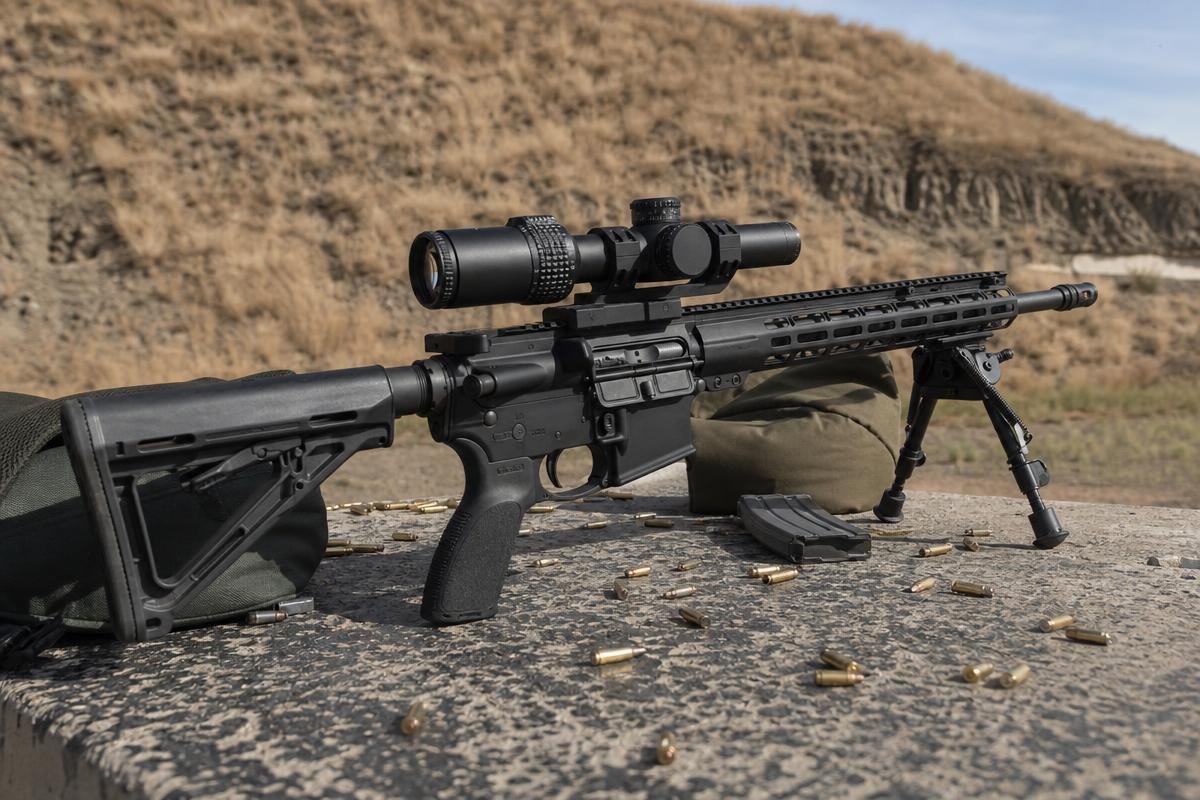
LPVO vs red dot is a practical buying decision: which optic fits your shooting role and AR-15 build? A red dot prioritizes close-range speed, while an LPVO adds magnification for targets farther out. Barrel length, caliber, mount fit, and rifle weight also shape which setup makes sense. We ship complete uppers and parts from our Denison, TX facility. Tell our team what you shoot, and we'll help you narrow down an upper and optic class.
LPVO vs Red Dot: Quick Buying Takeaways
- An AR-15 LPVO covers both close-quarters and medium-range shooting in a single optic, where a red dot cannot.
- Red dots offer faster target acquisition at short range but top out around 100 yards for precise shots.
- Illuminated LPVO reticles can be valuable for lawful low-light hunting when positive target identification is maintained.
- Glass quality, eye relief, and magnification range vary significantly across LPVO price tiers.
- Your shooting role, not your budget alone, should drive the optic decision for your AR build.
How LPVOs and Red Dots Work on an AR-15
An AR-15 LPVO (Low Power Variable Optic) is a magnified rifle scope with a variable power range that starts at or near 1x. Unlike a fixed-power scope, you can dial between close-range and medium-range magnification on the same optic. That flexibility is the whole reason shooters consider them over a standard red dot.
LPVO Mechanics: Magnification Classes and Focal Plane Explained
LPVOs come in four common magnification classes: 1-4x, 1-6x, 1-8x, and 1-10x. A 1-4x suits close-quarters work with limited reach past 200 yards. A six-power variable on a 16-inch mid-length upper is a common setup for shooters splitting time between range days and field use. A 1-8x or 1-10x adds reach for precision work but increases weight and eyebox sensitivity.
Focal plane matters too. On a first focal plane (FFP) scope, the reticle subtensions stay accurate at every magnification setting. On a second focal plane (SFP) scope, subtensions are only accurate at the calibrated power, usually maximum. For fast field shooting, that distinction affects how you read holdovers under pressure.
True 1x also matters more than most buyers expect. A scope that remains slightly magnified at its lowest setting can create an image-scale mismatch that makes both-eyes-open use less natural. If the spec sheet says "1x," verify it. A well-designed true-1x LPVO can approximate a red dot's sight picture, but it still requires proper eye relief and alignment.
Red Dot Mechanics: How Reflex Sights Work and Where They Excel
A red dot projects an LED dot onto a partially reflective lens. There is no magnification and no eyebox to manage. Eye relief is unlimited. Both-eyes-open shooting is natural, and target acquisition at close range is faster than any LPVO at 1x.
The Core Trade-Off: Weight, Speed, and Range Capability
A compact red dot may weigh 3 to 9 ounces depending on the model; larger models can weigh more. LPVO weight and eyebox vary by model and optical design, so compare the exact manufacturer specifications. The LPVO also demands consistent cheek weld to stay in the eyebox, something a red dot never requires. You gain range capability and reticle precision. You give up raw speed and simplicity.
Matching Your Optic to Your Shooting Role
The optic that makes sense for you depends entirely on what you're actually doing with the rifle. Range, light conditions, and how fast you need to get on target all point to different answers. Here is how each common shooting role reads out.
Home Defense: Speed Wins at 0-25 Yards
For a dedicated home-defense rifle, typical interior distances are short, so a 2-4 MOA red dot lets you shoot both-eyes-open under stress without thinking about magnification. An AR-15 LPVO at 1x is functional, but it adds weight and demands a repeatable cheek weld that stress can break. For a dedicated home-defense build, the red dot wins on simplicity.
Competition: 3-Gun and PRS Carbine Stages Demand Both Ends
Stages mix close steel at 5-25 yards with paper targets at 100-300 yards. A 1-6x or 1-8x LPVO on a 34mm tube with an illuminated reticle covers that full range. True 1x is critical on the close stages. A BDC reticle calibrated for the specific 5.56 NATO or .223 Remington load used in a .223 Wylde chamber can simplify verified holds at distance. Local shooters who train and compete at outdoor lanes with steel past 100 yards will feel the difference a proper variable optic makes every stage.
Building a multi-distance competition rig? Browse our .223 Wylde uppers built to run 55 to 77 grain loads accurately.
Hunting in North Texas: Whitetail, Hogs, and Variable Distances
Grayson County terrain is the core problem here. Open pasture shots run 200 yards across creek bottoms, then a deer steps out of a cedar break at 40 yards. A 1-6x LPVO handles both without a scope change. For lawful low-light hog hunting along the Red River corridor, an illuminated reticle can be valuable when positive target identification is maintained. For this terrain, a 300 Blackout upper paired with a six-power LPVO can be a practical option for a compatible suppressed hog-hunting setup.
Building a hog hunting rig for the Red River bottoms? Browse our 300 Blackout uppers and confirm suppressor compatibility for the exact configuration.
General Purpose: The Case for a 1-6x as a Do-Everything Optic
If you are doing a mix of range work, occasional hunting, and home storage on one rifle, a 1-6x is the most common answer. It covers 0-300 yards, fits a 16-inch carbine without front-heavy balance problems, and is available across a wider price range than 1-8x or 1-10x options. For most shooters, the best LPVO for an AR-15 is a 1-6x, full stop.
LPVO Specs to Check Before Buying for Your AR-15
Not every spec on a scope's product page tells you something useful. A few of them, though, will determine whether your AR-15 LPVO performs in the field or frustrates you at the range. Here is what actually matters.
True 1x: The Spec That Separates Functional LPVOs from Frustrating Ones
Many LPVOs advertise 1x but measure closer to 1.05x or 1.1x at the low end. That gap introduces parallax error and breaks both-eyes-open shooting. A true 1x projects the reticle at the same apparent size as the target, behaving like a red dot at close range. If the manufacturer does not publish a verified 1x measurement, that is a red flag worth taking seriously before you buy.
Eye Relief and Eyebox: Why Cheek Weld Consistency Is Non-Negotiable
Most AR-15 LPVOs offer 3.5 to 4.5 inches of eye relief at 1x, which narrows as magnification increases. The eyebox shrinks at 6x. A shooter who cannot repeat the same cheek weld will lose the full image at higher power. Maintaining a consistent cheek weld is not optional with an LPVO. It is a mechanical requirement of the optic's design.
Reticle Types: BDC, MOA, and MRAD Compared
Each reticle format suits a different shooter. Here is a direct comparison:
- BDC: Calibrated to a specified cartridge, load, and barrel length. Fast and practical for a general-purpose build when your load matches the calibration; verify holds at your shooting distances.
- MOA: Hash-mark holdovers work for any load if you know your drop data. More flexible than BDC across cartridges.
- MRAD: Preferred by precision shooters. Pairs cleanly with MRAD-graduated turrets for dialing corrections, and it is a natural fit for a 6.5 Grendel upper built for medium-range precision work.
Glass Quality and Tube Diameter: What the Numbers Mean in the Field
A 30mm tube covers most 1-6x LPVO builds and fits the widest range of rings and mounts. Some 34mm tubes allow greater erector travel, which matters more on a 1-8x or 1-10x than on a 1-6x. Objective diameter can affect low-light performance, but overall image quality also depends on the complete optical design. For hunters shooting open pasture at last light, that difference is a real field variable, not a spec-sheet abstraction.
Must-Have LPVO Features vs. Nice-to-Have Upgrades

Non-Negotiable Features: What Every Functional LPVO Must Have
Not every feature on an LPVO spec sheet earns its price tag. A few do. True 1x magnification is the first one. If the scope does not confirm true 1x in independent testing, you may be paying for a magnified optic that is less effective at close range. Next is an illuminated reticle with at least five or six brightness settings, including a daylight-bright level. For hunters running creek bottoms after dark, this can be valuable.
Finally, nitrogen-purged and waterproof construction. Texoma-area weather swings fast between a cold front and a humid afternoon, and an optic that fogs internally when temperatures shift is a liability, not a tool.
Features Worth Paying More For
A first focal plane reticle is the most defensible upgrade for shooters who use holdovers at multiple magnification settings. Subtensions stay accurate at every magnification setting, so your holdovers and ranging work at 3x the same as at 6x. That matters on a hunting build where you do not always have time to dial to max power. A throw lever or extended magnification ring is also worth the cost.
Fast power changes under time pressure require a positive grip on that ring. A locking diopter rounds out the short list. Set your focus once, lock it, and it stays put through recoil and rough handling. If you are building off a 6.5 Grendel upper for medium-range precision builds, FFP becomes even more practical.
Features Rarely Worth the Premium
Green illumination may not justify the added cost for every shooter, so compare visibility and features before paying more for it. Very high maximum magnification is another common overspend. A 1-10x is heavier and more expensive than a 1-6x, and the extra range only pays off past 400 to 500 yards. Most AR-15 builds are not optimized for that distance. Proprietary mounting systems are the third trap. They limit your ring and mount choices and add cost when you upgrade. Stick with standard 30mm or 34mm tubes and keep your options open. Browse our complete AR-15 uppers in 19-plus calibers to match your upper to the right optic class before you buy.
Have questions about the right LPVO for your specific caliber and barrel length? Call us at (888) 706-0633 and we will point you in the right direction, or browse complete uppers that can be configured with an optic to start your build.
LPVO Price Ranges and What Each Tier Gets You
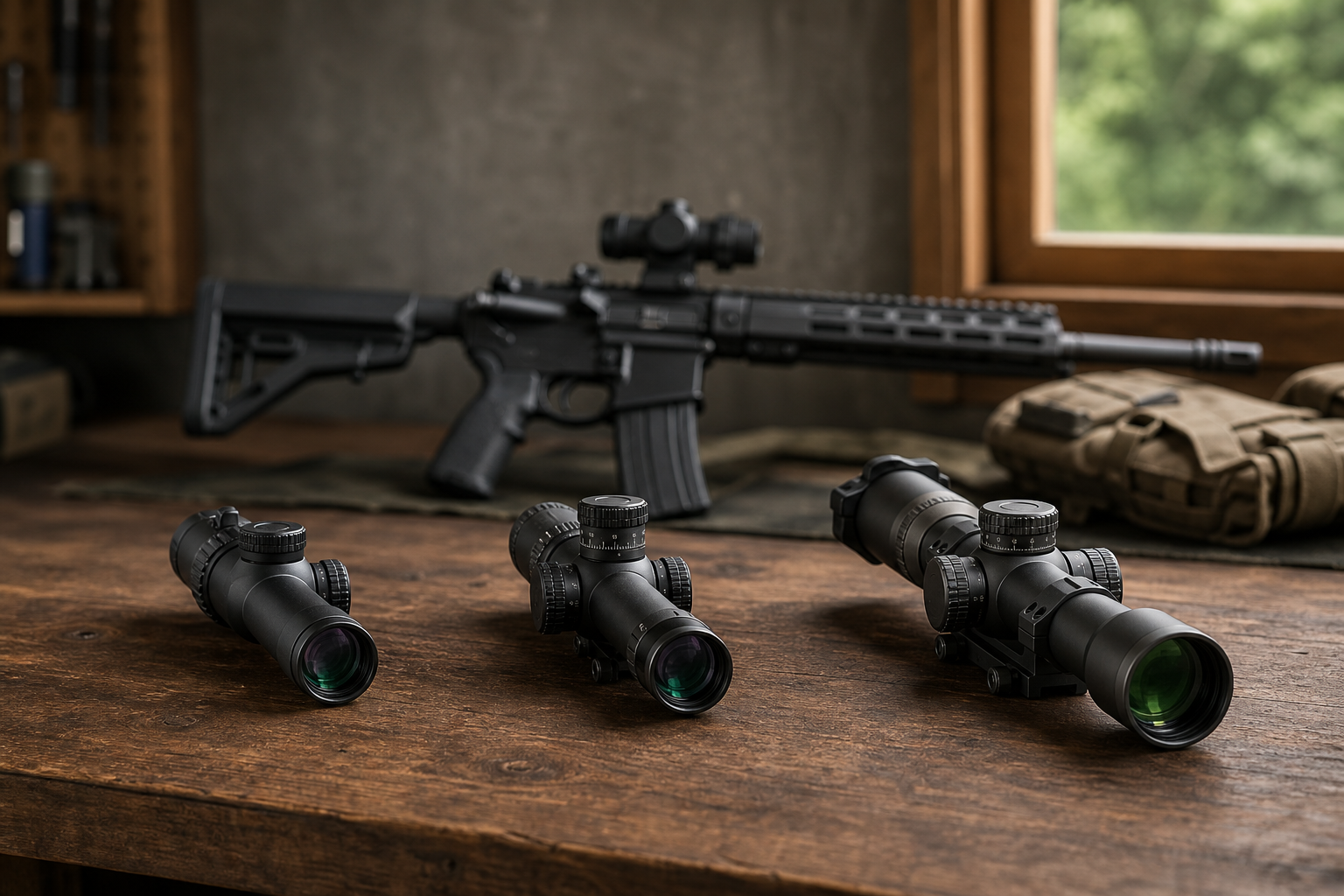
Budget shapes every build decision, and your optic is no different. Spend too little and the glass becomes the weakest link in an otherwise solid rifle. Spend without a clear reason and you are paying for performance your shooting role will never demand. Here is what different LPVO tiers typically deliver for an AR-15 build.
Entry-Level LPVOs
Entry-level 1-4x and 1-6x LPVOs can be adequate for range days and casual hunting. Trade-offs are real though. Eyebox is tighter, true 1x performance is inconsistent, illumination settings are limited, and most run SFP reticles that lose holdover accuracy when you change magnification. This tier is a reasonable starting point if you are testing whether an LPVO fits your shooting style before committing more money.
Mid-Range LPVOs
This is where most competition and hunting shooters land, and for good reason. Glass quality improves noticeably, true 1x is more consistent, illuminated reticles are brighter, and both SFP and FFP options open up. For a hunter running a 300 Blackout upper for a suppressed hog-hunting build, this tier covers the low-light performance you actually need without inflating your overall spend past what the role justifies. This is one of the most competitive segments of the LPVO market.
Premium LPVOs
Premium models may offer better light transmission, less chromatic aberration, a more forgiving eyebox, and precise FFP reticles. Durability still depends on the model, use, and maintenance. If you are building from scratch and shooting seriously in low light or past 200 yards regularly, budget for this tier from the start rather than upgrading later.
A Practical Decision Checklist: LPVO or Red Dot for Your AR-15?
Five Questions to Ask Before You Buy
Work through these before you spend a dollar on glass.
- What is your maximum expected engagement distance? Under 100 yards, a red dot handles the job cleanly. From 100 to 400 yards, an LPVO can provide useful magnification and more precise holdovers.
- Is weight a primary concern? A red dot is typically several ounces lighter than most LPVOs, though exact weight savings depend on the models compared. On a lightweight patrol or truck gun, that matters.
- Do you need precision shots at varied distances in the same session? If yes, an LPVO is the right call. If no, a red dot keeps things simpler.
- Can you maintain a consistent cheek weld under your shooting conditions? Inconsistent cheek weld degrades LPVO performance at higher magnification. Be honest about this one.
- What is your optic budget relative to your total build cost? Set the optic budget according to the rifle's role and the features you actually need.
When a Red Dot Is the Right Call
Some builds are clear red dot candidates. Choose a red dot for these roles:
- Home defense rifle where shots stay inside 50 yards
- Dedicated close-quarters competition build
- Lightweight patrol or truck gun where every ounce counts
- A first AR-15 where simplicity is the priority
When an LPVO Is the Right Call
If your shooting role crosses distance thresholds, an LPVO earns its weight. Choose one for these situations:
- 3-Gun or multi-distance competition where targets run from 10 to 300 yards
- Whitetail or hog hunting on open pasture and cedar breaks where shots vary from 40 to 200-plus yards
- A general-purpose rifle that pulls duty at the range and in the field
- A precision barrel build, such as a 6.5 Grendel upper for a medium-range precision build, where you want to use the barrel's full accuracy potential
A shooter running hog control on open pasture one weekend and training at an indoor range the next is exactly who this checklist is built for. Work through it honestly before you commit to either optic.
Choosing an AR-15 Optic for Shooting In and Around Denison, TX
The terrain around Denison shapes this decision more than most people expect. You are not picking an optic in a vacuum. You are picking one for a specific mix of hunting ground, range access, and shooting distances that are unique to this part of Texas.
Local Terrain and Hunting Conditions in Grayson County
The Red River corridor runs a mix of open pasture, cedar breaks, and creek bottoms. Whitetail deer and feral hog hunting are both common here. A shot in thick cedar might come at 40 yards. That same rifle could face a 200-yard crossing on open ground an hour later. A 1-6x AR-15 LPVO covers both ends of that range without swapping optics or rifles.
For lawful low-light hog hunting, an illuminated reticle can be valuable when positive target identification is maintained. If you are running a suppressed build for night hog control, pair it with a 300 Blackout upper for a suppressed hog-hunting build and an LPVO with a daylight-bright illuminated reticle. That combination handles close-brush shooting and open-field shots on the same platform.
For medium-range precision work on open ground, a 6.5 Grendel upper for medium-range precision builds pairs well with a quality 1-8x LPVO and gives you real reach past 300 yards.
Match Your Optic to Available Shooting Distances
Confirm the distance limits and rules wherever you shoot before choosing an optic. If you shoot primarily indoors at distances under 50 yards, a red dot removes the complexity of managing magnification. If you regularly shoot outdoor lanes past 100 yards, an LPVO can make aiming at smaller targets easier.
AR15Parts.com ships complete uppers and parts nationwide from 4000 Texoma Parkway, Denison, TX 75020. Local rifle owners can reach our team directly at (888) 706-0633 with questions about optic mounts, caliber selection, or complete AR-15 uppers in 19-plus calibers.
Frequently Asked Questions
What magnification range is best for a general-purpose AR-15 build?
A 1-6x LPVO covers the most ground for a general-purpose carbine. On a 16-inch barrel, that range handles 0 to 300 yards without compromise. If you regularly shoot past 300 yards, a 1-8x is worth the added weight, but only if your role actually demands it.
Can I use a true 1x LPVO the same way I use a red dot?
Close, but not identical. A true 1x LPVO allows both-eyes-open shooting, but the eyebox is smaller and less forgiving. Under stress or from unconventional positions, maintaining a consistent cheek weld is harder than with a red dot. If close-range speed is your primary need, a red dot is still faster.
Are LPVOs a good choice for pistol-length or short-barreled AR builds?
Not typically. LPVOs are optimized for rifle-length and carbine-length hosts. On a short-barreled build under 10.5 inches, the balance shifts forward and added magnification adds little practical value at the ranges those builds are used. A red dot is the more practical choice there.
What reticle type should I choose for a 5.56 or .223 Wylde build?
A BDC reticle matched to your specific 5.56 or .223 load and barrel length can work well for field and range use; verify holds with your ammunition. If you shoot multiple load weights or want holdover accuracy at any magnification setting, choose an FFP reticle with MOA or MRAD subtensions and calculate your own holds.
What is the difference between FFP and SFP reticles in practical use?
FFP subtensions stay accurate at every magnification setting. SFP subtensions are only accurate at the calibrated power, usually maximum. For a competition shooter who always dials to max before a precision shot, SFP is fine. For hunting or field use at varied magnification, FFP is more versatile.
What features should I prioritize when budgeting for an LPVO?
Choose an optic budget based on the complete build, intended use, required durability, glass quality, reticle, and mounting system. Pricing varies by model and availability.
Ready to build out your AR-15 with the right optic setup? Our team carries complete AR-15 uppers in 19-plus calibers, from 5.56 carbines to 300 Blackout upper configurations for suppressed builds and 6.5 Grendel uppers for medium-range precision rigs, all shipping nationwide from 4000 Texoma Parkway, Denison, TX 75020. Call AR15Parts.com at (888) 706-0633 or browse our complete AR-15 rifles to find the build that matches your optic choice.
Ready to Get Started with AR15Parts.com?
Call (888) 706-0633 to speak with our team directly. We're ready to answer your questions, walk you through your options, and help you find the right solution for your needs. Whether you're building a suppressed hog rig, a multi-distance competition carbine, or a simple home-defense gun, we'll make the process simple and stress-free. Reach out today and let's talk about how we can help you finish your build.