
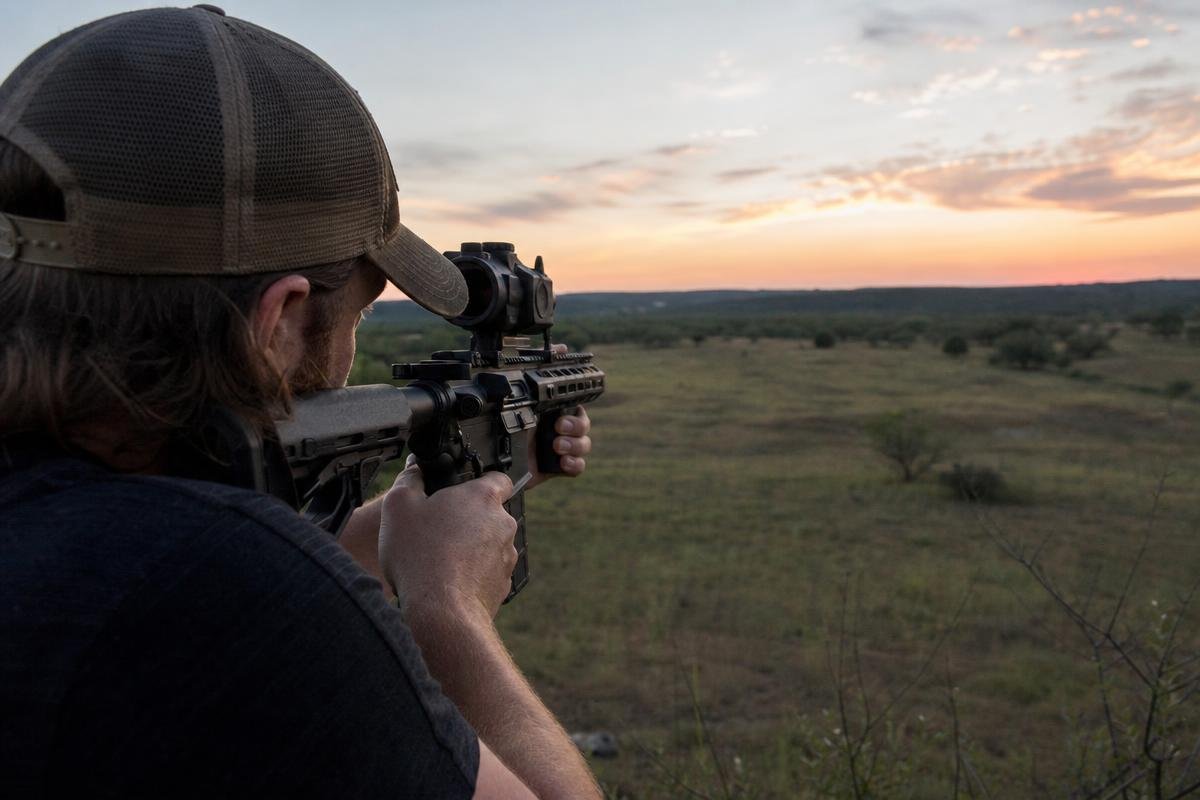
If you hunt feral hogs or coyotes in North Texas, you already know how fast a shot opportunity disappears in the dark. Night vision vs thermal for hunting comes down to how each optic performs on your terrain and which setup fits your rifle. Night vision amplifies available light. Thermal reads heat signatures. Those two sentences sound simple, but the real-world trade-offs in detection range, brush penetration, and image clarity determine which technology earns a place on your build.
At AR15Parts.com, we build complete uppers to order, assembling, headspacing, and function-checking them in-house before they ship from our Denison, TX facility. Browse our complete uppers and AR parts, or contact our team for help matching an upper to your optic.
Key Takeaways
- Thermal optics detect body heat and work in total darkness; night vision requires at least trace ambient or IR light to function.
- Choosing between night vision and thermal for your AR setup matters most in mixed terrain with open fields and dense brush.
- High summer humidity in North Texas can reduce thermal contrast, making fall and winter the most productive thermal hunting months.
- Night vision generally gives cleaner target identification in tight cover; thermal wins on raw detection range in open ground.
- TPWD allows feral hogs and depredating coyotes to be hunted on private property with landowner authorization without a hunting license. Hunter-education requirements still apply.
Night Vision vs Thermal for Hunting: How Each Works
Night Vision: Light Amplification Through Image Intensifier Tubes
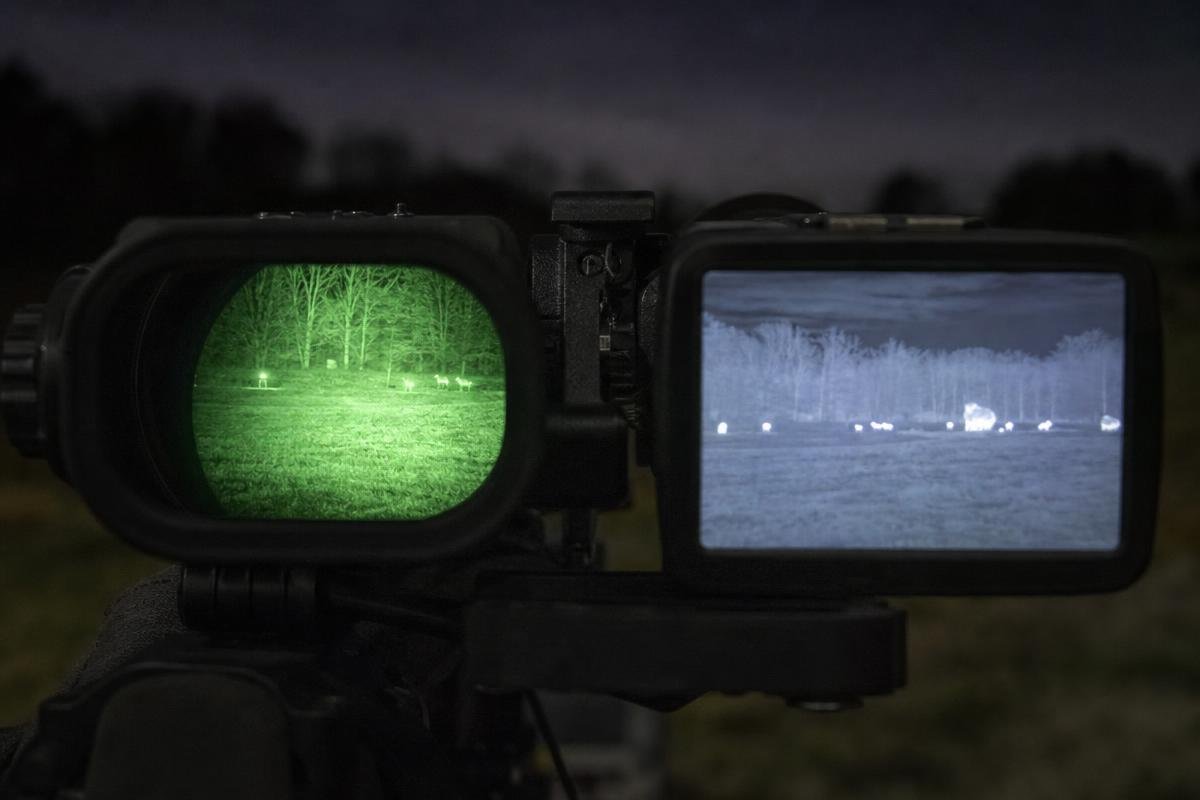
A night vision scope for an AR-15 does not generate its own image. It collects existing ambient light, whether moonlight, starlight, or the output from an IR illuminator, and amplifies it through an image intensifier tube. Photons enter the tube, strike a photocathode, and convert to electrons. Those electrons accelerate through a microchannel plate, multiply by a factor of thousands, then strike a phosphor screen and reconvert to visible light. The result is the familiar green or white monochrome image.
Generation matters here. Gen 1 tubes are affordable but produce noisy, low-contrast images. Gen 2 adds a microchannel plate and improves signal-to-noise ratio significantly. Gen 3 tubes from manufacturers like L3Harris are the military standard and deliver the sharpest low-light performance available. Digital night vision skips the image intensifier tube entirely, using a CMOS sensor instead. It costs less, but performance drops sharply in true darkness without a strong IR illuminator.
One practical note for the open fields around Sherman: Gen 1 is rarely worth the cost savings because the detection range gap versus Gen 3 is most punishing at distance, exactly where you need it in open country. The hard limit: NV requires some light to work. In total darkness with no IR source, even a Gen 3 tube produces nothing usable. In thick cedar and mesquite where ambient light is blocked, that gap matters.
Thermal Imaging: Heat Detection Without Any Light Source
A thermal scope for an AR-15 works on a completely different principle. It does not amplify light at all. An uncooled microbolometer sensor detects infrared radiation, the heat emitted by every object above absolute zero, and maps those temperature differences into a visible image. A wild pig at 98 degrees against 55-degree ground in December is an obvious target. No moonlight required.
The specs that actually determine performance in a thermal AR build are sensor resolution, pixel pitch, refresh rate, and NETD. Detection range depends mainly on sensor resolution and lens focal length, which determine the field of view and detail available per pixel. Smaller pixel pitch can produce a sharper image at a given lens size, but is not automatically better. NETD, measured in millikelvin, tells you how small a temperature difference the sensor can resolve. Lower is better. A 25mK NETD sensor picks up detail a 40mK sensor misses.
The real limitations are two. First, thermal cannot see through glass. Hunting from a vehicle cab or shooting through a window eliminates your image entirely. Second, in high summer humidity, warm ground temperatures reduce the contrast between an animal's body heat and the surrounding environment, which is why fall and winter produce the best thermal results in this region. For open agricultural fields, thermal generally offers a detection advantage over night vision. Tight brush at close range is where NV earns its place.
If you are building a dedicated night hunting upper, our 300 Blackout upper for suppressed night hunting builds pairs well with either optic type, and our complete AR-15 uppers assembled and headspaced in-house give you a verified platform to mount either system on.
Detection Range, Image Detail, and Target Identification: Where Each Technology Wins
What You Can See and How Far: Detection, Recognition, and Identification
The NATO DRI framework breaks performance into three levels: Detection means something is out there. Recognition means it is an animal, not a fence post. Identification means it is a hog, not your neighbor's dog. Each technology wins at a different level of that chain.
Detection and identification ranges vary by sensor, lens, weather, terrain, and target size. Higher-resolution thermal can detect heat signatures at longer distances across open fields, while Gen 3 night vision with an IR illuminator can provide more recognizable visual detail at closer ranges. Always use the manufacturer's DRI data and positively identify the target before shooting.
For suppressed close-range hog hunting in tight cedar cover, a 300 Blackout upper pairs naturally with a Gen 3 NV setup where identification detail at short distance is the priority.
Building a night hog setup? Tell us your terrain, average shot distance, and whether you're running suppressed, and we'll spec the right upper and caliber to match your optic. Call (888) 706-0633 or reach out below.
Image Clarity Trade-Offs at Real Hunting Distances
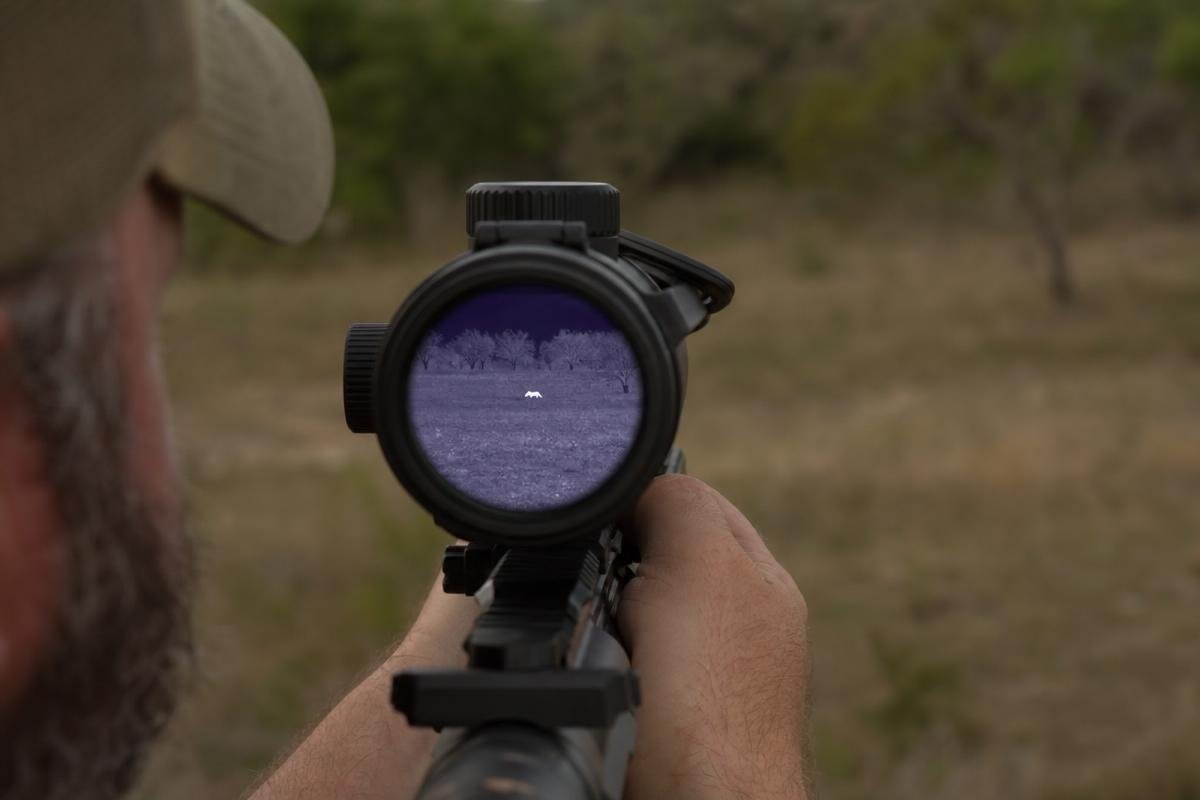
Sensor resolution changes everything. Lower-resolution thermal sensors provide less identification detail at distance than higher-resolution systems. Detection does not equal positive identification, so use the manufacturer's DRI data and confirm the animal before taking a shot.
Brush affects thermal more than most buyers expect. Dense cedar and tall grass absorb and re-emit heat, which flattens the contrast between an animal's body temperature and the surrounding vegetation. In North Texas creek bottoms thick with cedar, that contrast advantage shrinks fast. Night vision does not suffer the same way in brush because it reads reflected IR light, not heat signatures. It can also be temporarily blinded by a truck's headlights sweeping a field, which thermal ignores entirely. If most of your shots come inside a hundred yards in heavy cover, weight your decision toward night vision before you spend on a premium thermal.
Choosing the best AR-15 optics for hog hunting comes down to where you hunt. Open pasture favors thermal for detection range. Tight brush can favor night vision for identification detail per dollar spent.
Performance Tiers and What Different Systems Offer in 2026
Budget is the first real filter for most hunters. Night vision and thermal scopes both span a wide price range, and what you get at each tier is not a matter of minor refinement. It is a meaningful difference in detection range, image quality, and real-world reliability in the field.
Entry-Level Night Vision
Gen 1 and Gen 2 analog tubes at this price point produce noticeable edge distortion and low signal-to-noise ratios. Tube life is short. Digital night vision, which uses a CMOS sensor rather than an image intensifier tube, also lands here. A digital night vision scope for an AR-15 will get the job done on hogs inside 100 yards with a quality IR illuminator, but it is not a Gen 3 replacement. At this tier, you are buying a capability. You are not buying a performance tool.
An entry-level digital night vision scope can work at shorter distances when paired with a reliable IR illuminator, but identification range depends on the device, conditions, and target. Past that distance, image noise and low resolution make target identification unreliable.
Entry-Level Thermal
Entry-level thermal scopes often use lower-resolution sensors and smaller lenses, while higher-tier systems may offer 384x288 or 640x480 sensors, finer pixel pitch, and lower NETD values. Compare the manufacturer's DRI data, lens specification, and environmental limits for the exact model.
Thermal does not require an IR illuminator or ambient light, while Gen 1 and Gen 2 night vision generally depends more heavily on available or supplemental IR light. The better choice depends on terrain, identification needs, weather, and the specifications of the exact device.
Mid-Range and Premium: Where the Performance Gap Closes
Premium Gen 3 night vision and higher-resolution thermal systems can improve image detail and detection performance, but results vary by tube or sensor, lens, weather, terrain, and target size. If you are pairing a longer-range build, a 6.5 Grendel upper can make longer observation distances more useful downrange.
At the highest performance tiers, the choice becomes use-specific rather than price-driven. Premium optics make the most sense when the required identification distance, environmental conditions, and rifle configuration justify the added capability.
Questions about pairing a night vision or thermal scope with your AR-15 build? Call us at (888) 706-0633 and we will help you match the right optic to the right upper.
Which Is Better for Hog Hunting: Night Vision or Thermal in North Texas?
For most hunting around Denison, thermal wins on open ground for detection while night vision wins in heavy brush for identification. The terrain here is not uniform, and that is exactly why the honest answer depends on where you hunt and what time of year you are out there.
Hog and Coyote Hunting: Open Fields and Brush Country
In open agricultural fields and rolling pasture, thermal wins. No ambient light required, detection ranges can stretch past 200 yards with quality mid-to-high tier sensors, and a pig rooting in a bare field stands out clearly against cooler ground. That is the scenario thermal was built for.
Dense cedar and mesquite along the creek bottoms tell a different story. Vegetation absorbs and re-emits heat, which compresses the contrast between an animal's body temperature and the surrounding brush. At 50 to 100 yards in tight cover, a Gen 2 or digital NV unit with an IR illuminator often produces a more readable image than thermal. If most of your hunting is in those creek drainages, NV is worth serious consideration as the best AR-15 optic for hog hunting in that specific environment.
Coyote hunting in open country follows the same logic as hogs. Thermal gives you the detection edge. Suppressors are legal to own and hunt with in Texas; as of 2026, the federal transfer tax is $0, though ATF Form 4 or Form 1 registration and approval are still required. Pairing a 300 Blackout upper with a thermal or NV scope is an option for night hunting.
Terrain, Weather, and the Red River Corridor Factor
Denison sits at roughly 750 feet elevation with flat to gently rolling ground. That geography favors thermal on most properties, because longer sight lines let the technology do what it does best.
Summer humidity along the Red River is a real problem for thermal performance. In July and August, ground temperatures and vegetation stay warm well into the night. That narrows the contrast between a hog's body heat and the background, producing a muddy image. Fall and winter, October through March, are when thermal contrast sharpens dramatically in this region. If you hunt year-round and the summer months matter to you, NV holds its performance regardless of ambient temperature.
Legal Considerations for Night Hunting in Texas
TPWD allows feral hogs and depredating coyotes to be hunted on private property with landowner authorization without a hunting license. Hunter-education requirements still apply. Hunters should verify current TPWD rules, lawful methods, and local restrictions before hunting at night. Deer, turkey, and other game animals cannot be hunted at night.
That legal framework makes this corner of Texas active night hunting territory. If you are building a dedicated night hunting AR, browse our complete AR-15 uppers assembled and headspaced in-house to find a caliber and barrel length that fits the work.
How Your AR-15 Build Affects Your Optic Choice
Your optic choice does not exist in a vacuum. A thermal or night vision scope puts real demands on your hardware, and a build that works fine with a standard daytime optic may not hold zero or balance correctly once you add a 2-pound thermal unit up front.
Rail Length, Handguard Type, and Mounting Requirements
Thermal scopes typically weigh 1.5 to 2.5 lbs and require a full-length Picatinny top rail for a repeatable zero. A free-float handguard is strongly preferred here. Drop-in handguards contact the barrel, and that contact point shifts under the added weight and recoil of a heavy optic, pulling your zero over time.
Night vision clip-on setups add another variable. You need enough rail real estate to mount both the NV device and your daytime optic without interference. M-LOK free-float handguards are the current standard for AR-15 night hunting builds in this area. They let you position an IR laser, pressure switch, and sling mount without stacking unnecessary weight on the rifle.
Caliber Selection for Night and Thermal Hunting Builds
Caliber matters more at night than during daylight. Follow-up shot acquisition is harder in the dark, so recoil management, muzzle flash, and suppressor compatibility all carry more weight in your decision.
300 Blackout is the most popular suppressed night hunting caliber on the AR-15 platform. Subsonic loads cycle reliably in a properly tuned gas system and produce minimal muzzle flash. That flash control is critical with a night vision scope because a bright muzzle blast can temporarily wash out your image. Our 300 Blackout uppers are assembled, headspaced, and function-checked in-house at our Denison facility and are ready to drop onto your lower receiver.
5.56 NATO on standard loads produces significant muzzle flash. It can work with night vision if you run a quality muzzle device or suppressor, but it is not the first choice for dedicated night builds.
For hunters shooting longer distances across open ground, 6.5 Grendel uppers extend your effective range while staying on the AR-15 platform. Hog hunters who want a flatter-shooting option with suppressor compatibility should also look at 6mm ARC. Both calibers give you the reach that open pasture country around Denison demands when you are hunting past 200 yards under a thermal optic.
Frequently Asked Questions
Can my existing AR-15 lower accept a thermal scope without modification?
Yes. Your lower receiver has nothing to do with optic compatibility. Compatibility issues live in the upper receiver and handguard. A free-float handguard with a full-length top rail gives you the most mounting flexibility and holds zero better under the added weight of a thermal scope. Browse our complete AR-15 uppers assembled and headspaced in-house if your current upper is not free-float ready.
Does night vision work in total darkness?
Standard night vision requires some ambient light or an IR illuminator. Gen 1 and Gen 2 units produce a dark, noisy image in true zero-light conditions without an IR source. An IR illuminator solves that problem, but it also makes you visible to anyone else running NV. Thermal has no light requirement at all.
Is thermal or night vision better for hog hunting in Texas?
For most open agricultural fields and rolling pasture in this part of Texas, thermal is the more practical choice. NV is worth considering for dense cedar and mesquite brush at close range, or where budget is the primary constraint. October through March produces the best thermal contrast. Summer months push ground temperatures high enough that the gap between soil heat and hog body heat narrows, which reduces image clarity.
Can I use a clip-on NV device with a daytime LPVO?
Yes. Clip-on night vision devices mount in front of your existing daytime scope and use its magnification and reticle at night. The trade-off is added length and weight. You will need a longer handguard and a solid mounting solution to keep zero consistent.
What caliber should I run in a suppressed night hunting build?
300 Blackout with 220gr subsonic loads is the most widely used option for suppressed night hunting. Our 300 Blackout uppers for suppressed night hunting builds are assembled and headspaced in-house. If you need more range, our 6.5 Grendel uppers for extended-range thermal hunting and 6mm ARC complete uppers for longer-range hog hunting both run on a standard AR-15 lower.
Are thermal and night vision optics legal for hog hunting in Texas?
TPWD allows feral hogs and depredating coyotes to be hunted on private property with landowner authorization without a hunting license. Hunter-education requirements still apply. Verify current TPWD rules and local restrictions, and always positively identify the target before shooting.
Our team assembles and headspaces complete uppers in-house at 4000 Texoma Parkway, Denison, TX 75020, and ships nationwide. If you are building a night hunting AR and need help matching the right caliber to the optic you are running, call us at (888) 706-0633.
Ready to Get Started with AR15Parts.com?
Call (888) 706-0633 to speak with our team directly. We're ready to answer your questions, walk you through your options, and help you find the right solution for your needs. Whether you're just starting to plan or ready to move forward, we'll make the process simple and stress-free. Reach out today and let's talk about how we can help.