
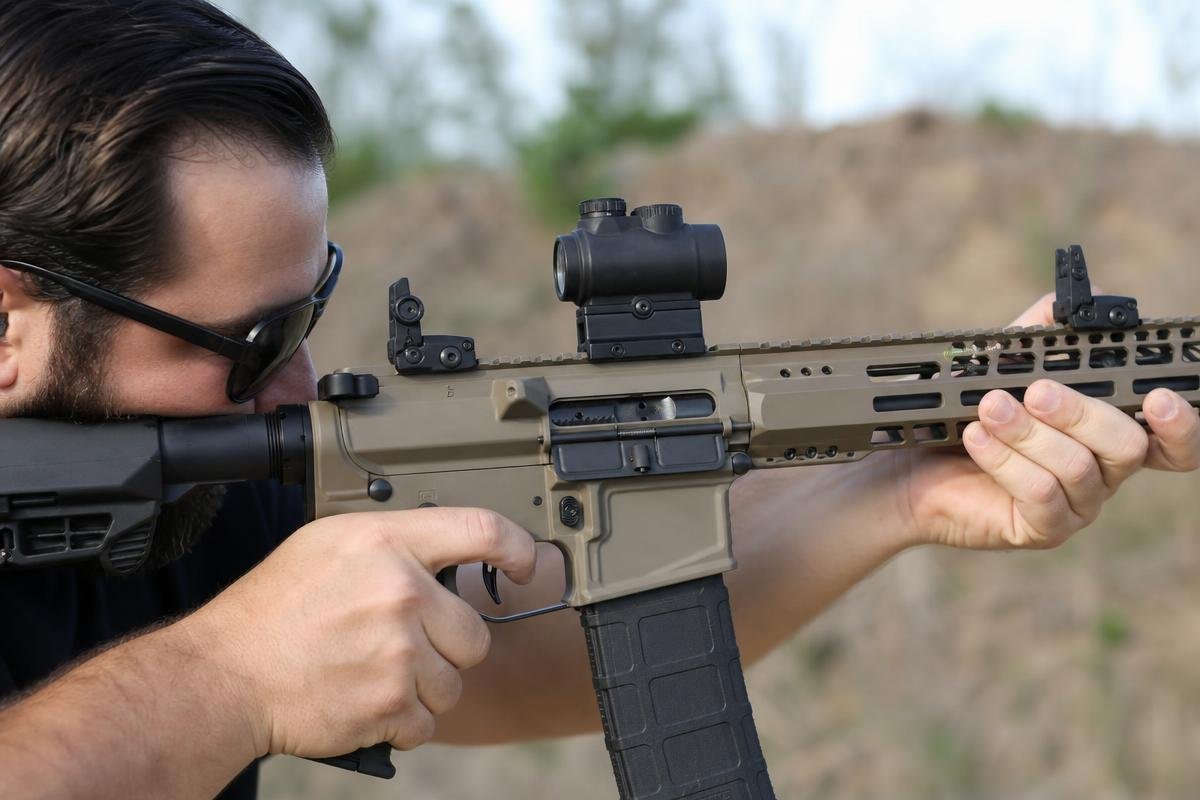
Red dot vs holographic is a practical choice when selecting an AR-15 optic and backup sight setup. Compare battery needs, size, and mount fit before choosing parts for your build. At AR15Parts.com, we ship uppers nationwide from our Denison, TX facility and offer parts and compatibility advice by phone or contact form.
Red dots and holographic sights both work as co-witness or standalone backup solutions, but they are not the same tool. We compare their tradeoffs so you can choose compatible parts with confidence. Have questions about your optic or backup sight setup? Call us or contact our team for parts and compatibility advice.
Red Dot vs Holographic: Key Takeaways
- AR-15 backup sights give you a reliable aiming system if your primary optic fails or loses battery.
- Red dot sights run longer on a single battery and weigh less than most holographic units.
- Some holographic sights may retain a usable reticle with a partially obstructed window, depending on the model and conditions.
- Some shooters with astigmatism report a cleaner holographic reticle, but results vary and both optic types should be tested before purchase.
- Battery life is a dominant factor for stored home defense rifles when rifles may sit for extended periods.
How Red Dot and Holographic Sights Actually Work
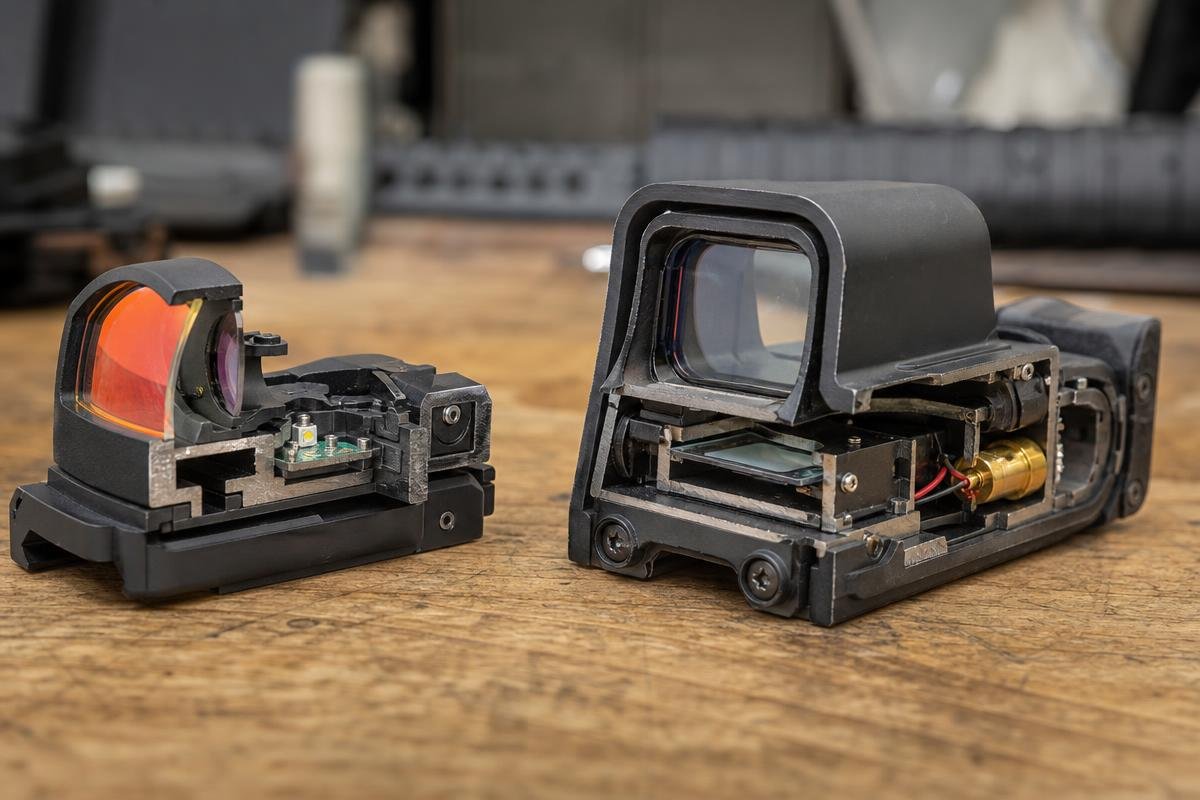
These two optic types look similar on a rail, but the technology inside them is fundamentally different. Confusing them as "basically the same thing with a different reticle shape" leads to bad decisions, especially when you're setting up a backup optic where reliability is the whole point.
How a Red Dot Sight Projects Its Reticle
A red dot sight uses an LED emitter mounted inside the housing. That LED bounces light off a curved, coated lens back toward your eye. The dot you see is a reflection superimposed on your target, not a point of light sitting on the glass. The lens coating reflects the emitter's wavelength to create the visible dot while allowing the shooter to see the target.
Reticle size is measured in MOA. A 2 MOA dot gives you more precision at distance. A 4 MOA dot is faster to pick up under stress. Either way, the dot stays usable across a wide range of eye positions because parallax is minimal at typical engagement distances. You do not need a perfect cheek weld to get a centered sight picture.
Battery life is one of the strongest arguments for a red dot sight on an AR-15. LED emitters draw very little current. Many units run thousands of hours on a single battery, which matters if you're storing a home defense build for extended periods between range sessions.
How a Holographic Sight Generates Its Reticle
A holographic sight works on a different principle entirely. A holographic sight uses a laser diode and holographic optical element to create the reticle. The exact optical design varies by model, so use the manufacturer's documentation for model-specific details.
That distinction has a real operational consequence. Some holographic designs may retain a usable reticle when part of the viewing window is obstructed, but performance depends on the model and damage. A damaged red-dot lens can also affect visibility, so neither condition should be treated as guaranteed. For a complete AR-15 upper running a backup optic in field conditions, that difference is worth understanding before you buy.
The tradeoff is battery consumption. Laser diodes draw significantly more power than LED emitters. Holographic-sight battery life varies by model and brightness setting and is generally shorter than that of many LED red dots. That is a meaningful gap compared to most red dots.
Red Dot vs. Holographic Sight: Head-to-Head Comparison
These two optic types are built on different technology, and that technology produces real differences in weight, battery life, reticle behavior, and price. Here is how they stack up across the five factors that matter most for your backup optic system.
Battery Life
This is where red dots win decisively. Many quality red dots advertise battery life in the tens of thousands of hours. Confirm the battery type and runtime for the exact model, and follow a regular battery-check schedule for any defensive firearm.
Holographic sights generally have shorter battery life than many red dots. Confirm the exact model's battery type and runtime, especially for a rifle that is checked infrequently. For anyone storing a dedicated defensive carbine, battery longevity is not a minor spec. It is a reliability variable.
Weight and Size
Most quality red dots run 3 to 6 oz. Holographic sights run 9 to 12 oz with a larger, boxier housing. On a carbine already wearing a primary optic and a set of backup iron sights, that weight difference is noticeable. If you are building a lightweight carbine upper, a red dot can help keep the rifle's weight manageable.
Reticle Options and Clarity
Some shooters with astigmatism report that a holographic reticle appears cleaner than an LED red dot, while others do not. Test both optic types before choosing one. Holographic units also offer more complex reticle patterns, including circle-dot and ranging reticles. If you have astigmatism and a red dot has always looked blurry to you, a holographic sight is worth the price difference before deciding that an electronic optic does not work well with your vision.
Low-Light and Night Vision Performance
Night-vision compatibility and low-light performance vary by model. Compare the manufacturer's specifications for the exact red-dot or holographic sight and confirm compatibility with the intended night-vision equipment.
For night-vision use, check each optic's NV settings and compatibility with the intended equipment. If your build uses a 300 Blackout upper, compare model-specific mount height and NV settings rather than assuming one optic type will work best.
Price
Red dots and holographic sights are available across different price tiers, and pricing varies by model, features, and availability. For a backup role where the optic is a secondary system, the price-to-value ratio favors the red dot for most shooters. Spend the savings on a quality mount and proper installation. Correct mounting affects zero retention as much as the optic itself.
Not sure which optic fits your build? Browse our complete uppers or contact our team for help choosing compatible parts.
Which Optic Works Best as an AR-15 Backup Optic?
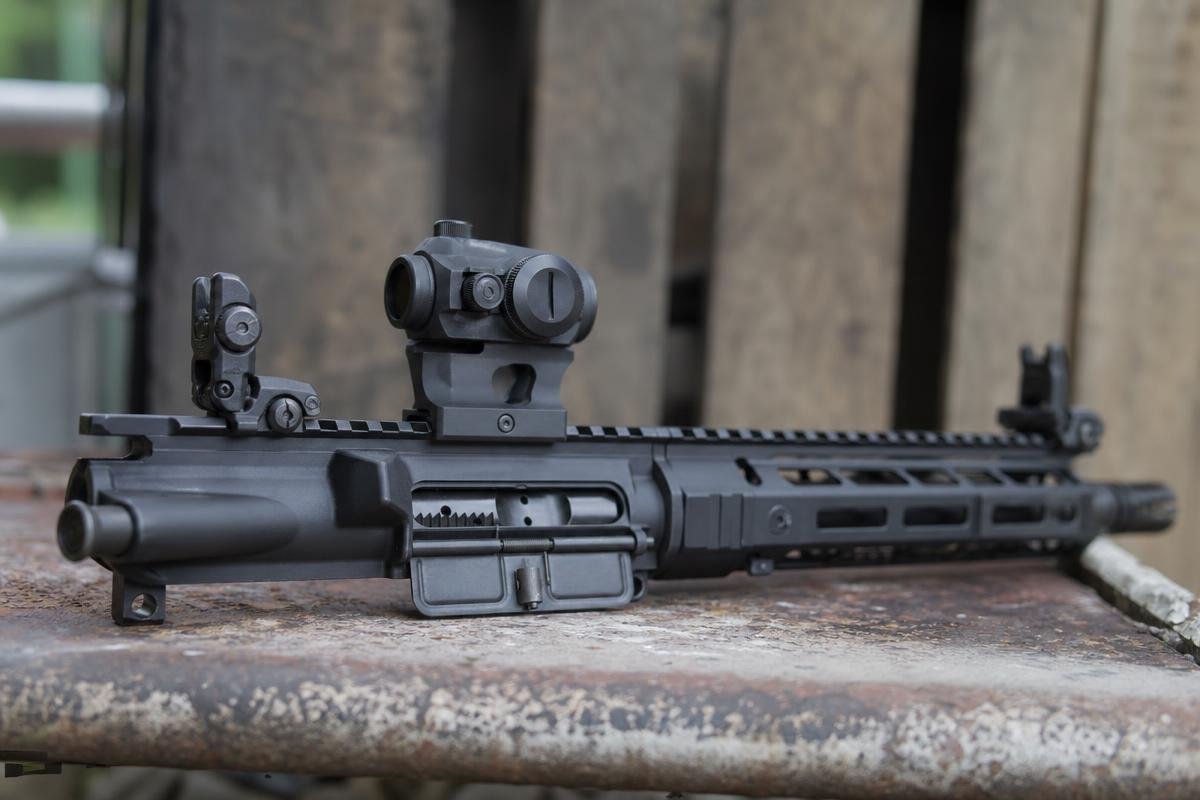
The answer depends on how you plan to run the rifle. A pure backup role, where the optic only comes into play if your primary fails, calls for different thinking than a dual-role setup where you actively switch between two sighting systems. Here is how each configuration plays out in practice.
Offset Backup Sights: Running a Red Dot at 45 Degrees
If you run a magnified LPVO as your primary optic, close-range targets become a problem fast. An offset red dot mounted at 45 degrees on your M-LOK handguard rail solves that. You cant the rifle, the dot is on target, and you engage without touching your primary optic or its magnification setting.
Red dots are the right call here. They are lighter, have a smaller footprint, and put a single dot on the target the moment you cant. Holographic sights are heavier and physically larger, which makes a 45-degree offset mount awkward and harder to acquire quickly. On a rifle with a magnified primary optic, an offset red dot adds a compact option for closer targets.
Co-Witnessed Backup Sights: Pairing a Primary Optic with BUIS
Co-witness setups keep your iron sights visible through the optic window. Absolute co-witness lines the irons up through the center of the window. Lower-third co-witness drops them to the bottom of the window, leaving the reticle unobstructed for normal shooting. Holographic sights, with their larger windows, typically run lower-third co-witness. Red dots can run either, depending on mount height.
For a home defense carbine stored for extended periods, a co-witness setup with flip-up BUIS is the most practical configuration. The irons are there if the battery dies. The red dot or holographic sight handles every normal use case. Confirm the zero for each sighting system separately.
Red Dot vs. Holographic vs. Iron Sights: A Three-Way Look
Iron sights provide a non-electronic backup for an AR-15. No battery. No electronics. No single point of failure. A quality set of flip-up BUIS on a well-built upper assembly gives you a failsafe that works regardless of conditions.
Red dots add speed and low-light capability at the cost of battery dependency. Holographic sights add reticle complexity and night-vision compatibility at a higher weight and price. For a pure backup role, iron sights remain the most reliable option. A holographic sight for AR-15 use makes more sense as a primary or co-primary optic, not as a fallback. Red dots sit in the middle, useful enough to serve as a capable secondary without the weight and cost penalty of a holographic unit.
Need help picking the right backup setup for your build? Call us at (888) 706-0633 and we can offer parts and compatibility advice.
Quick-Reference: Red Dot vs. Holographic Sight Decision Table
Use this quick-reference table to compare the factors that matter most.
| Category | Red Dot Sight | Holographic Sight |
|---|---|---|
| Battery Life | Often tens of thousands of hours, model-dependent | Usually shorter, model-dependent |
| Weight | 3 to 6 oz | 9 to 12 oz |
| Reticle Complexity | Single dot | Complex reticle options |
| Astigmatism Friendliness | Varies by shooter | Varies by shooter |
| Low-Light and NV Use | Model-dependent | Model-dependent |
| Pricing | Pricing varies by model | Pricing varies by model |
| Best Backup Role | Home defense, range, hunting | NV-equipped builds, astigmatism |
| BUIS Compatibility | Works with offset or folding BUIS | Works with offset or folding BUIS |
For most shooters, choosing between a red dot and holographic sight comes down to one clear default. A quality red dot covers the backup role on any AR-15 build, whether you use it for home defense or at the range.
The battery and weight penalty of a holographic sight can be hard to justify unless you are running night-vision equipment or your astigmatism makes an LED dot unusable. If either of those applies, consider a compatible holographic sight for your 300 Blackout or 350 Legend upper. Otherwise, the red dot is the right call for a practical AR-15 backup optic.
Storage and Low-Light Considerations for AR-15 Optics
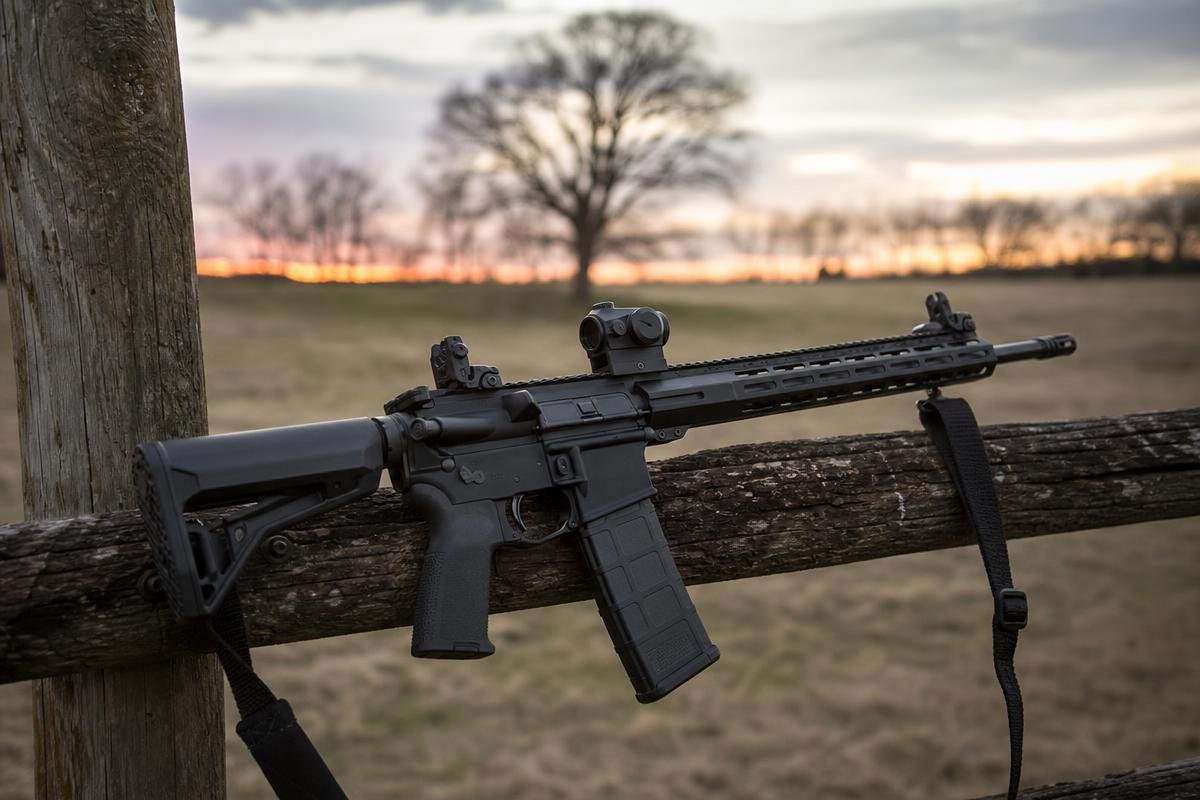
Storage conditions and low-light use can influence your optic choice. Compare model-specific battery life, temperature ratings, and night-vision compatibility before choosing backup sights.
Low-Light and Night-Vision Use
For low-light or night-vision use, compare the exact models' brightness settings and NV compatibility. Window size and reticle visibility vary by model, so check the manufacturer's specifications for your intended setup.
For a 350 Legend upper, check optic mount compatibility and any NV settings against your intended equipment rather than assuming holographic sights always have an advantage.
The trade-off is battery life. Holographic sights typically offer far fewer hours of battery life than LED red dots, varying by model and brightness setting. For any rifle used infrequently, check the battery before each use.
Battery and Storage Considerations
A rifle may sit in a safe for months between uses. Battery longevity becomes the dominant variable. Many red dots advertise long battery life, but confirm the runtime for the exact model and check the battery regularly.
High storage temperatures can affect batteries and electronics. Follow the optic and battery manufacturers' storage guidance, and do not leave a firearm unsecured in a vehicle or unconditioned space.
For a home defense build, a red dot paired with flip-up AR-15 backup sights is the more reliable combination. The optic stays on, the irons are there if the battery ever fails, and regular battery checks still matter. We ship complete uppers and parts nationwide from our Denison, TX facility.
Frequently Asked Questions
How do red dot and holographic sights differ on an AR-15?
A red dot uses an LED reflected off a coated lens to project a dot onto your field of view. A holographic sight uses a laser to reconstruct a reticle at the target plane. In some holographic designs, the reticle may remain usable despite partial window damage, but performance varies by model and damage and is not guaranteed. Red dots are often lighter and typically use less battery power.
Can I use a red dot or holographic sight as a true backup if my primary optic fails?
Both types work as a backup, but both introduce battery dependency that iron sights do not. For a home defense or field build where reliability is non-negotiable, the most dependable AR-15 backup sights setup pairs either optic with flip-up BUIS. That gives you a non-electronic fallback if the battery dies at the wrong moment, which matters on a rifle stored for extended periods.
Do holographic sights work better than red dots for shooters with astigmatism?
Astigmatism causes the LED dot to appear as a starburst or smear rather than a clean point. Some shooters with astigmatism report that holographic reticles appear sharper, while others do not. If you have astigmatism, it is worth testing both types before committing to a mount.
How long do batteries last in red dot vs. holographic sights?
Many red dots advertise longer battery life than holographic sights, but exact runtime and battery type vary by model and brightness setting. For a backup-sights role where the optic may sit on the rifle for months between uses, that gap is operationally significant. A red dot is the lower-maintenance choice for a stored home defense build.
What backup sight setup works best for co-witness with AR-15 iron sights?
Lower-third co-witness is the most common configuration for both optic types paired with flip-up BUIS. It keeps the reticle in your upper visual field with irons visible below. Absolute co-witness is also common with red dots on a standard-height mount, though it can clutter the sight picture during magnified use.
Is a red dot or holographic sight better for night vision use on an AR-15?
Holographic sights have the edge here. Their laser-generated reticle holds contrast and definition better at NV brightness settings. Both types offer NV-compatible modes, but holographic sights have a longer track record in NV-equipped applications. For night-vision use, check the exact optic's NV settings and compatibility with your equipment.
Ready to build out your backup-sights setup? AR15Parts.com offers parts, upper assemblies, and selected optics, subject to current availability, and ships nationwide from 4000 Texoma Parkway, Denison, TX 75020. Call us at (888) 706-0633 with questions about which optic fits your specific build. We will give you a straight answer, not a sales pitch.
Ready to Get Started with AR15Parts.com?
Call (888) 706-0633 or contact our team for parts and compatibility advice. We can help you compare options for your build.