
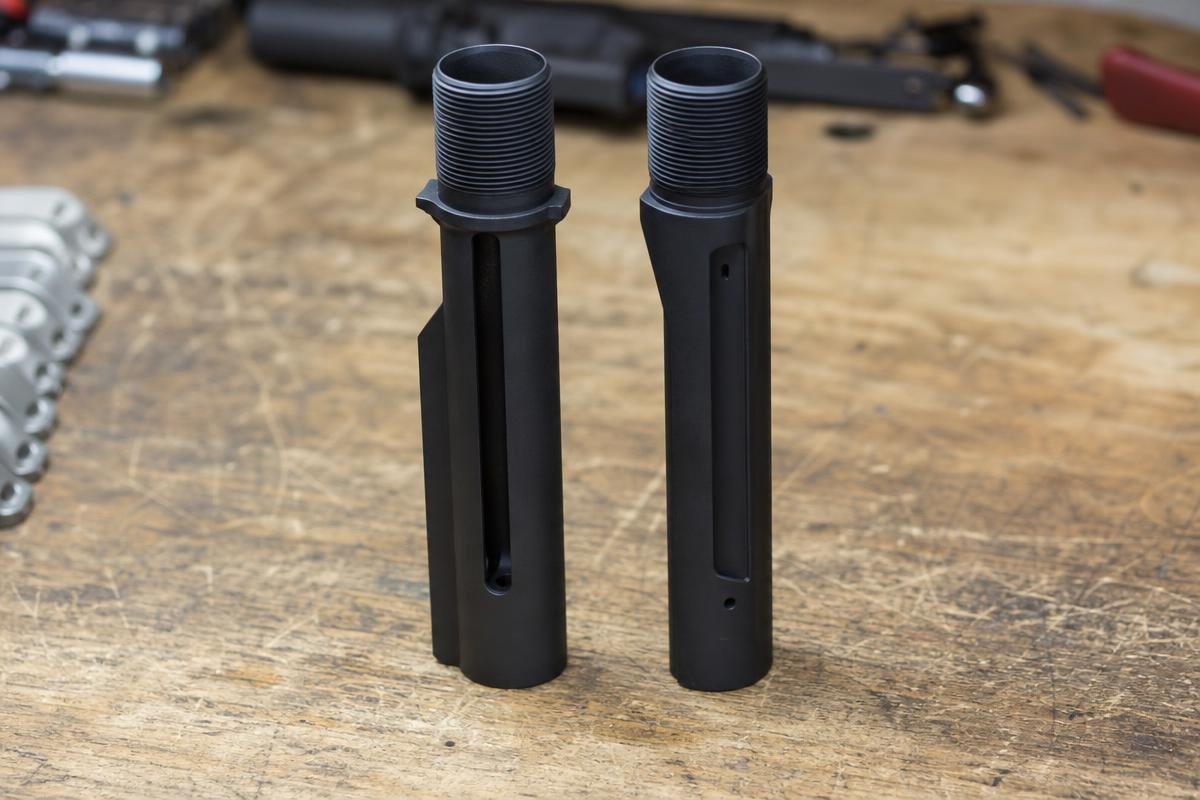
Choosing the wrong buffer tube creates fitment problems that can sideline your build. The difference between a mil-spec buffer tube and a commercial buffer tube comes down to one critical measurement: outer diameter. Mil-spec carbine receiver extensions are approximately 1.146 to 1.148 inches in outside diameter, while commercial-spec extensions are approximately 1.168 inches. That difference determines which collapsible stock body fits, while both standards use the same lower-receiver thread specification. We stock AR-15 receiver-extension components at our Denison, TX location and ship nationwide, so you can review the available specifications before ordering. Not sure which buffer tube fits your build? We can help you sort it out fast.
Key Takeaways
- A mil-spec carbine extension is approximately 1.146 to 1.148 inches in outside diameter and typically has a flat rear face; a commercial-spec extension is approximately 1.168 inches and commonly has a slanted rear profile.
- Tube and stock must share the same standard, since the two are not interchangeable.
- A standard AR-15 lower can accept either carbine-extension standard because the receiver threads are the same, but the installed extension determines which collapsible stock body fits.
- Mixing standards can cause a loose fit or prevent the stock from seating and locking correctly.
- A caliper reading at the stock end before you order a stock prevents a costly return or refit.
The Common Mismatch That Stops a Build Cold
You order a replacement stock, it arrives, and it will not seat correctly on the receiver extension. It either wobbles or will not fit at all. That mismatch happens because two separate buffer tube standards exist, and most builders do not know which one they have until assembly goes wrong.
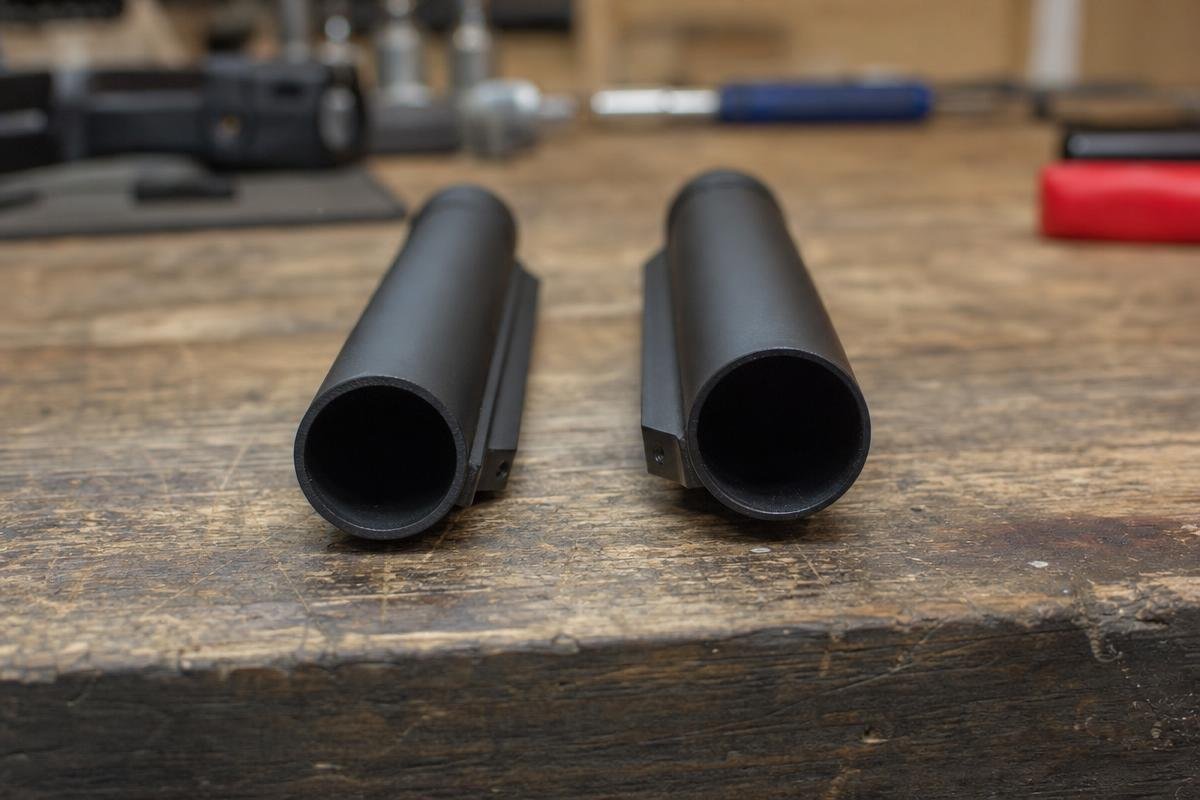
The two tubes look nearly identical at a glance, but the commercial version is slightly wider at the stock end and tapers backward, while the mil-spec version runs a uniform diameter its full length. That small dimensional and geometric gap means stocks built for one standard will not lock correctly on the other.
Stock upgrades can expose a tube-spec mismatch when the original extension standard is unknown. Knowing which standard your lower uses before you order saves a return trip. Browse our complete AR-15 rifles ready to configure from AR15Parts.com if you want a verified starting point.
What Is an AR-15 Buffer Tube and What Does It Do?
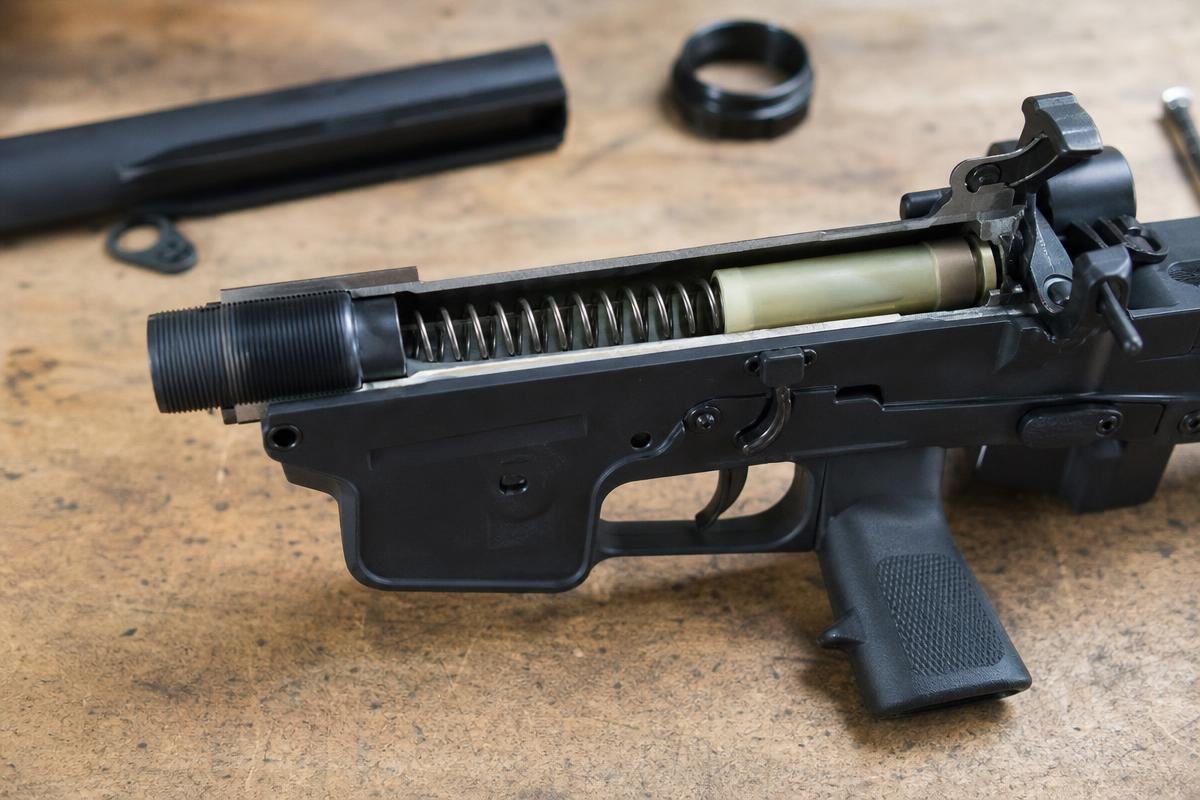
The buffer tube, technically called the receiver extension, is an aluminum tube threaded into the rear of your lower receiver at 1.1875-16 TPI. It houses the recoil buffer and recoil spring. Those two components do the actual work of slowing the bolt carrier group on rearward travel and returning it to battery after each shot. Without the tube, the whole cycling system has nowhere to live.
Function Inside the Lower Receiver
Every time the rifle fires, the bolt carrier group travels rearward under gas pressure. The buffer compresses the spring inside the tube, absorbs that energy, and then the spring pushes everything back forward. The diameter and profile of the tube determine which stocks fit over it. For readers who want more detail on how the BCG interacts with this system, our AR-15 parts section covers the full lower parts group.
Rifle-length tubes are almost exclusively mil-spec. Carbine-length tubes exist in both mil-spec and commercial versions. The thread pitch is identical across both standards, so either one threads into a standard lower receiver without modification.
The Two Standards: Where They Come From
The mil-spec receiver extension standard was defined by the U.S. military to ensure parts interchangeability across service rifles. Every component had to fit every other component, regardless of manufacturer.
The commercial spec came later as a civilian cost-reduction approach. Manufacturers adjusted the outer diameter profile at the stock end to simplify production. The thread pitch stayed the same. The difference between the two is purely dimensional at that stock-end profile, which is exactly what the following sections cover in detail.
The Exact Dimensional Differences Between Mil Spec and Commercial Buffer Tubes
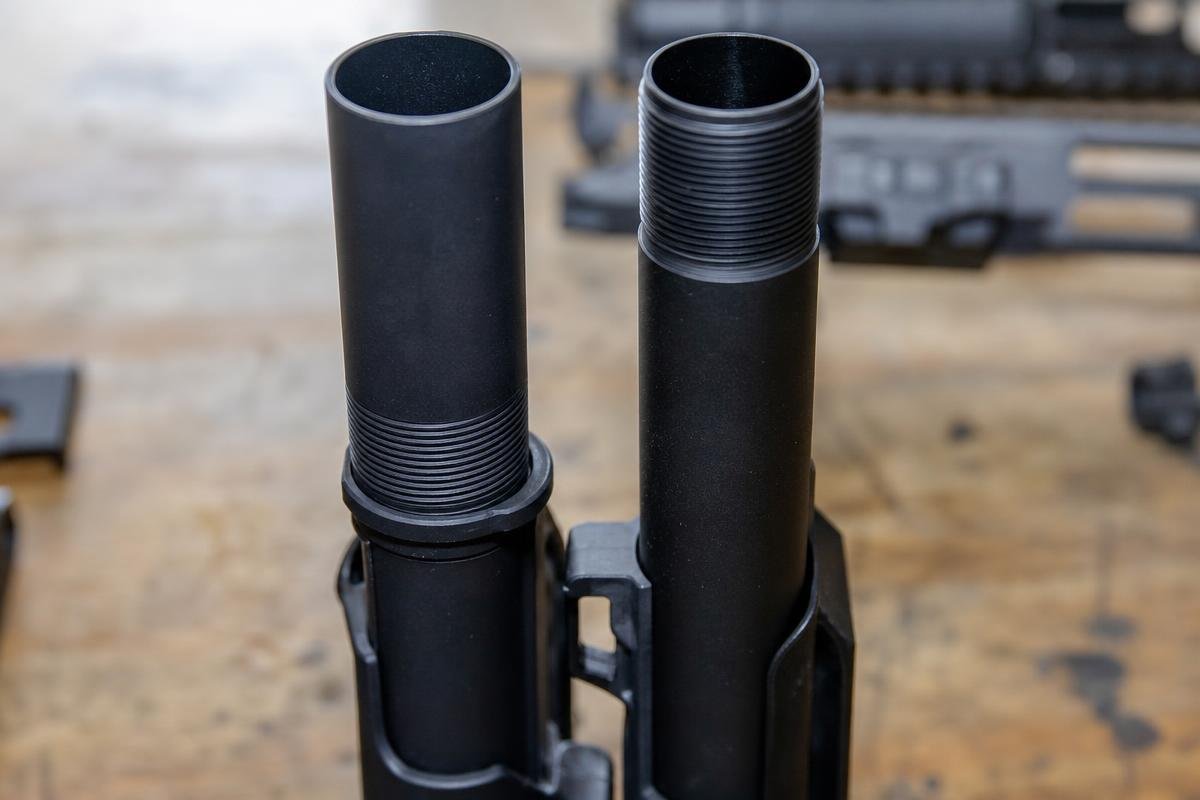
Compare outer diameter and rear profile to match the tube with a stock. Check the listed aluminum alloy separately when evaluating durability; diameter alone does not establish material.
Outer Diameter: The Number That Determines Stock Fit
The diameter difference between the two standards is enough to make their collapsible stock bodies incompatible. A commercial stock dropped onto a mil-spec tube will rattle laterally under recoil, since the stock bore is oversized for the smaller tube. A mil-spec stock forced onto a commercial tube simply will not seat, because the bore is undersized. Thread pitch is identical on both at 1.1875-16 TPI, so the threads are never the differentiator. The diameter at the rear is.
Profile Shape: Straight vs. Tapered
A mil-spec tube runs a uniform outer diameter along its full length. Commercial-spec extensions generally have a larger stock-bearing diameter and often a slanted rear end. Both standards use a locking pin that engages adjustment positions in the receiver extension's lower rail.
They use the same basic adjustment mechanism but require stock bodies sized for the correct extension diameter. A mil-spec stock may not fit over the larger commercial-spec extension, while a commercial-spec stock can fit loosely on the smaller mil-spec extension.
Material and Construction Standards
True military-specification extensions use specified materials and manufacturing methods, but retail products labeled mil-spec may use the term for stock-body diameter alone. Commercial-spec products may use different alloys and manufacturing methods, so material should not be inferred from diameter alone. For a rifle that rides in a pickup rack across gravel county roads or takes a knock in a deer stand, that material difference is real. A quick-reference comparison:
- Mil-Spec diameter: approximately 1.146 to 1.148 in. OD / typically flat rear face
- Commercial-spec diameter: approximately 1.168 in. OD / commonly slanted rear profile
If you are building on a standard mil-spec lower, browse our AR-15 parts inventory to confirm your tube selection before ordering stocks or end plates. Ready to spec the right receiver extension for your lower?
Stock Compatibility: Which Stocks Fit Which Tube?
Pairing a tube and stock from two different standards is one of the most common ordering mistakes we see. The bore diameter of the stock has to match the outer diameter of the tube. If it does not, the stock will either rock under fire or refuse to lock at all.
Mil-Spec Stocks on Mil-Spec Tubes
Mil-spec collapsible stocks are sized for an extension approximately 1.146 to 1.148 inches in outside diameter. The number of adjustment positions and amount of play vary by extension and stock model. Most quality aftermarket adjustable stocks are mil-spec by default. Fixed A2-style rifle stocks use a rifle-length receiver extension rather than either carbine-tube standard. If you are building from scratch and have not already committed to a tube standard, mil-spec is the right call. Nearly every stock worth buying is designed around it. For current fixed and adjustable stock options, see our AR-15 stock category.
Commercial Stocks on Commercial Tubes
Commercial stocks are designed around a tapered tube. That taper is the key detail, since the stock bore is cut to match the wider rear profile. Put a commercial stock on a mil-spec tube and it shifts under recoil because the bore is too large for the smaller tube. The fit is loose from the start and only gets worse as the detent surfaces wear.
Can You Mix Mil-Spec and Commercial Parts?
No. Forcing a mil-spec stock onto a commercial tube means the bore is undersized for the larger tube. The stock will not lock properly and risks cracking the receiver channel under recoil. Adapters exist, but we do not recommend them for any defensive or duty build.
Worth noting on the lower side: most quality AR-15 lowers are cut to accept a mil-spec tube, but some budget forgings and polymer lowers ship with a commercial tube installed from the factory. Do not assume your lower is mil-spec just because it is new. Verify it before ordering a stock. A1- and A2-style rifle stocks require a compatible rifle-length receiver extension, buffer, and spring, so confirm the complete system before ordering.
Builders in Grayson County replacing a factory stock for the first time should measure the existing tube before ordering anything. A caliper reading at the stock end tells you immediately which standard you are working with.
Pros and Cons of Each Buffer Tube Standard
Why Mil-Spec Is the Default Choice for Most Builds
The mil-spec receiver extension wins on two concrete points: material and aftermarket depth. True mil-spec tubes use 7075-T6 aluminum, but check the listed material of retail tubes labeled mil-spec. The straight outer profile is also easier to measure and verify at the bench.
Stock selection is the bigger practical advantage. Nearly every quality collapsible stock on the market is built around the mil-spec diameter. Shooters who trained on GI-spec rifles will find these tubes fully compatible with components they already own. Current pricing varies by manufacturer and product specification.
When a Commercial Tube Makes Sense
Commercial tubes are not defective. If your factory rifle shipped with a commercial tube and a commercial stock, replacing that tube with another commercial tube is the correct call. Swapping to mil-spec in that situation means replacing the stock too, which adds cost with no functional gain.
Commercial tubes also work fine on range-only builds where the stock is rarely adjusted and the rifle sees light use. The real risk is mixing standards solely to reduce cost, not the commercial standard itself.
For new builds, start with a mil-spec receiver extension. The stock selection is broader and the material is more durable. If you want a complete AR-15 rifle ready to configure, browse our complete AR-15 rifles and confirm the listed receiver extension before ordering.
Not sure which tube standard your build needs? Call us at (888) 706-0633 and we will point you in the right direction.
Buffer Tube Variations Beyond the Mil-Spec vs. Commercial Split
The mil-spec vs. commercial debate covers most carbine builds, but it is not the whole picture. AR-15 buffer tube differences go further once you factor in length, intended use, and specialty features. Knowing which category you need before you order saves time and prevents a parts mismatch.
Rifle-Length vs. Carbine-Length Tubes
Rifle-length tubes run approximately 9.5 to 9.75 inches and are designed for fixed A1 or A2 stocks only. They house a longer buffer and spring, and they are almost exclusively mil-spec in diameter. You cannot mount an adjustable collapsible stock on a rifle-length tube. Carbine-length tubes run approximately 7 inches and accept adjustable stocks. This is the standard for most modern AR-15 builds, and it is where both mil-spec and commercial specs compete.
Pistol Buffer Tubes and Braces
An AR-platform pistol may use a standard carbine receiver extension or a dedicated smooth pistol extension, depending on the brace and recoil system. Verify the extension's internal depth, spring, buffer, and brace compatibility for the specific product. Do not assume a dedicated pistol extension is interchangeable with carbine or rifle-system components. Local shooters putting together hog-hunting AR pistols for the ranchland southwest of town will encounter this category.
Texas allows hunting feral hogs year-round with no bag limit, which drives a lot of these compact, maneuverable builds. If you are building a pistol configuration, verify the brace manufacturer's spec before ordering. The 2023 ATF pistol brace rule was vacated by courts and is not currently enforced, but confirm current regulations before finalizing a brace-equipped build.
Enhanced and Specialty Tubes
Enhanced tubes add features like built-in QD sling sockets, extended length for taller shooters, or integrated end-plate designs that eliminate the separate end plate and castle nut. They are almost always mil-spec in diameter. For a standard carbine build, none of these additions are necessary. They are worth the cost on precision or competition builds where every component is optimized. If you want to see how these tubes pair with a finished platform, browse our complete AR-15 rifles ready to configure from AR15Parts.com.
How the Buffer and Spring Interact with Your Tube Choice
The mil-spec vs. commercial designation does not change which buffer or spring you need. Tube length determines that. A carbine-length tube accepts carbine buffers and a carbine recoil spring. A rifle-length tube requires a rifle buffer and the longer rifle spring. Those two systems are not interchangeable regardless of which standard your tube follows.
Buffer Weight and Carbine vs. Rifle Spring
Carbine-length tubes accept standard, H, H2, and H3 weight buffers. Each step up in weight adds tungsten or steel mass that slows the bolt carrier group on rearward travel. That slower cycle reduces felt recoil and prevents the carrier from outrunning the magazine on fast strings. Rifle-length tubes use a single rifle buffer and a longer rifle spring. There is no H-weight option in a rifle-length setup.
Heavier carbine buffers are used in some suppressed and overgassed carbines. Ejection direction alone does not diagnose overgassing, so evaluate ammunition, lockback, extraction, gas settings, spring, buffer, and manufacturer guidance before changing parts.
Matching Your Buffer Setup to Your Gas System
Carbine-length gas systems on 16-inch barrels generate higher port pressure than mid-length or rifle-length systems on the same barrel. Builders running carbine gas frequently benefit from an H or H2 buffer. Mid-length and rifle-length gas systems on 16-inch or 18-inch barrels typically run a standard carbine buffer without issue. Before adjusting buffer weight, review the gas-system details listed with each complete upper receiver so you are solving the right problem first.
Building in Denison, TX: What Local Shooters Should Know Before They Order
Whether you're ordering parts in Grayson County or elsewhere, check your existing receiver extension before choosing a replacement stock. Getting the tube spec right before you order can save a return shipment and keep your build moving.
Verifying Your Existing Tube Spec Before You Buy
Pull the stock off and look at the tube from the rear. A straight, consistent profile means mil-spec. A tube that visibly narrows toward the back is commercial. That visual check alone handles most cases.
If you want a hard number, use a caliper at the stock end. A reading of 1.14 inches confirms a mil-spec tube. Anything in the 1.168 to 1.17 inch range is commercial. That measurement also tells you which stocks will fit, so check it before you finalize any AR-15 stock compatibility buffer tube order. If you are unsure what you are looking at, call us at (888) 706-0633 and we can walk you through it.
Ordering Mil-Spec Parts From Denison, TX
We ship from 4000 Texoma Pkwy, Denison, TX 75020. Our inventory covers buffer tubes, castle nuts, end plates, buffers, and springs as individual components. Confirming the spec before checkout can help prevent a return.
If you want a complete upper instead of a component build, browse our complete AR-15 upper receivers made to mount to a compatible lower and reduce the spec guesswork.
Frequently Asked Questions
What is the outer diameter of a mil spec buffer tube?
A mil spec buffer tube measures 1.14 inches in outer diameter at the stock-mounting end and holds that diameter consistently along the full length of the tube. Commercial buffer tube diameter runs 1.168 to 1.17 inches and tapers toward the rear. That dimensional difference is the root cause of every compatibility issue between the two standards.
Will a mil spec stock fit on a commercial buffer tube?
No. A mil spec stock is bored to 1.14 inches and will not seat correctly on a 1.168-inch commercial tube. It will not lock at the detent positions and may not seat at all. Always match stock spec to tube spec. There is no workaround.
Is a mil spec buffer tube stronger than a commercial tube?
Not necessarily. True mil-spec tubes use 7075-T6 aluminum, but retail tubes labeled mil spec may refer only to the stock-fit diameter. Compare the listed material and construction of each tube rather than assuming strength from its diameter. For hard-use, duty, or defensive builds, that material difference matters. For a range rifle or hunting build that sees moderate use, either can hold up fine.
Do mil spec and commercial buffer tubes use the same thread pitch?
Yes. Both standards use 1.1875-16 TPI threads. Thread pitch is not the compatibility issue. The outer diameter and rear profile at the stock end are where the two standards diverge.
How do I tell if my buffer tube is mil spec or commercial without a caliper?
Remove the stock and look at the tube from the rear. A straight, uniform profile along the full length indicates a mil spec buffer tube. If the tube narrows toward the rear, it is commercial. That taper is the easiest visual tell.
Does the buffer tube spec affect which buffer weights I can use?
No. Mil spec vs. commercial buffer tube spec does not determine buffer weight. Tube length, carbine or rifle, determines which buffer fits. Buffer weight selection depends on your gas system and intended use. If you need help matching weight to your build, our complete upper receivers listings include gas system details to help you spec the right combination.
Ready to order the right tube for your build? Call our team at (888) 706-0633 or browse mil-spec buffer tubes, castle nuts, end plates, and complete lower parts kits at AR15Parts.com. We ship from Denison, TX, and we can confirm your spec before you place the order.
Ready to Get Started with AR15Parts.com?
Call (888) 706-0633 to speak with our team directly. We're ready to answer your questions, walk you through your options, and help you find the right solution for your needs. Whether you're just starting to plan or ready to move forward, we'll make the process simple and stress-free. Reach out today and let's talk about how we can help.