
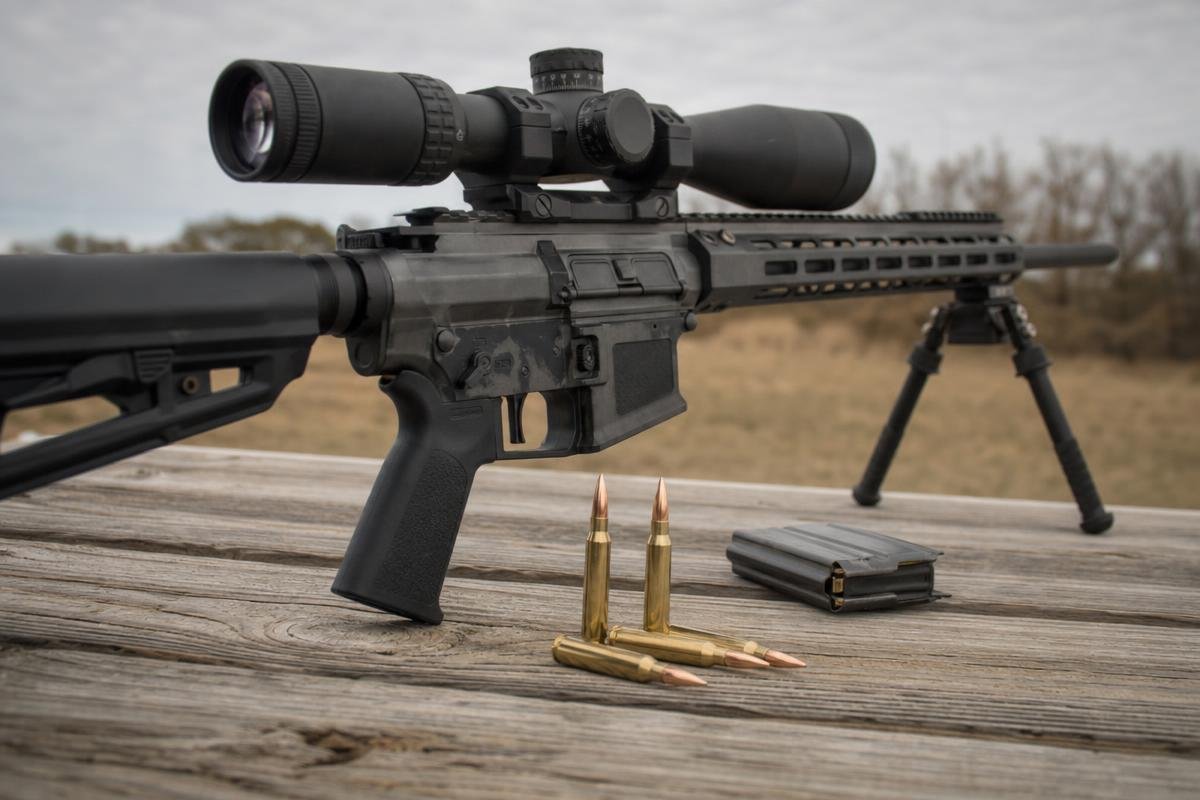
.224 Valkyrie gives AR-15 shooters a way to launch long, high-BC .22-caliber bullets for extended-range target work. The useful answer is always load-specific: bullet design, measured muzzle velocity, barrel length, zero, optic height, and weather determine the trajectory you actually dial. AR15Parts.com is based in Denison, Texas, and offers components for shooters building around those requirements. Need help matching barrel twist, bolt, and magazines to a heavy-bullet .224 Valkyrie build?
Key Takeaways
- Published velocity is a baseline, while chronograph data from your rifle is the correct input for final dope.
- Higher-BC 77-, 88-, and 90-grain bullets may reduce wind drift versus lighter .22-caliber options, depending on velocity, twist, and chamber compatibility.
- The table below provides a defined 1,000-yard planning example, including velocity, energy, elevation, time of flight, and wind drift.
- Confirm zero and impacts at safe, known distances before using any chart at extended range.
Why .224 Valkyrie Ballistics Vary by Rifle and Load
Understanding .224 Valkyrie ballistics from the muzzle to 1,000 yards means separating a manufacturer’s test data from your rifle’s field data. Two rifles can return different velocities with the same box of ammunition because of barrel length, chamber and throat dimensions, bore condition, ammunition lot, and cartridge temperature.
We explain muzzle velocity, retained velocity, energy, drop, wind drift, and transonic performance. It also helps you compare .224 Valkyrie complete uppers and barrel choices for your intended distance.
For North Texas range days, do not ignore ammunition temperature. Cartridges left in direct summer sun can be substantially warmer than the air at the firing line, which may change velocity from the conditions used to create your data card. Record temperature, pressure or density altitude, and your measured velocity whenever you confirm long-range corrections.
What .224 Valkyrie Ballistics Actually Measure
.224 Valkyrie ballistics describe what a specific bullet does after it leaves the muzzle. These values help establish elevation corrections, wind holds, retained velocity, and the distance at which a bullet approaches the transonic region. They are only useful when the chart inputs resemble your rifle and conditions.
What Is the Typical .224 Valkyrie Muzzle Velocity?
A typical heavy-bullet .224 Valkyrie muzzle velocity is commonly in the mid-2,000 fps range, but there is no single correct number. For this planning example, Sierra’s 77-grain Tipped MatchKing #7177 uses a published G1 BC of 0.420 and G7 BC of 0.207. The 2,800 fps launch velocity is hypothetical and not tied to a specific factory load; many 77-grain factory loads run closer to 2,600 to 2,700 fps, depending on barrel and conditions. Use the velocity printed for the exact ammunition you own, then replace it with your chronograph average before relying on long-range corrections.
Sierra Bullets, “22 CAL 77 GR Tipped MatchKing (TMK),” product specifications, checked September 2026, identifies #7177 as a 77-grain bullet and recommends a 1:8 twist or faster.
Ballistic Coefficient, G1 and G7
Ballistic coefficient, or BC, estimates how efficiently a projectile resists air drag. Higher-BC bullets generally retain speed better and need less elevation and wind correction at distance.
G1 BC uses a traditional reference projectile. G7 BC better reflects the shape of many modern boat-tail match bullets. Sierra lists a G1 BC of 0.420 for its 77-grain .224-caliber Tipped MatchKing, product number 7177, and a G7 BC of 0.207. Use the same BC model in your calculator that the bullet maker publishes.
Trajectory, Retained Energy, and Wind Drift
Trajectory is the bullet path relative to the line of sight. Drop is the correction below the zero line, not the bullet’s total fall below the bore. Retained energy is calculated from bullet weight and remaining velocity, and it is not a guarantee of terminal performance. Wind drift is a separate horizontal correction that becomes increasingly important as time of flight grows.
| Term | What It Measures | Why It Matters |
|---|---|---|
| Muzzle velocity | Speed at the muzzle | Sets the starting point for your data |
| Ballistic coefficient | Resistance to drag | Helps predict long-range velocity and drop |
| Retained energy | Energy remaining downrange | Supports target and hunting load selection |
| Time of flight | Travel time to target | Shows why wind corrections increase |
| Wind drift | Horizontal movement from wind | Requires a separate hold or dial correction |
| Transonic range | Distance before slowing near Mach 1 | Can affect consistency at long range |
Start with a defined chart, then validate it with actual impacts. If you are selecting a barrel for a particular heavy bullet, review AR-15 barrels before finalizing a build.
.224 Valkyrie Load Data for 77, 88, and 90 Grain Bullet Examples
Bullet weight alone is not enough to select a .224 Valkyrie load. Projectile length, bearing surface, recommended twist rate, cartridge overall length, chamber throat, and magazine clearance all matter. The following comparison uses manufacturer bullet specifications as component-selection context, not handloading instructions.
How to Read the Load Comparison
The 77-grain Sierra Tipped MatchKing #7177 has published G1 and G7 BC values. The 88- and 90-grain examples are match bullets intended for careful compatibility checks, especially when loaded near the limits of AR-15 magazine length. Always follow ammunition and barrel maker guidance.
| Bullet Weight | Example Projectile | Published BC | Twist Guidance | Magazine and Chamber Considerations | Practical Tradeoff |
|---|---|---|---|---|---|
| 77 grain | Sierra Tipped MatchKing, #7177 | G1 0.420, G7 0.207 | Sierra recommends 1:8 twist or faster | Component example requires verified cartridge overall length and chamber compatibility | Accessible factory-match option with useful long-range BC |
| 88 grain | Hornady ELD Match | Hornady publishes G1 0.545, G7 0.274 | Hornady recommends 1:7 twist or faster | Long projectile length makes throat and magazine-length checks important | Higher BC can improve wind performance, but velocity and compatibility must be confirmed |
| 90 grain | Sierra MatchKing, #9290 | Sierra publishes G1 0.563, G7 0.278 | Sierra specifies a 1:6.5 twist below 2,650 fps and a 1:7 twist above 2,650 fps | Often demands careful seating-depth, throat, and magazine-length evaluation | Excellent drag profile, with the strictest twist and setup requirements of these examples |
77 Grain Tipped MatchKing Context
Sierra’s 77-grain Tipped MatchKing #7177 provides the projectile reference for the planning example. Sierra lists a G1 BC of 0.420 and G7 BC of 0.207. The table below uses that bullet profile with a clearly stated example muzzle velocity and atmospheric setup.
For a ready-to-install setup, review our .224 Valkyrie complete uppers and match ammunition to the barrel specifications.
What Changes With 88 and 90 Grain Bullets
Hornady lists its 88-grain ELD Match at 1.090 inches long and recommends a 1:7 twist or faster. Sierra lists its 90-grain MatchKing at 1.245 inches long and recommends a 1:6.5 twist below 2,650 fps or a 1:7 twist above 2,650 fps. Those lengths help explain why a faster twist, appropriate freebore, and careful overall-length planning matter more as bullet weight rises.
.224 Valkyrie uses 6.8 SPC-pattern magazines, not standard 5.56/.223 magazines; usable internal length varies by magazine design, so check the magazine and ammunition maker's overall-length guidance. A long bullet seated to fit the magazine may occupy more case capacity, while a longer overall length may not fit or feed from a magazine. Do not assume a 90-grain projectile is suitable for every .224 Valkyrie barrel. Confirm twist rate, chamber guidance, magazine compatibility, and ammunition maker data before purchasing or loading ammunition.
How Barrel Length Changes .224 Valkyrie Velocity
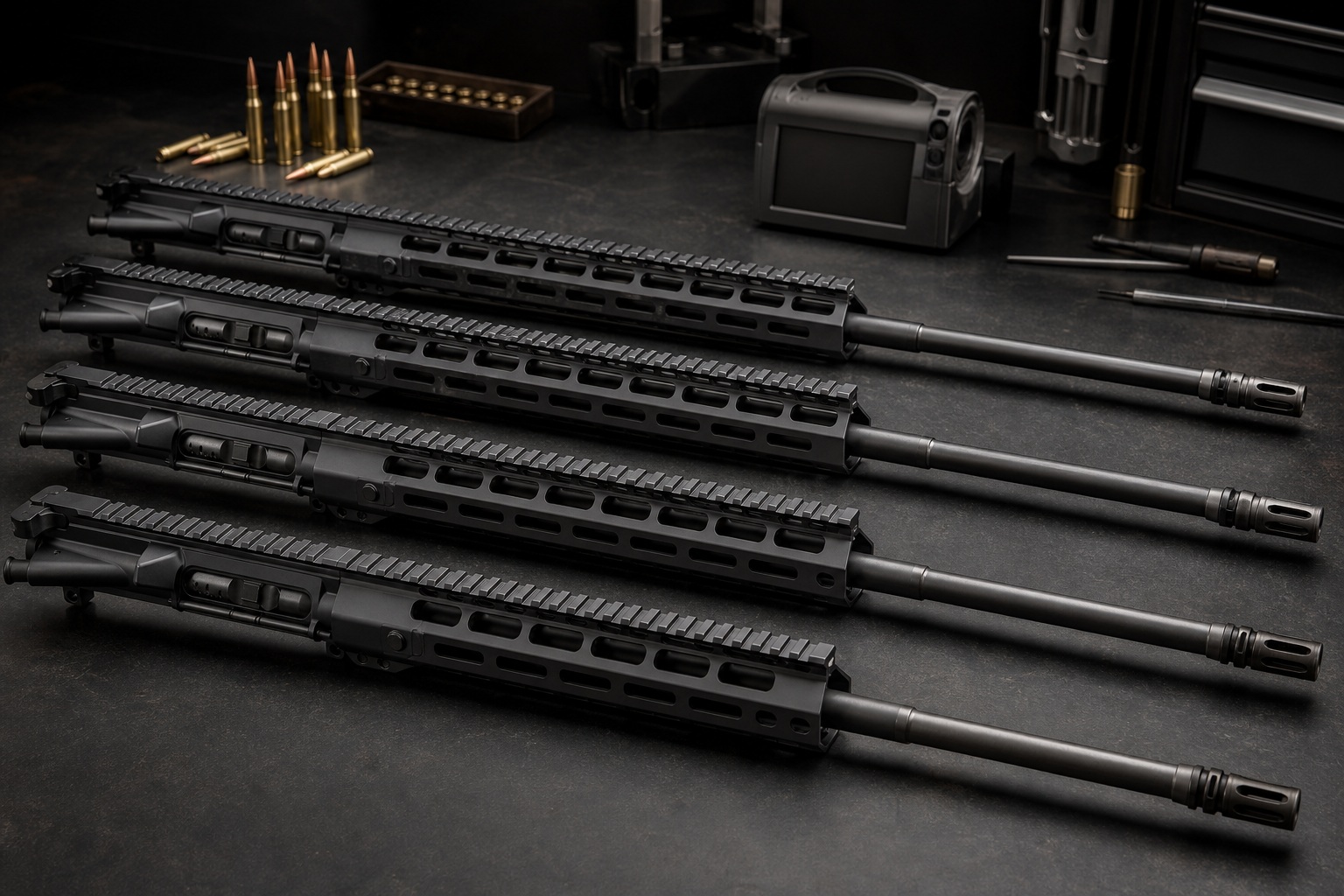
Barrel length changes .224 Valkyrie velocity because powder gases have more or less bore length in which to accelerate the bullet. There is no reliable fixed fps-per-inch rule. The exact load, chamber, gas system, barrel finish, temperature, and lot variation all influence results.
18 and 20 Inch Barrels
An 18-inch barrel can keep a .224 Valkyrie rifle compact and manageable, while a 20-inch barrel adds velocity potential without the length of a dedicated distance build. Either can work well for targets, but do not use velocity from a 24-inch test setup as if it were measured from a shorter rifle.
Chronograph the specific ammunition you intend to shoot. Match barrel length with the gas system and complete upper configuration rather than selecting it in isolation. Our .224 Valkyrie complete uppers provide a compatible starting point for a purpose-built rifle.
22 and 24 Inch Barrels
A 22-inch barrel is a practical middle ground for shooters seeking more velocity with 80- to 90-grain bullets. A 24-inch barrel favors a distance-focused configuration when additional weight and length are acceptable for prone or supported shooting.
Published ammunition specifications are useful comparison points, but your rifle remains the authority for your ballistic calculator. Review AR-15 barrels alongside gas-system needs, intended shooting position, and total rifle weight.
Build a Rifle-Specific Velocity Record
Your own velocity record is more valuable than a generic velocity-by-barrel-length chart. Before building a trajectory profile, record:
- Barrel length
- Ammunition brand, load, and lot number
- Average velocity, extreme spread, and standard deviation
- Temperature and elevation
- Sight height and zero distance
Use the same data card before travel or a long-range session. If you need help matching a barrel and upper to your intended use, call (888) 706-0633.
How Much Does .224 Valkyrie Drop at 1,000 Yards?
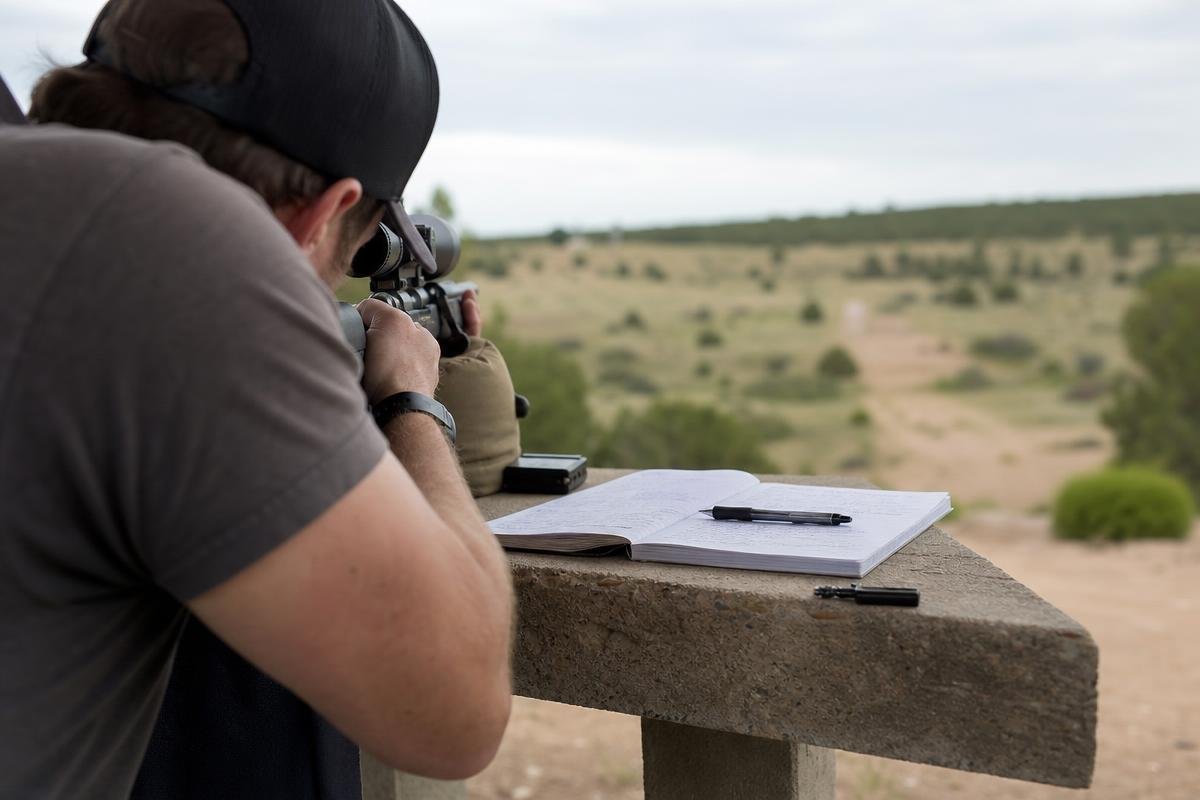
Defined 1,000-Yard Planning Example
Load model: 77-grain Sierra Tipped MatchKing #7177, G7 BC 0.207. Example launch velocity: 2,800 fps. This is a component-based planning example, not a current factory-load specification. Barrel reference: 24 inches. Zero: 100 yards. Optic height: 2.6 inches over bore. Atmosphere: 59°F, 29.92 inHg, 0% humidity, sea-level density conditions. Wind: 10 mph, 90-degree full-value. Values are rounded ballistic-calculator estimates, calculated with the listed G7 BC, and are for planning and range verification only.
| Range | Velocity | Energy | Drop | Elevation | Time of Flight | 10 mph Drift | Transonic Status |
|---|---|---|---|---|---|---|---|
| 100 yards | 2,577 fps | 1,135 ft-lb | 0 in | 0.0 MOA / 0.0 MRAD | 0.11 sec | 0.8 in | Supersonic |
| 200 yards | 2,364 fps | 955 ft-lb | -2.6 in | 1.3 MOA / 0.4 MRAD | 0.23 sec | 3.3 in | Supersonic |
| 300 yards | 2,161 fps | 798 ft-lb | -11.5 in | 3.7 MOA / 1.1 MRAD | 0.37 sec | 7.8 in | Supersonic |
| 400 yards | 1,969 fps | 663 ft-lb | -27.9 in | 6.7 MOA / 1.9 MRAD | 0.51 sec | 14.6 in | Supersonic |
| 500 yards | 1,786 fps | 545 ft-lb | -53.2 in | 10.2 MOA / 3.0 MRAD | 0.67 sec | 23.9 in | Supersonic |
| 600 yards | 1,611 fps | 444 ft-lb | -89.5 in | 14.3 MOA / 4.1 MRAD | 0.85 sec | 36.2 in | Supersonic |
| 700 yards | 1,444 fps | 356 ft-lb | -139.3 in | 19.0 MOA / 5.5 MRAD | 1.05 sec | 51.9 in | Supersonic |
| 800 yards | 1,285 fps | 282 ft-lb | -205.8 in | 24.6 MOA / 7.2 MRAD | 1.27 sec | 71.9 in | Supersonic |
| 900 yards | 1,138 fps | 221 ft-lb | -293.5 in | 31.1 MOA / 9.1 MRAD | 1.51 sec | 96.7 in | Near transonic |
| 1,000 yards | 1,046 fps | 187 ft-lb | -408.0 in | 39.0 MOA / 11.3 MRAD | 1.79 sec | 126.6 in | Subsonic in this model |
Methodology and source note: Bullet BC and twist guidance come from Sierra Bullets’ Tipped MatchKing #7177 specifications, checked September 2026. This component-based example uses a 2,800 fps planning velocity and standard sea-level conditions, not a current factory-load specification or a claimed result from every 24-inch rifle. Verify current manufacturer specifications, use safe range practices, and confirm actual impacts before applying these values.
How Far Does .224 Valkyrie Stay Supersonic?
With this 77-grain, 2,800 fps example under sea-level conditions, the projectile enters the transonic region near 900 yards and is slightly subsonic by 1,000 yards in this model. A faster measured velocity, a higher-BC projectile, or thinner air can extend that distance, while lower velocity or denser air can shorten it.
The transonic region is not an automatic accuracy failure, but it is a point where drag behavior and stability deserve closer verification. Confirm impacts on target rather than assuming any published supersonic-range claim applies to your rifle.
Inputs Every Useful Chart Must Show
Read the load label first. A 77-grain bullet at one velocity does not share the same drop or drift as an 88- or 90-grain bullet. A usable chart should state the BC model, measured or declared muzzle velocity, zero, sight height, temperature, pressure or density altitude, and wind direction.
For shooters planning a heavy-bullet build, compare the chart inputs to the specifications of the barrel and upper you intend to use.
Four Checks Before Dialing
Check these four items before you dial a .224 Valkyrie ballistic chart correction:
- Confirm your zero at a known distance.
- Confirm actual muzzle velocity with a chronograph.
- Confirm turret units match your chart, MOA or MRAD.
- Confirm wind direction and wind value before applying drift.
Confirm impacts safely at known distances before moving farther out. A 10 mph full-value wind is a major correction at 1,000 yards, and wind speed can vary significantly between the firing point and target. Ready to turn a ballistic plan into a compatible build? Compare complete .224 Valkyrie configurations and select the barrel length that fits your distance goals.
Is .224 Valkyrie Effective at 1,000 Yards?
.224 Valkyrie can be effective for 1,000-yard target shooting when the rifle, load, optic, and shooter are set up for consistent long-range work. The challenge is not simply reaching the target. It is controlling velocity variation, reading wind, and validating corrections as the projectile nears the transonic region.
Long-Range Target Use
.224 Valkyrie is a practical target cartridge when you want heavy .22-caliber match bullets from an AR-15-pattern rifle. Reliable 1,000-yard performance requires consistent muzzle velocity, a correct BC input, stable support, a repeatable firing process, and disciplined wind calls.
Chronograph your chosen load and verify corrections at known distances before relying on a ballistic app. A quality .224 Valkyrie complete upper provides a proper starting point, but ammunition testing determines your actual dope.
Hunting Decisions Need More Than an Energy Number
Hunting use requires more than a retained-energy figure from a chart. Check current regulations where you hunt, then consider bullet construction, game pursued, expected impact velocity, shot placement, distance, and your demonstrated ability from field positions.
Match bullets and purpose-built hunting bullets can behave very differently on impact. Read the bullet maker's current guidance, verify your load at realistic distances, and pass on shots that exceed your tested capability.
Comparing Cartridge Roles
.224 Valkyrie fits shooters who want long-range .22-caliber performance from an AR-15-sized platform. It is not the answer for every role, especially where a larger bullet or different terminal behavior is required.
6.5 Grendel also fits the AR-15 platform and carries a heavier bullet. 6.5 Grendel complete uppers are worth considering if that cartridge role better matches your intended use. 6.5 Creedmoor and .308 Winchester commonly require AR-10-size rifles, with different weight, recoil, magazine, and component requirements.
Preparing a .224 Valkyrie Setup
Bring your rifle setup and verified ammunition data together before chasing extended-range .224 Valkyrie trajectory. The cartridge requires .224 Valkyrie-specific components, including a compatible bolt and 6.8 SPC-pattern magazines.
Complete Upper or Barrel-Based Build
A complete upper is the simpler choice if you need a compatible system without selecting each part. Our .224 Valkyrie complete uppers are ready to drop onto your lower, provided you use the correct 6.8 SPC-pattern magazine and a compatible bolt.
A barrel-based build gives you control over barrel length, twist rate, gas system, handguard, and muzzle device. Start with one of our .224 Valkyrie barrels, then confirm component compatibility, verified headspace, and safe function checks before firing.
Create a Data Card Before the Range
A rifle-specific data card should use your ammunition lot, not catalog figures alone. Record bullet weight, ballistic coefficient, actual chronograph readings, sight height, zero distance, temperature, and wind conditions.
Add confirmed impacts at safe known distances. This shows how your actual velocity compares with catalog data and gives you usable elevation corrections for each load.
- Load manufacturer, bullet type, and grain weight
- Average muzzle velocity and extreme spread
- Zero distance and optic height over bore
- Confirmed elevation holds or turret corrections
- Wind holds observed during verified impacts
If you need help selecting compatible parts for a .224 Valkyrie setup, contact AR15Parts.com at (888) 706-0633.
Frequently Asked Questions
How Far Does .224 Valkyrie Stay Supersonic?
.224 Valkyrie can remain supersonic to 1,000 yards with suitable heavy bullets, but exact distance depends on load, muzzle velocity, BC, barrel length, and atmospheric conditions. Check current manufacturer data, then confirm your actual velocity with a chronograph.
What Barrel Length Is Best for .224 Valkyrie?
No single barrel length is best for every build. Choose based on handling, ammunition, and velocity goals. Longer barrels generally offer more velocity potential, while shorter setups are easier to carry.
Can I Use 77, 88, or 90 Grain Bullets in Any Barrel?
No. 77-, 88-, and 90-grain .224 Valkyrie bullets require a twist rate and chamber suited to long, heavy projectiles. Follow barrel-maker and ammunition-maker guidance before selecting a load.
Are Online .224 Valkyrie Ballistic Charts Accurate?
A .224 Valkyrie ballistic chart is useful only when its inputs match your rifle and ammunition. Verify zero, muzzle velocity, bullet BC, and impacts at known distances before relying on .224 Valkyrie 1,000 yard ballistics.
How Does .224 Valkyrie Compare With .223 Remington?
.224 Valkyrie was designed to carry heavier .22-caliber bullets farther than .223 Remington in an AR platform. It needs its own bolt, magazines, barrel, and chamber, so parts are not interchangeable.
What Should Hunters Consider Before Using .224 Valkyrie?
Hunters should match bullet construction and impact velocity to the intended game. Confirm local hunting rules, shot placement limits, and terminal performance from the ammunition manufacturer.
Where Can I Ask About Product Availability and Compatibility?
Have a .224 Valkyrie upper, barrel, or compatibility question before you buy? Call us at (888) 706-0633 for current availability and help finding parts that fit your planned setup. We also carry .224 Valkyrie complete uppers ready to install on a compatible AR-15-pattern lower after verifying the lower, magazine, buffer system, and product specifications.
Ready to Get Started with AR15Parts.com?
Call (888) 706-0633 to speak with our team directly. We're ready to answer your questions, walk you through your options, and help you find the right solution for your needs. Whether you're just starting to plan or ready to move forward, we'll make the process simple and stress-free. Reach out today and let's talk about how we can help.