
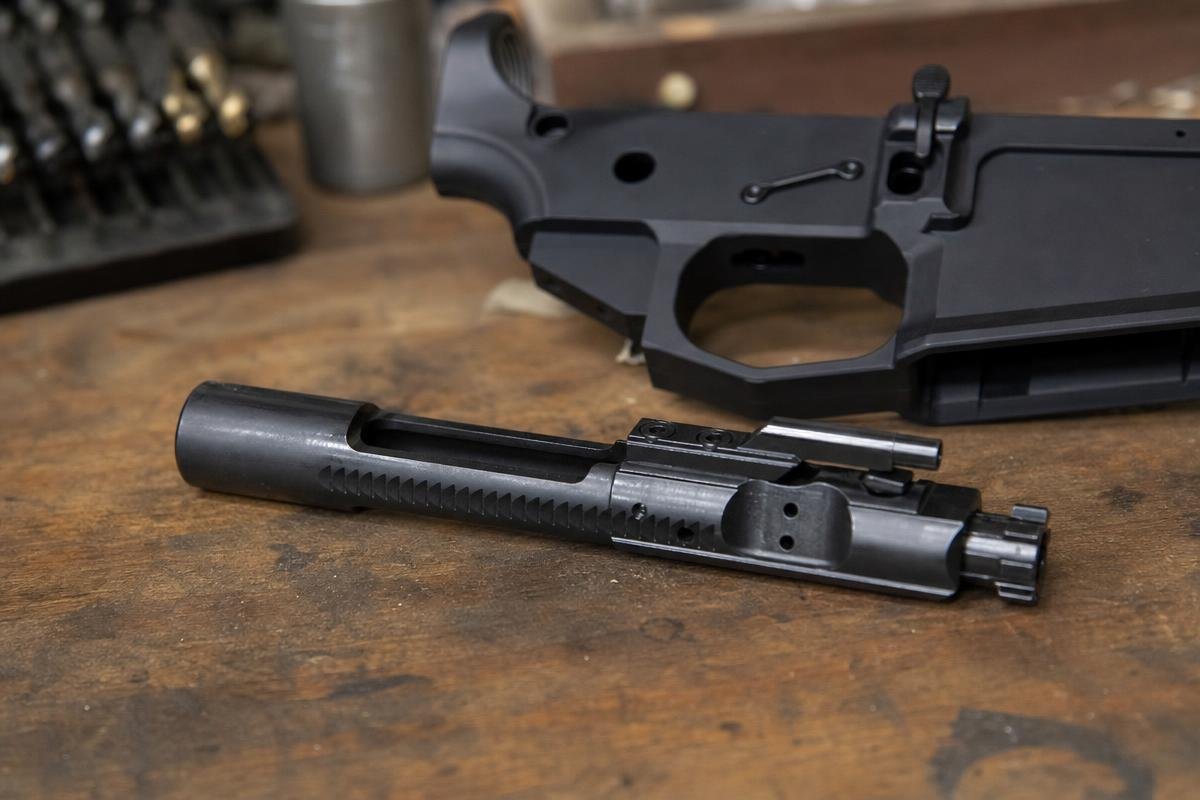
If you are building an AR-15 and trying to decide which bolt carrier group to buy, the steel spec matters more than most builders realize. A Carpenter 158 BCG is the mil-spec standard for a reason, and understanding what that means for your build keeps you from spending money on the wrong part. We stock BCGs and complete uppers and ship them nationwide from Denison, TX, and we can walk you through exactly what you need. Have questions about BCG steel specs or need help picking the right part for your build?
Key Takeaways
- Carpenter 158 is the original mil-spec steel for AR-15 bolts, specified by the U.S. military for a reason.
- The carbon and nickel contents affect how Carpenter 158 responds to heat treatment; 9310 uses a different heat-treatment process.
- Neither Carpenter 158 nor 9310 is a bad choice, but knowing the difference helps you buy from a reputable maker with confidence.
- A Carpenter 158 BCG from a quality manufacturer will be magnetic particle inspected and proof-tested before it ships.
Why the Steel Designation Matters More Than the Price Tag
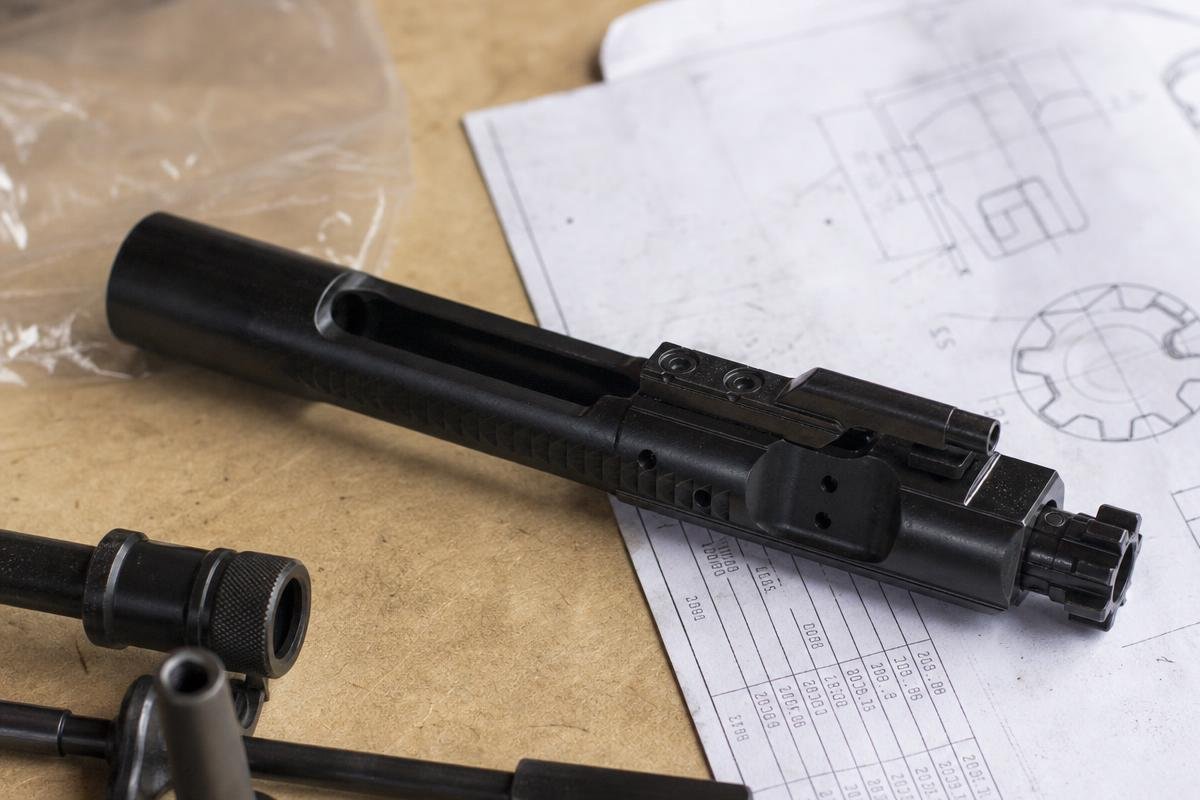
The steel designation in a bolt carrier group listing is a metallurgical specification. It determines how the part hardens, how it wears under sustained fire, and whether it meets mil-spec standards. It is not marketing language. Shoppers who skip past it are making a real decision without the information they need.
A product page tells you the coating and the price. It rarely explains why the base steel matters or what the difference between a Carpenter 158 BCG and a 9310 or 8620 bolt actually means for your build. The sections below compare all three steels, explain the historical rationale for Carpenter 158, and outline what civilian builders should weigh before buying.
We ship BCGs and AR-15 complete uppers in 19-plus calibers nationwide from Denison, TX. For a broader foundation, our AR-15 parts catalog covers the full range of M16/M4-spec bolt options we carry.
What Is Carpenter 158 Steel?
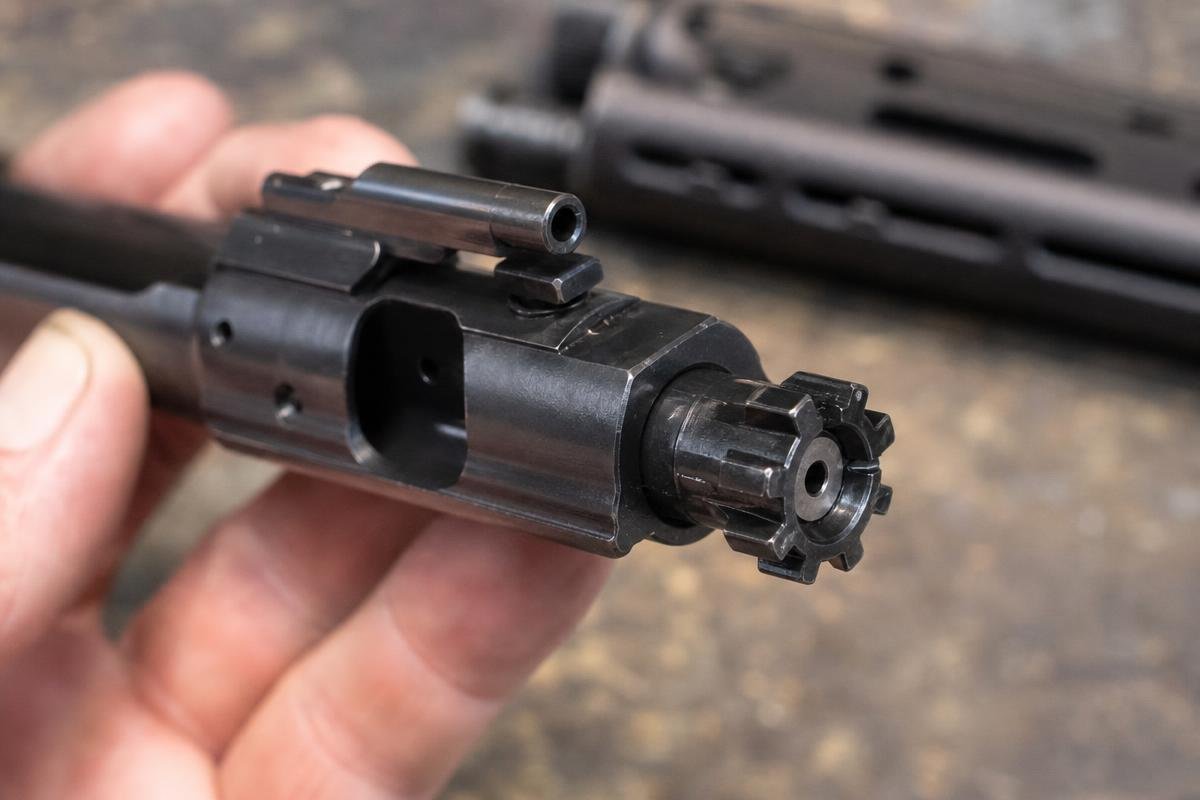
Carpenter 158 is not a generic AISI grade you can order from any steel mill. It is a proprietary alloy produced exclusively by Carpenter Technology Corporation. The mil-spec TDP for the M16 and M4 bolt specifies C158 by name, which means no substitute alloy meets that document's requirements by definition. When you see "Carpenter 158" in a product listing, it refers to that specific manufacturer and that specific alloy, not a quality tier or marketing label.
What Is the Composition of Carpenter 158 Steel?
The nominal composition runs approximately 0.55% carbon, 0.75 to 1.00% manganese, 0.80 to 1.10% chromium, 0.25 to 0.45% molybdenum, and 0.40 to 0.70% silicon. That carbon level is the critical number. It is high enough to support case hardening, which produces a hard, wear-resistant surface shell over a tough, ductile core. The bolt lug seats and cam pin hole take the worst of the load in a firing cycle. A case-hardened C158 bolt can absorb that stress without cracking at the core or galling at the surface.
9310 is commonly carburized and heat-treated according to the manufacturer's process; it should not be described as simply through-hardened without documentation. The composition of C158 makes case hardening the correct process, not an arbitrary choice.
Why Carpenter Technology Owns This Spec
Because C158 is proprietary, the supply chain is traceable in a way commodity AISI grades are not. A manufacturer sourcing C158 bar stock is buying from one company, and that company controls the melt chemistry. That traceability matters for military-specification bolt production, where lot-to-lot consistency affects dimensional tolerances and heat treatment response.
Any BCG marketed as mil-spec that is not made from verified C158 is not actually meeting the M16/M4 bolt specification. If you are building on a complete 5.56 NATO upper and want a bolt that matches the original military procurement standard, the steel source is the first thing to confirm.
What Is AISI 9310 Steel, and How Is It Different?
AISI 9310 is a nickel-chromium-molybdenum alloy steel. The nominal composition runs roughly 3.0 to 3.5 percent nickel, 1.0 to 1.4 percent chromium, 0.08 to 0.15 percent molybdenum, and 0.08 to 0.13 percent carbon. That low carbon number is the key difference from Carpenter 158 in practical terms.
9310 Composition and Through-Hardening
Because 9310 carries so little carbon, it does not respond to case hardening the same way C158 does. Manufacturers commonly carburize and heat-treat 9310 bolts to create the specified surface and core properties; the final hardness profile depends on the documented process. Some engineers argue that more uniform hardness improves fatigue resistance under cyclic loading, which matters in sustained-fire situations. For most civilian AR-15 builds, including complete 5.56 NATO uppers and 300 Blackout complete uppers, either hardening method holds up well under normal round counts.
The higher nickel content in 9310 also contributes to toughness. The alloy resists cracking under impact loads, which is one reason commercial BCG makers adopted it. The finish you choose interacts with the base steel differently as well, so the coating on our BCG and parts listings is worth reviewing alongside the alloy before you finalize a build.
Where 9310 Came From
9310 is a standard AISI grade. Multiple steel mills produce it, so supply is consistent and cost is generally lower than Carpenter 158. That availability is exactly why commercial manufacturers moved toward it. C158 is a proprietary Carpenter Technology blend with tighter sourcing. 9310 is not listed in the original mil-spec technical data package for the M16 bolt, so it carries no mil-spec designation.
That does not make it a weak choice in a Carpenter 158 vs. 9310 comparison. It makes it a commercial-grade alternative that covers most civilian use cases without issue. When comparing BCG steel types for an AR-15, the sourcing difference matters more to manufacturers than it will to most shooters.
Carpenter 158 vs. 9310 vs. 8620: A Direct Comparison
Steel-by-Steel Breakdown
Three steels dominate the AR-15 BCG market: Carpenter 158, 9310, and 8620. Each has a different alloy composition, and those differences show up in how the bolt behaves under sustained fire and high round counts.
| Steel | Hardening Method | Mil-Spec Status | Nickel Content | Carbon Content | Typical Cost Tier |
|---|---|---|---|---|---|
| Carpenter 158 | Case hardened | Yes | ~0.25% | ~0.55% | Mid to high |
| 9310 | Carburized / process-dependent | No | ~3.0 to 3.5% | ~0.08 to 0.13% | Mid |
| 8620 | Carburized | No | ~0.40 to 0.70% | ~0.18 to 0.23% | Lower |
8620 is adequate for moderate round counts. It handles casual range use without issue. Under sustained, high-volume fire, it gives up ground to both C158 and 9310. If you are building a complete 5.56 NATO upper intended for heavy use, 8620 is the weakest option of the three. Ready to order a Carpenter 158 BCG? Browse our in-stock options and complete uppers shipping nationwide from Denison, TX.
Case Hardening Method and What It Means for Wear
Case hardening, used on Carpenter 158, creates a hard outer shell over a tough, ductile core. That combination is exactly what bolt lugs and the bolt face need. Surface contact points resist wear while the core absorbs the shock of each firing cycle without cracking.
Carburizing creates a hardened surface case over a tougher core; the final hardness profile depends on the specified heat-treatment process. Neither method is wrong. They just address wear from different angles, which is why the Carpenter 158 vs. 9310 debate rarely produces a clean winner on metallurgy alone.
8620 is also carburized, but its lower nickel content means less toughness at the core compared to 9310. For builders weighing these alloy options before a purchase, that distinction matters. If you want a 9310 vs. C158 bolt decision based on data rather than brand preference, the table above gives you the numbers to work from. We also carry 300 Blackout complete uppers if your build runs a suppressor-heavy setup where BCG durability is especially relevant.
Why Did the Military Choose Carpenter 158?
The military did not land on Carpenter 158 by accident. The Technical Data Package for the M16 and M4 specifies C158 for the bolt by name. That specification exists because the alloy's chemistry, specifically its elevated carbon, chromium, and molybdenum content, produces a bolt that survives full-auto cyclic stress, lug abrasion against the barrel extension, and repeated firing pin impact without fracturing at the core. No other commonly available alloy checked every box at the time the TDP was written, and the spec has not changed since.
The Mil-Spec TDP
The TDP defines material, heat treatment, and dimensional tolerances for every component in the bolt carrier group. For the bolt itself, C158 is required because it responds to case hardening in a specific way. The outer surface becomes very hard, which resists lug wear and cam pin abrasion. The core stays tough, which prevents brittle fracture under impact. That combination is not easy to replicate with a single-alloy through-hardened steel. The chromium and molybdenum content also improve corrosion and heat resistance, which matters in sustained fire conditions.
MPI Testing and the Quality Standard That Comes With It
A military-specification bolt is not just about composition. The process certifications matter just as much. Magnetic particle inspection, commonly called MPI, is required for mil-spec bolts. The bolt is magnetized and coated with iron particles in suspension. Any surface or near-surface crack causes those particles to cluster at the defect, making invisible flaws visible before the part ships.
High-pressure testing, or HPT, is typically performed first. HPT stresses the bolt under a proof load to open latent cracks, so MPI can detect them. When you read a product listing, look for both "MPI tested" and "HPT tested." Those are process certifications, not marketing language. A bolt that skips either step has not been held to the same standard. Knowing what to look for in a BCG spec sheet before you buy saves you from guessing later.
Have questions about MPI-tested BCGs or which steel fits your build? Call us at (888) 706-0633 and we will point you to the right parts.
Is Carpenter 158 Steel Actually Better for Your Build?
The honest answer is: it depends on how you shoot. For most civilian semi-auto builds, the practical difference between a properly heat-treated carpenter 158 BCG and a properly heat-treated 9310 bolt is negligible. Service life varies by heat treatment, dimensions, ammunition, gas-system behavior, inspection, and maintenance. The variable that actually matters is heat treatment quality and manufacturer certification, not the steel name on the box. A poorly processed C158 bolt is worse than a correctly processed 9310 bolt, every time.
High-Volume and Duty Use
This is where the 9310 vs C158 bolt debate has a clear answer. C158 earns its reputation under sustained high-volume fire, full-auto platforms, and professional duty use where the rifle sees thousands of rounds per year. For a patrol rifle, a competition gun running 10,000 or more rounds annually, or a registered full-auto lower, C158 matches the original design intent. It was specified for exactly this kind of use. If your build fits that profile, C158 may be an appropriate choice when a documented specification or use case calls for it.
Shooters across North Texas who run hard at competition or high-round-count training will find this guidance relevant. Between the ranges around Grayson County and the long, hot summers that push a barrel and bolt harder, round count adds up fast. If you are pairing a C158 BCG with a high-output upper, our 5.56 NATO complete uppers are built to handle that kind of volume.
Recreational and Range Use
If you shoot 500 to 2,000 rounds per year for hunting, home defense, or recreational range sessions, a quality 9310 BCG with MPI and HPT certification can perform reliably when properly manufactured, inspected, lubricated, and maintained. You do not need C158 for that use case. Spend your attention on the certification markings, not the alloy designation.
Builders running suppressed setups or pistol-caliber configurations should also look at the full upper assembly. Our 300 Blackout complete uppers pair well with either bolt steel depending on your round count and intended use.
What to Look for When Buying a Carpenter 158 BCG
The label "mil-spec steel" means almost nothing on its own. Any seller can write that. What you want to see in the product description is the specific alloy name: Carpenter 158 or C158. If the listing just says "mil-spec bolt" without naming the steel, you have no way to confirm what you are actually buying.
Certifications and Markings
Beyond the steel call-out, look for two process verifications: magnetic particle inspection (MPI) and high-pressure testing (HPT). A magnetic particle inspection BCG has been checked for surface and subsurface cracks using a magnetic field and iron particles. HPT fires a proof load to stress the bolt before it ever reaches you. These are not marketing phrases. They are documented manufacturing steps, and a legitimate listing will name both.
Manufacturer identity matters too. Many branded BCGs are sourced from OEM manufacturers and sold under different labels. Confirm bolt material, testing, and provenance through the seller or manufacturer rather than relying on a stamp alone.
Coatings That Work With C158
Phosphate, also called parkerized, is the traditional mil-spec finish. It works fine with C158 and holds oil well. Nitride, sometimes listed as melonite or QPQ, is the most popular finish right now. It penetrates the steel surface rather than sitting on top of it, which improves corrosion resistance without adding any dimensional thickness. Nickel boron adds a slick, easy-to-clean surface layer. None of these coatings change what the steel underneath is or how it behaves. The C158 properties stay the same regardless of which finish you choose.
If you are pairing a new BCG with a complete upper, browse our AR-15 complete uppers in 19-plus calibers to match the bolt to the right chamber from the start.
AR-15 Builders in Denison, TX and Across the Region
We stock and ship Carpenter 158 BCG options and complete uppers nationwide from 4000 Texoma Parkway, Denison, TX 75020. Builders in our corner of North Texas run high volumes of both complete 5.56 NATO uppers and 300 Blackout complete uppers, and the BCG steel question comes up for both calibers equally.
The answer is the same regardless of what you are chambering. Bolt material and heat treatment matter more than the label on the box. A properly specified bolt in a 300 Blackout build needs the same metallurgical integrity as one running 5.56.
If you have questions about which BCG fits your build, call us at (888) 706-0633. We can point you to the right component before you order.
Frequently Asked Questions
What does "Carpenter 158" mean in a BCG listing?
Carpenter 158 is a proprietary alloy from Carpenter Technology Corporation. It is not a generic AISI designation. The original mil-spec TDP for the M16 and M4 bolt calls out Carpenter 158 by name, which is why the term carries real weight in a product listing.
Is 9310 good enough for a civilian build?
Yes, for most semi-auto use. Under 20,000 to 30,000 rounds of standard range fire, 9310 performs reliably. A Carpenter 158 BCG holds an edge in sustained high-volume or full-auto conditions. Heat treatment quality and MPI plus HPT certification matter more than the steel name alone.
What is magnetic particle inspection and why does it matter?
Magnetic particle inspection magnetizes the bolt and coats it with iron particles in suspension. Cracks cause those particles to cluster at the defect, making structural flaws visible before the bolt ever ships. A BCG without MPI certification is an unknown quantity.
Will a 9310 bolt work in a standard mil-spec upper?
Yes. The BCG seats in the upper receiver and barrel extension regardless of bolt material. Steel grade alone does not determine compatibility; the bolt must match the cartridge and barrel extension, and headspace must be verified.
How do I confirm a BCG is genuinely Carpenter 158?
Look for "Carpenter 158" or "C158" in the bolt material field of the spec sheet, plus MPI and HPT certifications. If the listing says only "mil-spec steel," contact the manufacturer before purchasing.
Ready to order? Browse our full BCG selection at AR15Parts.com or call us at (888) 706-0633. We ship nationwide from Denison, TX, and product listings should be checked for the steel specification, heat-treatment information, and coating details relevant to the build.
Ready to Get Started with AR15Parts.com?
Call (888) 706-0633 to speak with our team directly. We're ready to answer your questions, walk you through your options, and help you find the right solution for your needs. Whether you're just starting to plan or ready to move forward, we'll make the process simple and stress-free. Reach out today and let's talk about how we can help.