
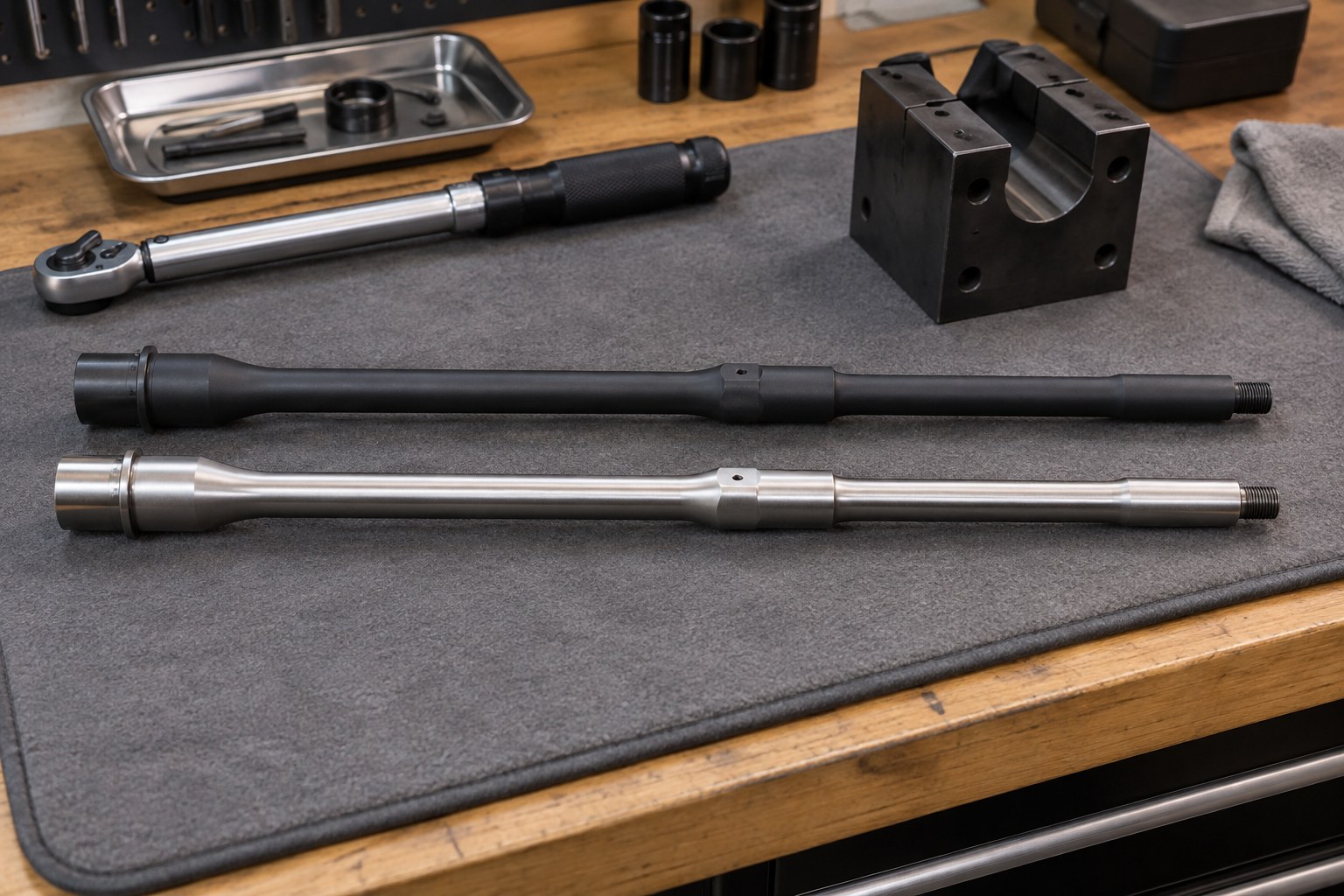
The 4150 CMV vs 416R stainless choice comes down to how you plan to use the rifle, not which steel is objectively "better." Both are proven AR-15 barrel materials, but they trace back to different design goals: one was developed for military duty guns that need to run hot and hard, the other for machinists chasing tight tolerances on precision barrels. AR15Parts.com carries barrels in both steels, and the difference deserves a straight answer before Denison and Texoma-area builders order. Have questions about a specific caliber or profile?
Key Takeaways
- 4150 chrome moly vanadium (CMV) is the chrome-moly-vanadium steel built to the military's MIL-B-11595E barrel steel specification, and it is usually chrome lined or nitride treated rather than left bare.
- 416R stainless is a low-sulfur, pre-hardened variant of 416 stainless steel developed specifically for barrel machining and is a common choice among precision and hunting barrel makers.
- 416R stainless resists surface rust better than bare or parkerized 4150 CMV, but neither steel is corrosion proof, and both still need regular cleaning and a light coat of oil.
- 4150 CMV with a chrome lining or nitride treatment is the common choice for duty-style, suppressed and sustained-fire builds because the coating adds wear resistance the base steel alone does not have.
- 416R stainless is prized for its machinability and consistent finish, which is why many precision and hunting barrel makers cut it without a bore coating.
- AR15Parts.com stocks 416R barrels from Satern Barrels, Wilson Combat, Shaw Barrels and Ballistic Advantage alongside parkerized 4150 CMV barrels and QPQ-treated 4150 CMV barrels from the Ballistic Advantage Modern Series.
What Is 4150 CMV Barrel Steel?
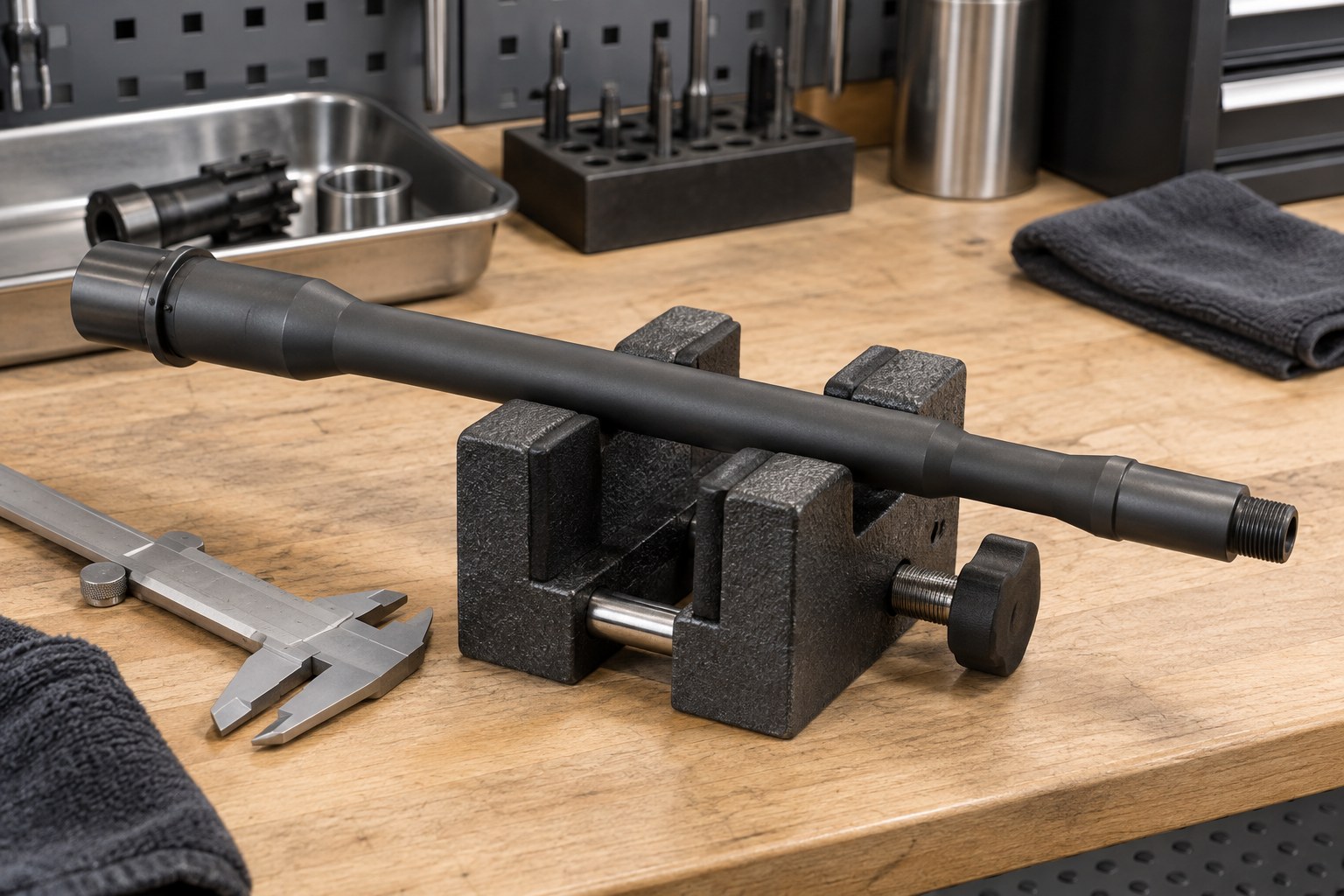
4150 CMV stands for 4150 chrome moly vanadium, a steel alloy built around the SAE-AISI 4150 chromium-molybdenum family with a vanadium addition. It became the standard for military M16 and M4 barrels and is manufactured to the MIL-B-11595E specification, which defines the chemistry, heat treatment and testing that a true mil-spec CMV barrel blank has to pass.
Mil-Spec Origin and Composition
Published data for SAE-AISI 4150 steel places chromium around 0.8 to 1.1 percent and molybdenum around 0.15 to 0.25 percent, with carbon near 0.5 percent for strength and wear resistance. The military specification adds a vanadium requirement on top of that base chemistry, which is what separates true CMV from generic 4140 or 4150 chrome moly barrel steel. The chromium and molybdenum content is what gives the alloy its heat tolerance and toughness under repeated firing, while the vanadium helps refine the grain structure during heat treatment.
This alloy was originally developed for military-issue M16 and M4 platforms, and that duty-rifle lineage is still the main reason shooters reach for 4150 CMV today. A barrel steel that had to survive sustained fire in a service rifle, then get chrome lined for corrosion resistance in field conditions, naturally became a default for AR-15 barrels built for hard use rather than a bench rest.
Why Chrome Lining or Nitride Treatment Matters
4150 CMV is rarely left bare inside the bore. Military-pattern barrels are typically chrome lined per the applicable military finish standard, and many commercial 4150 CMV barrels use a salt-bath nitride process instead, often called QPQ (quench-polish-quench). Both treatments add a hard surface layer for wear and corrosion resistance that the base 4150 CMV steel does not have on its own. AR15Parts.com carries 4150 CMV barrels with a parkerized exterior finish, plus QPQ-treated 4150 CMV barrels in the Ballistic Advantage Modern Series, so you can match the bore treatment to how hard you plan to run the rifle. For a deeper breakdown of chrome lining versus nitride versus stainless, our AR Upper Hub guide on chrome-lined vs nitride vs stainless barrels covers the finish question in more depth than this steel comparison does.
What Is 416R Stainless Barrel Steel?
416R stainless is a purpose-built variant of 416 stainless steel developed for barrel manufacturing, not a generic stainless alloy pulled from a hardware catalog. Barrel makers adopted it because its chemistry is tightly controlled for machining consistency, and that consistency shows up in bore finish and accuracy potential.
Composition and Machinability
Standard 416 stainless chemistry runs roughly 12 to 14 percent chromium with added sulfur to improve machinability. 416R tightens that sulfur content compared to standard 416 stainless specifically to avoid the inclusions that can hurt barrel performance, while keeping the free-machining characteristics that let barrel makers gun drill, ream and lap the bore to a fine finish. That combination, closely controlled chemistry plus a finish-friendly bore, is why 416R shows up under so many match and hunting barrel labels rather than a generic stainless grade.
Barrel makers generally supply 416R either annealed for machining or already heat treated to a working hardness range before final chambering and profiling. The tighter chemistry control does not just help during manufacturing. A consistent bore surface also tends to foul more predictably and clean up faster than a rougher bore, which matters over a long shooting session.
Corrosion Resistance Is Not Corrosion Proof
The chromium content in 416R gives it meaningfully better resistance to surface rust than uncoated carbon steel, which is part of why stainless barrels are popular for hunting rifles left in a truck or a blind through humid North Texas mornings. That resistance is not immunity. Powder residue, moisture and bore neglect can still cause pitting and corrosion on a stainless barrel over time, so cleaning and a light protective oil after range trips still matter regardless of which steel you choose.
If you would rather drop a finished assembly on your lower, see our full range of AR-15 uppers for sale.
Which Steel Handles Heat and Sustained Fire Better, 4150 CMV or 416R Stainless?
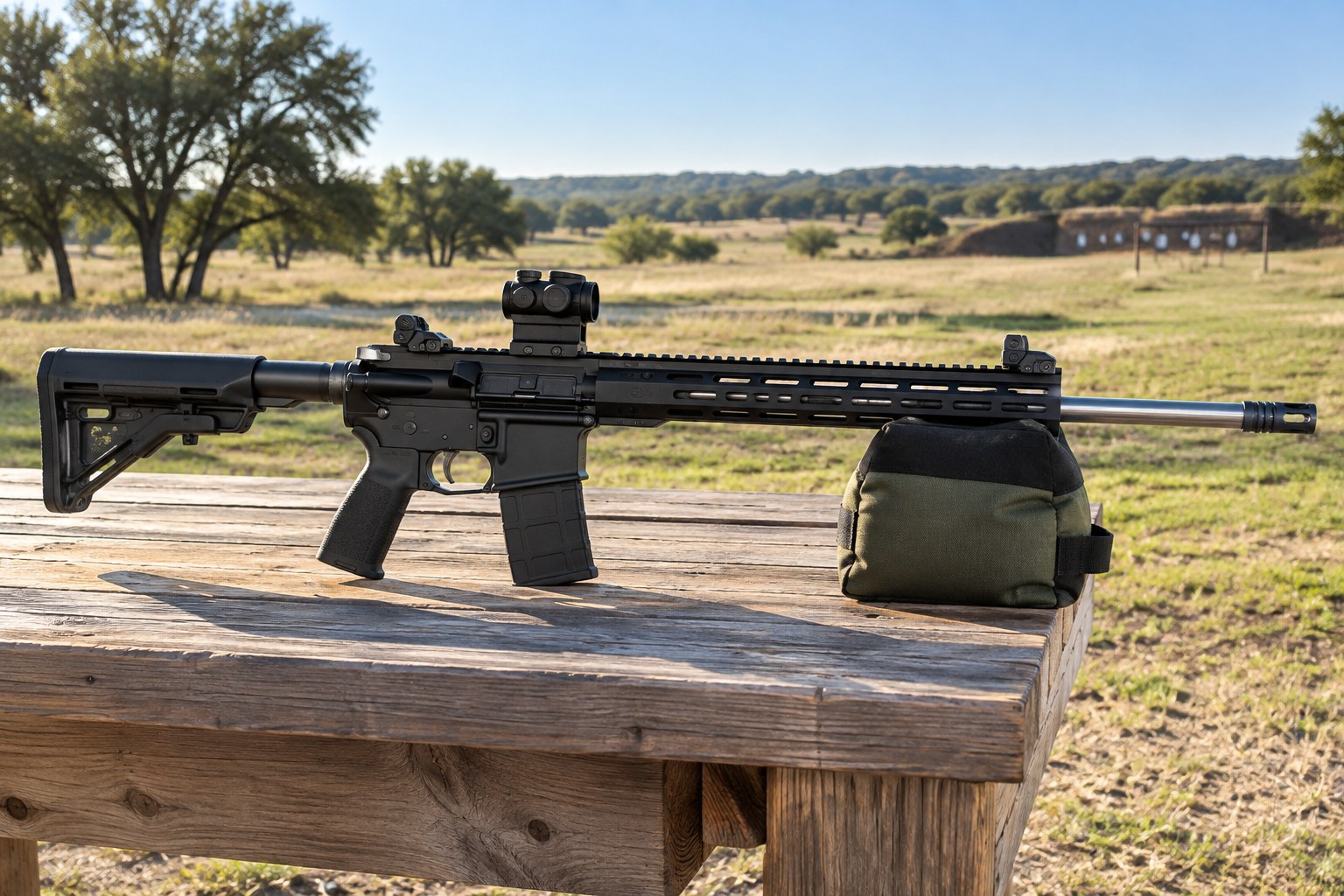
The honest answer is that 4150 CMV and 416R stainless are built for different stress patterns. 4150 CMV with a chrome lining or nitride treatment is the traditional choice for barrels that need to run hot repeatedly without losing structural integrity, which is exactly the profile the military specification was written around. 416R stainless is prized more for dimensional consistency and bore finish than for withstanding sustained cyclic heat, and many precision shooters accept a lighter-duty cycle in exchange for that accuracy edge.
Heat management still comes down to more than the alloy. Barrel profile, gas system length, cyclic rate and how many rounds you send downrange in a short window all affect how much heat a barrel actually absorbs during a session. A heavier-profile barrel in either steel will shed heat more slowly and resist stringing shots during a long range day than a lightweight pencil-profile barrel in the same caliber.
| Factor | 4150 CMV (Chrome Lined or Nitride Treated) | 416R Stainless |
|---|---|---|
| Origin | Developed for military M16/M4 barrels under MIL-B-11595E | Developed as a machining-optimized variant of 416 stainless for barrel makers |
| Typical bore treatment | Chrome lined or salt-bath nitride (QPQ) | Usually left bare, sometimes bead blasted or glass beaded for exterior finish |
| Reputation for | Durability under sustained and high-volume fire | Machinability, bore finish and accuracy potential |
| Corrosion behavior | Relies on the chrome or nitride surface treatment for corrosion resistance | Better inherent corrosion resistance from chromium content, but not corrosion proof |
| Common use case | Duty-style, suppressed, high-round-count and hard-use builds | Precision, hunting and range builds where bore finish and accuracy are the priority |
Throat Erosion and Accuracy Over Time
Every centerfire barrel experiences throat erosion as high-pressure, high-temperature gas passes the chamber end of the bore with each shot. How a barrel's accuracy degrades as that erosion progresses depends on more than the steel alone, including chamber design, cartridge, gas system and how hot the barrel gets during a shooting session. Rather than promising a round count for either steel, the practical takeaway is that both 4150 CMV and 416R stainless barrels can deliver long service life when they are cleaned properly and not fired in rapid strings hot enough to glow. A proper break-in and a consistent cleaning routine matter for both steels, and our AR Upper Hub guide on AR-15 barrel break-in walks through a sensible approach for a new barrel of either material.
Which Barrel Steel Fits Your Build?
Matching the steel to the mission matters more than picking a "winner" between the two alloys. Think through how the rifle will actually be used before you decide.
- Duty-style rifles, suppressed hosts and builds expected to run hard: a chrome lined or nitride treated 4150 CMV barrel is the traditional, proven choice.
- Precision rifles, deer and hog rifles, and range guns where accuracy and bore finish are the priority: a 416R stainless barrel is the common recommendation.
- Budget-focused carbine builds: parkerized 4150 CMV barrels remain a practical, widely used option.
- Builds where corrosion exposure is a concern, such as a truck gun stored through humid stretches near Lake Texoma: 416R stainless offers an edge, though it still needs maintenance.
AR15Parts.com carries 416R barrels from Satern Barrels, Wilson Combat, Shaw Barrels and Ballistic Advantage, along with parkerized 4150 CMV barrels and QPQ 4150 CMV barrels in the Ballistic Advantage Modern Series, across calibers including 5.56 NATO, .223 Wylde, 300 Blackout and 308 Winchester. Browse current options to see lengths, twist rates and gas system lengths in stock for your build. If you are shopping for other upper and lower parts to finish the build, AR15Parts.com's full parts selection covers bolt carrier groups, handguards and muzzle devices as well.
4150 CMV vs 416R Stainless Help for Denison and Texoma Builders
Texoma summers push barrels hard during long range sessions, and North Texas humidity does not do a bare carbon steel barrel any favors between cleanings. Whether you are building a truck gun for deer and hog season or a dedicated range rifle, the steel choice interacts with how you store and maintain it just as much as how you shoot it.
If you are comparing a chrome lined or nitride treated 4150 CMV barrel against a 416R stainless option for the same caliber, our team can walk through the tradeoffs for your specific build, whether that is a suppressed 300 Blackout upper or a 6.5 Creedmoor range rifle. We can also help confirm twist rate and gas system length so the barrel you choose matches the rest of your upper.
Reach AR15Parts.com at 4000 Texoma Parkway, Denison, TX 75020, or call (888) 706-0633 during business hours. Our customer service team answers fitment and compatibility questions by phone, email or the contact form before you place an order.
Frequently Asked Questions
Is 416R Stainless Stronger Than 4150 CMV?
Not in the way most shooters mean by "stronger." 4150 CMV, especially with a chrome lining or nitride treatment, has a long track record for durability under sustained and high-volume fire, which is why it was chosen for military barrels. 416R stainless is valued for machinability, bore finish and accuracy rather than outright toughness under hard use.
Do 416R Stainless Barrels Rust?
Yes, they can. 416R stainless resists surface corrosion better than bare carbon steel because of its chromium content, but it is not rust proof. Powder fouling, moisture and long-term neglect can still cause pitting, so clean the bore and apply a light protective oil after every range session regardless of which steel you choose.
Does a Chrome Lined Barrel Last Longer Than a Stainless Barrel?
It depends on the use case rather than a fixed answer. A quality chrome lining or nitride treatment on 4150 CMV adds wear and corrosion resistance for hard, sustained use, while a 416R stainless barrel is built around machining precision for accuracy. Cleaning habits, cartridge choice and how hot the barrel runs during a shooting session all affect service life more than the coating alone.
Can I Use a 4150 CMV Barrel for a Precision Build?
Yes, plenty of shooters do, particularly with a nitride-treated 4150 CMV barrel. Many precision shooters still prefer 416R stainless for its machining consistency and bore finish, but a well-made 4150 CMV barrel from a reputable maker can deliver solid accuracy for range and field use.
What Does QPQ Mean on a 4150 CMV Barrel?
QPQ stands for quench-polish-quench, a salt-bath nitride treatment applied to the barrel's interior and exterior surfaces. It is a nitrocarburizing process, not a chrome coating, and it adds hardness and corrosion resistance to the base 4150 CMV steel. AR15Parts.com lists QPQ 4150 CMV barrels in the Ballistic Advantage Modern Series.
Is a Short Stainless or CMV Barrel Legal on an AR-15?
The steel choice does not change the legal rules around barrel length. Under federal law, a rifle barrel shorter than 16 inches makes the firearm a short-barreled rifle, which requires Bureau of Alcohol, Tobacco, Firearms and Explosives (ATF) registration regardless of whether the barrel is 4150 CMV or 416R stainless. Confirm your configuration is compliant before ordering a shorter barrel, and check current Texas Parks and Wildlife Department (TPWD) regulations if the rifle will be used for hunting.
Ready to Get Started with AR15Parts.com?
Our team can help you match a 4150 CMV or 416R stainless barrel to your caliber, twist rate and intended use. Call (888) 706-0633, email [email protected], or reach us Monday through Friday, 8:00 AM to 4:00 PM Central.