
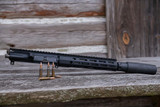
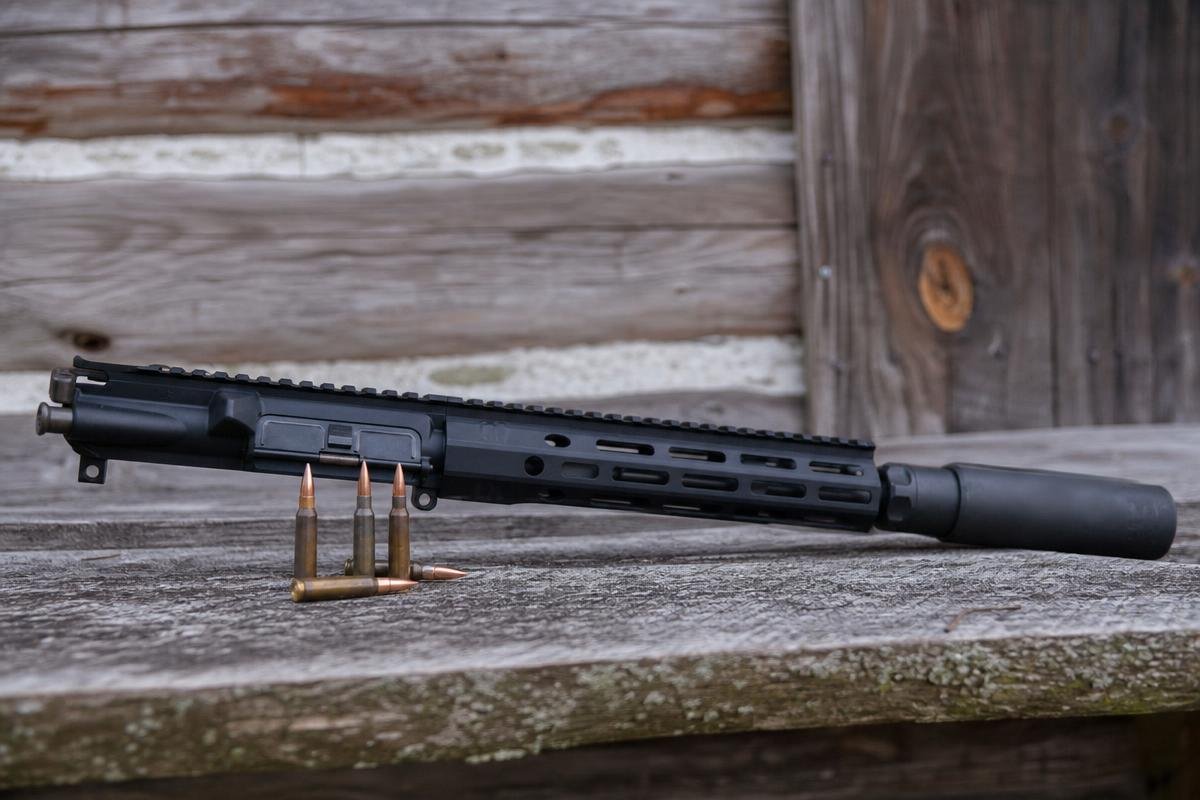
The .300 Blackout was purpose-built for short-range performance, suppressor compatibility, and versatility across hunting and defensive use. If you’ve been asking what 300 Blackout is good for, the answer covers more ground than most shooters expect. We ship from our Denison, TX facility at 4000 Texoma Pkwy, Denison, TX 75020. Our complete 300 Blackout uppers are built to order, assembled in-house, headspaced, and function-checked before shipping, and we stock individual components for custom builds.
Key Takeaways
- 300 Blackout runs both supersonic and subsonic loads from the same platform, making it one of the most flexible AR-15 cartridges available.
- Subsonic 300 BLK paired with a suppressor can reduce muzzle report, but suppressed gunfire can still damage hearing, so appropriate hearing protection remains recommended.
- For deer hunting in dense brush and creek-bottom terrain, 300 Blackout is effective inside 200 yards with proper load selection.
- For home defense, barrier penetration varies by the specific load and construction; do not assume heavy subsonic bullets reduce overpenetration compared with 5.56 without load-specific testing.
- 300 Blackout uses standard AR-15 lowers, magazines, and bolt carriers, requiring only a barrel change from a 5.56 build.
Browse our in-stock 300 Blackout complete uppers, assembled and function-checked before they ship.
What Makes 300 Blackout Different from Other AR-15 Calibers?
Case Design and Platform Compatibility
The .300 AAC Blackout was standardized by SAAMI to meet a military requirement for a suppressed .30-caliber round in a standard AR-15. Its parent case is 5.56 NATO, trimmed to 1.368 inches and re-necked for a .30-caliber bullet, and it feeds from standard STANAG magazines. That military origin matters to civilian builders for a practical reason: because the round was engineered around the existing AR-15 platform rather than a proprietary one, parts standardization is excellent and supply is deep. Bolts, magazines, and gas components are widely available, which keeps a build affordable and easy to source.
You do not need a new lower receiver or a new bolt carrier group. The only part that changes is the barrel. That makes a 300 BLK build one of the most straightforward caliber conversions on the AR-15 platform.
Supersonic vs. Subsonic: Two Rounds in One Cartridge
This is where the cartridge separates itself from nearly everything else in the AR-15 lineup. Supersonic loads run 110-grain bullets at roughly 2,350 fps from a 16-inch barrel. Subsonic loads push 220-grain bullets at or below 1,080 fps. Reliable cycling depends on barrel length, gas-system length, gas-port size, ammunition, buffer setup, and suppressor use; short 300 Blackout barrels commonly use pistol-length gas systems.
No other common AR-15 cartridge gives you that range of bullet weight and velocity while using the same BCG and magazine. Pair subsonic loads with a 300 blackout suppressor and the report drops dramatically, with no gas system modifications required.
300 Blackout vs. 5.56 and .350 Legend
Against 5.56, the trade-off is straightforward. The 5.56 is faster and flatter past 300 yards. The 300 BLK hits harder inside 200 yards and is the only one of the two that cycles reliably with subsonic suppressed loads. If you already run 5.56 complete uppers, a 300 BLK upper is a barrel swap away, not a platform change.
Against .350 Legend, both are short-range deer rounds. The 350 Legend launches a 150-grain bullet at 2,100 to 2,300 fps with a flatter arc to 200 yards. The 300 BLK gives up a little trajectory but wins on suppressor compatibility and magazine capacity. If suppressed hunting is the goal, that matters. We carry 350 Legend uppers for straight-wall cartridge hunting if that comparison helps you decide.
Is 300 Blackout Good for Deer Hunting?
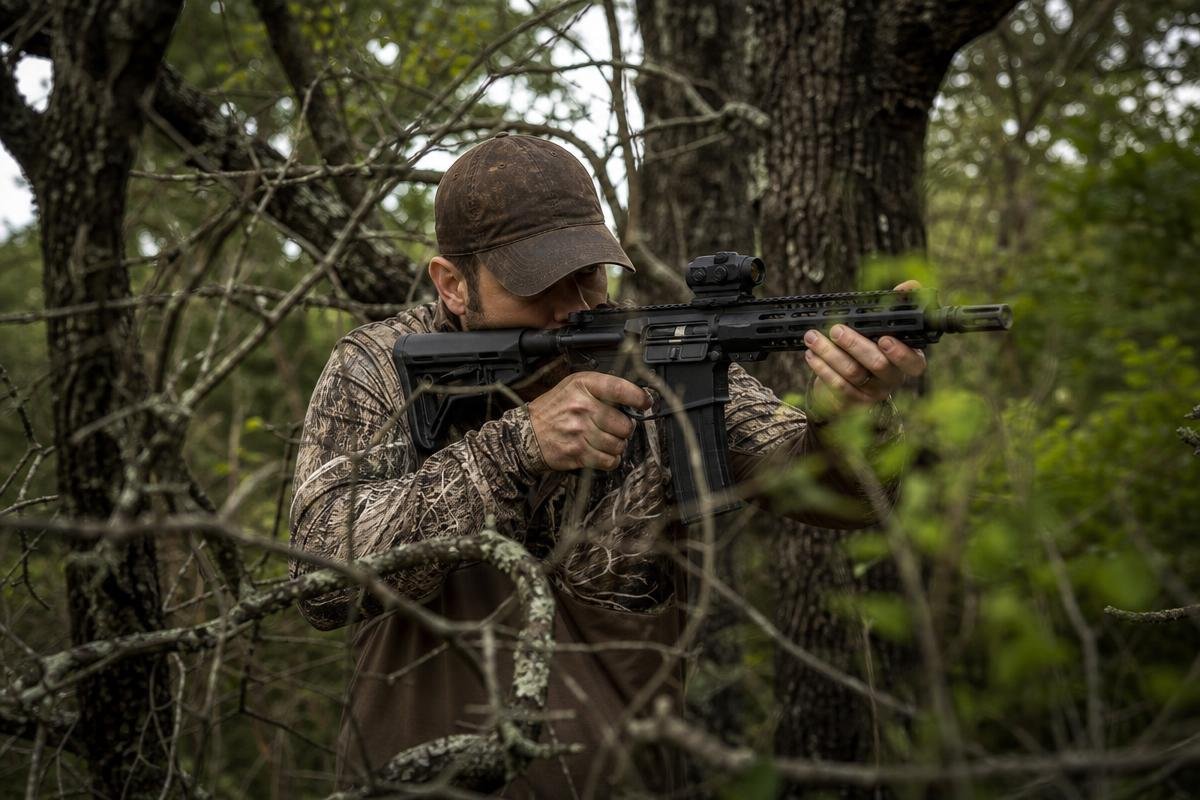
Yes. In brush and creek-bottom terrain, shorter shooting distances can suit 300 BLK supersonic hunting loads when used within the ammunition manufacturer's guidance.
Effective Range and Energy Retention
A 125 gr supersonic load leaves a 16-inch barrel at roughly 2,215 fps and, per Hornady and Barnes published load data, carries around 900 to 1,000 ft-lbs of energy at 100 yards. That is enough for an ethical kill on whitetail at that distance. By 200 yards, retained energy and expansion vary considerably by load, and bullet performance can become less predictable. Call 150 yards the honest ethical ceiling for 300 BLK deer hunting, and plan your shots accordingly.
One thing to say plainly: subsonic loads are not appropriate for deer hunting. Subsonic loads may not provide the expansion and penetration expected from purpose-built deer ammunition. Use purpose-built supersonic expanding loads within the ammunition manufacturer’s guidance.
Best Bullet Weights for Whitetail
Stick to 110 to 130 gr expanding supersonic loads for 300 blackout deer hunting. The Hornady BLACK 110 gr V-MAX, Remington 120 gr OTFB, and Barnes TAC-TX are all proven performers on whitetail. The 125 gr load at 2,215 fps is the most commonly cited hunting load and a solid starting point. These bullets expand reliably at supersonic velocities and transfer energy efficiently in the chest cavity.
Short-Barrel Builds for Tight Cover
A 10.5-inch SBR or 16-inch carbine is easy to maneuver in a ground blind or dense brush. Felt recoil runs roughly half that of a .308 Win, which matters for younger or recoil-sensitive hunters. Our complete upper assemblies are available in multiple configurations, and we stock a range of 300 Blackout barrels if you want to spec the build yourself.
Texas TPWD allows 300 BLK for deer statewide. If you hunt a WMA with straight-wall cartridge rules, verify your specific unit's regulations before the season. Texas also allows suppressed hunting, which pairs naturally with this cartridge on the small private tracts common to this part of North Texas.
Spec your hunting build with the right barrel and gas system. We ship in-stock 300 BLK builds and barrels nationwide.
How Does 300 Blackout Perform for Home Defense?
The 300 BLK home defense case is straightforward. The cartridge was designed to run in short-barreled AR platforms, and that geometry fits a house. A short pistol-configuration upper clears hallways and doorways without the handling penalty you get from a 16-inch rifle. Muzzle blast from a short 5.56 barrel indoors is punishing.
The 300 BLK burns most of its powder before the muzzle, so blast and concussion are noticeably lower from the same barrel length. For rural properties around this area, where a shot may travel from a barn or outbuilding toward a fence line, the ability to run a suppressed configuration legally under Texas law is a genuine advantage.
Short Barrels and Indoor Maneuverability
An 8.5-inch pistol-config upper on a mil-spec lower gives you a compact, controllable package that is commonly optimized for short-barrel use, while short 5.56 systems can be more sensitive to gas-system, ammunition, and component choices. That is why 300 BLK owns the sub-10-inch space for defensive builds. If you are building a dedicated home defense upper, complete AR-15 uppers in 300 BLK are ready to drop onto your existing lower without additional modifications.
Overpenetration: What the Ballistic Data Shows
Supersonic 110- to 125-grain expanding loads, including hollow-point and V-MAX projectiles, are designed to fragment or expand on impact. Barrier performance varies by load and test protocol, so consult manufacturer or independent testing rather than assuming reduced wall penetration. Subsonic loads in the 200 to 220 grain range penetrate more predictably but expand less reliably at low velocity. Load selection matters more with subsonic defensive rounds than with supersonic ones.
Recommended Home Defense Loads
For supersonic use, Hornady BLACK 110 gr V-MAX and Speer Gold Dot 150 gr are well-documented performers in gel testing. Both expand consistently and limit overpenetration relative to ball ammunition. For a suppressed 300 Blackout build running subsonic ammunition, Lehigh Defense and Remington 220 gr OTM loads are viable options, but confirm reliable expansion data before committing to either.
A suppressed subsonic setup can reduce muzzle blast substantially compared with many unsuppressed AR configurations, but appropriate hearing protection remains recommended.
300 Blackout and Suppressor Builds: The Best AR-15 Suppressor Cartridge?
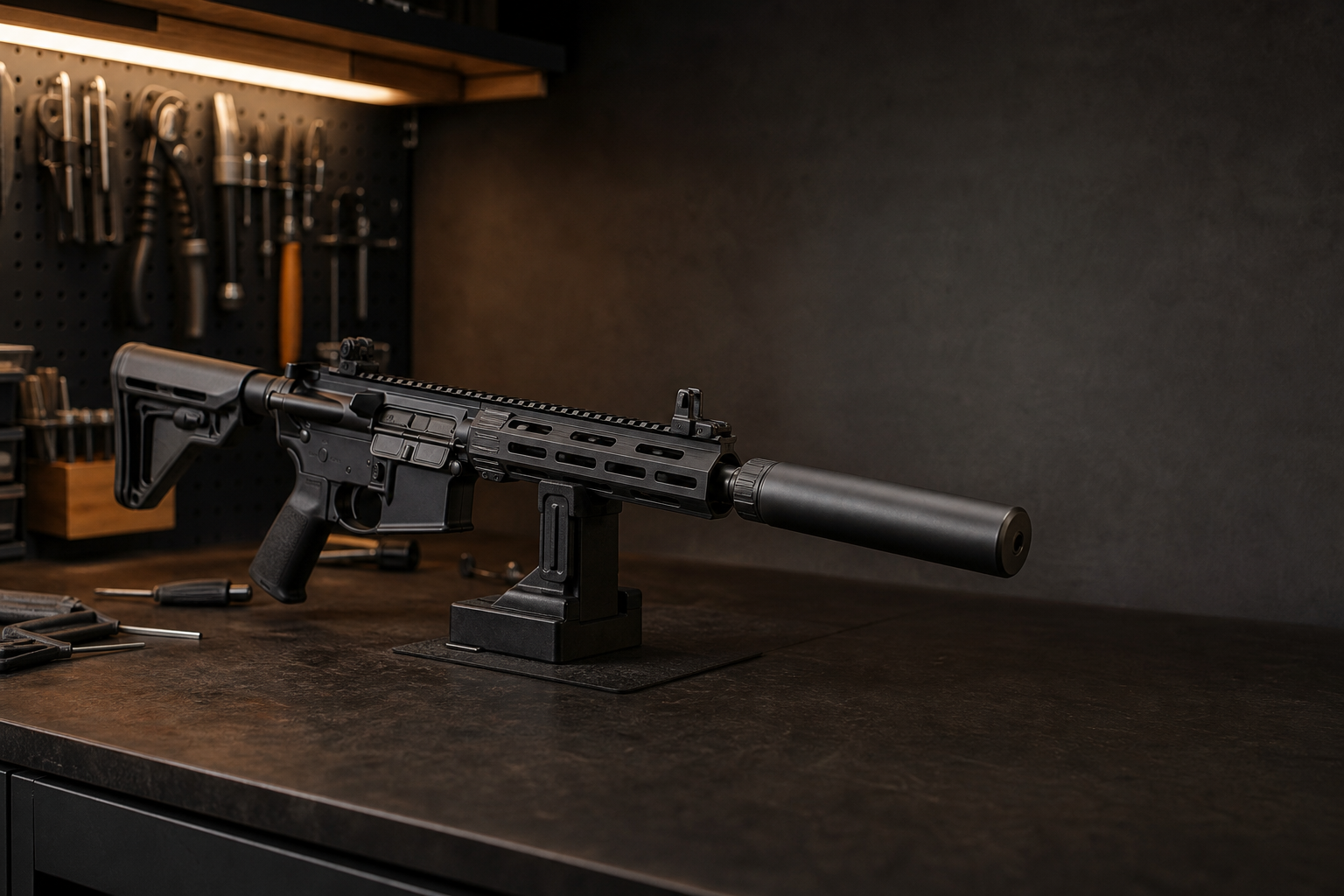
Engineered for Suppressed Use from Day One
Most cartridges get adapted for suppressed use as an afterthought. The 300 BLK was not. It was designed from the start to cycle subsonic loads reliably through a suppressed AR-15 platform, with no modification to the lower receiver. That requirement drove every design decision, from case dimensions to powder burn rate.
The key is dwell time. Short 300 Blackout barrels commonly use pistol-length gas systems, and reliable cycling depends on the complete configuration and ammunition. A 5.56 barrel at subsonic velocities cannot do that. The gas pressure simply is not there. With 300 BLK, it cycles cleanly, round after round.
What Subsonic 300 BLK Actually Sounds Like
Unsuppressed 300 BLK gunfire is often measured in the 155 to 165 dB range, depending on barrel length and measurement method. Run quality subsonic ammunition through a quality suppressor and that drops to roughly 130 to 140 dB. Sound levels vary by firearm, suppressor, ammunition, barrel length, environment, and measurement method, and appropriate hearing protection remains recommended. You still hear the action cycling and the bullet impact, but the muzzle blast is largely gone.
Accuracy holds up. Quality subsonic factory loads from a 16-inch barrel typically group in the 1.5 to 2.5 MOA range. That is enough precision for pest control, close-range training, and tactical applications. Subsonic loads are not suitable for deer hunting, but for the other 300 blackout uses they cover, the performance is real.
Components for a Suppressor-Ready Build
A suppressor-ready 300 BLK upper needs a few specific parts. The barrel needs a muzzle thread compatible with the suppressor or its mount; 5/8x24 is the most common thread pitch for .30-caliber barrels in the U.S. The bolt carrier group is the same as any .223/5.56 build since the bolt face is identical. You do not need a special BCG.
An adjustable gas block is worth adding if you plan to alternate between supersonic and subsonic loads. Gas tuning makes the transition cleaner and reduces bolt velocity with a suppressor attached. Our 300 Blackout barrels include threaded muzzles ready for suppressor mounting, and we ship nationwide from Denison. Texas is a suppressor-legal state for hunting, which matters to builders putting together a suppressed platform for the field.
Building a suppressor-ready 300 BLK upper? Call us at (888) 706-0633 and we will help you spec the right barrel, gas system, and components for your build.
Effective Range and Ballistic Limitations of 300 Blackout
Supersonic Performance from 0 to 300 Yards
A 125 gr supersonic load leaves a 16-inch barrel at roughly 2,215 fps with about 1,360 ft-lbs of muzzle energy, based on published manufacturer load data. At 200 and 300 yards, retained energy, drop, and wind drift vary materially by load, barrel length, and zero. That's workable for close-range hunting and general range use, but the numbers are tightening fast.
Wind drift adds to the problem. In a 10 mph crosswind, drift at 300 yards depends on the bullet's ballistic coefficient, muzzle velocity, and load, so check the trajectory data for your ammunition. For precision work at that distance, that margin matters.
Where 300 BLK Runs Out of Gas
Past 300 yards, the cartridge's ballistic coefficient deficit becomes real. Compared with 5.56 at longer distances, typical heavy 300 BLK projectiles shed velocity faster and experience more wind drift. Shooters who need consistent 400-plus yard performance should look at 6.5 Grendel uppers or 6.5 Creedmoor complete uppers instead. This cartridge was not designed for long-range precision, and the ballistics confirm it.
Practical Range by Use Case
Here is how the cartridge’s practical uses break down by distance:
- Home defense: 0 to 50 yards, subsonic or supersonic expanding
- 300 blackout deer hunting: 0 to 150 yards, supersonic expanding, 110 to 130 gr
- Suppressed target and pest control: 0 to 100 yards, subsonic
- General range use: 0 to 200 yards, supersonic FMJ
For hunting in dense brush or tight shooting lanes, the cartridge's shorter practical range can be a good fit when shots remain within the selected load's effective distance.
Building or Upgrading a 300 Blackout AR: What Parts You Actually Need
If you already own a mil-spec 5.56 AR-15, converting it to fire 300 BLK is simpler than most shooters expect. Your lower receiver, BCG, buffer, buffer spring, and magazines all carry over unchanged. The cartridge headspaces off the case mouth, so standard 5.56 mags feed it without modification.
The One-Part Swap: Converting Your 5.56 Lower
One part changes: the barrel, or the complete upper assembly. That is the entire conversion. Your existing lower is ready to drop a new upper onto without any additional fitting or gunsmithing. This is what makes 300 BLK one of the most practical caliber conversions in the AR platform.
Choosing the Right Barrel Length
Barrel length drives everything else in this build. Here is how the common options break down for the main 300 blackout uses:
- 8.5-inch barrel: Commonly paired with a pistol-length gas system and often selected for compact suppressed builds. Use only in a lawful pistol configuration or with approved NFA registration when configured as an SBR; verify current federal and state requirements.
- 10.5-inch pistol/SBR: Carbine or pistol gas. Balances super and subsonic performance. Compact enough for hunting blinds and 300 BLK home defense applications.
- 16-inch carbine barrel: Carbine-length gas. Full supersonic velocity. Title I rifle, no NFA paperwork. Best all-around choice for hunting and general use.
Browse our 300 Blackout barrels to compare profiles, gas system lengths, and materials across each length category.
Complete Uppers vs. Building from Parts
A complete upper ships assembled, headspaced, and function-checked. Drop it onto your lower and you are ready to shoot. No gauges, no guesswork. Our complete 300 Blackout uppers are built to order, assembled in-house, headspaced, and function-checked before shipping from our Denison, TX facility.
Building from individual parts gives you more control over each component. It also requires headspace verification with go/no-go gauges. That is a higher-risk path for most shooters. If you want to explore other calibers alongside this build, our complete AR-15 uppers page covers 19-plus options.
Suppressor Rules for 300 Blackout Hunting
Texas Suppressor Laws: What You Need to Know
Texas allows suppressor use for hunting, which makes 300 blackout suppressor builds a practical choice for North Texas deer hunters. Suppressors may be owned and used when all applicable federal, state, and local requirements are met, including the relevant federal approval and registration process. Verify current ATF and state requirements before acquisition or manufacture.
ATF approval is required before any NFA item transfers to you. Plan for a wait period. Nothing here is legal advice. Verify current federal and state requirements before you build or buy.
Shop currently available parts. Our FFL ships assembled, headspaced 300 BLK uppers and barrels straight to your door.
Frequently Asked Questions
What is 300 Blackout best for?
Short-range hunting inside 150 yards, home defense, and suppressed AR-15 builds. It runs on the same lower receiver, bolt carrier group, and magazines as 5.56. The only part that changes is the barrel.
Can I hunt deer with 300 Blackout in Texas?
Current TPWD rules permit legal firearms for deer and prohibit rimfire ammunition. Verify current TPWD, WMA, season, and property-specific requirements; 300 Blackout is a bottleneck cartridge and does not satisfy straight-wall-only rules. Use purpose-built supersonic expanding ammunition within its manufacturer-tested limits.
Is 300 BLK better than 5.56 for home defense?
It depends on your setup. Short-barreled 300 BLK produces less muzzle blast than 5.56 from the same length barrel. Suppressed subsonic 300 BLK can produce substantially less muzzle blast than many unsuppressed AR configurations. Overpenetration risk varies by the specific expanding load and barrier, so compare load-specific testing rather than relying on a cartridge-wide rule.
Do I need a suppressor to run 300 Blackout?
No. The cartridge functions normally without one. Suppressor compatibility is an advantage, not a requirement. Many shooters run it unsuppressed with supersonic loads for hunting and general range use.
What barrel length is best?
For suppressed subsonic builds, 8.5 to 10.5 inches works well. For hunting and general use, 16 inches delivers full velocity and keeps the rifle Title I legal without a tax stamp. Going longer than 16 inches adds minimal velocity gain. Browse our 300 Blackout barrels to compare length options.
How hard is it to convert a 5.56 AR to 300 Blackout?
It is straightforward. Swap the barrel or drop on a complete upper. Everything else on your lower stays the same. A 300 Blackout complete upper is the fastest path; we build our complete uppers to order, assemble them in-house, and headspace and function-check them before shipping from our Denison, TX facility.
How far can 300 Blackout shoot for hunting?
Practical hunting range varies by load, barrel length, impact velocity, and manufacturer guidance. At longer distances, trajectory drop, wind drift, retained energy, and expansion become more significant factors. For creek-bottom and brush-country shots, that range ceiling is rarely a limitation.
Ready to build or upgrade your setup? Call us at (888) 706-0633 with questions about barrel length or upper configuration. AR15Parts.com ships assembled, headspaced units nationwide from Denison, TX.
Ready to Get Started with AR15Parts.com?
Call (888) 706-0633 to speak with our team directly. We're ready to answer your questions, walk you through your options, and help you find the right solution for your needs. Whether you're just starting to plan or ready to move forward, we’ll help explain the available options and next steps. Reach out today and let's talk about how we can help.